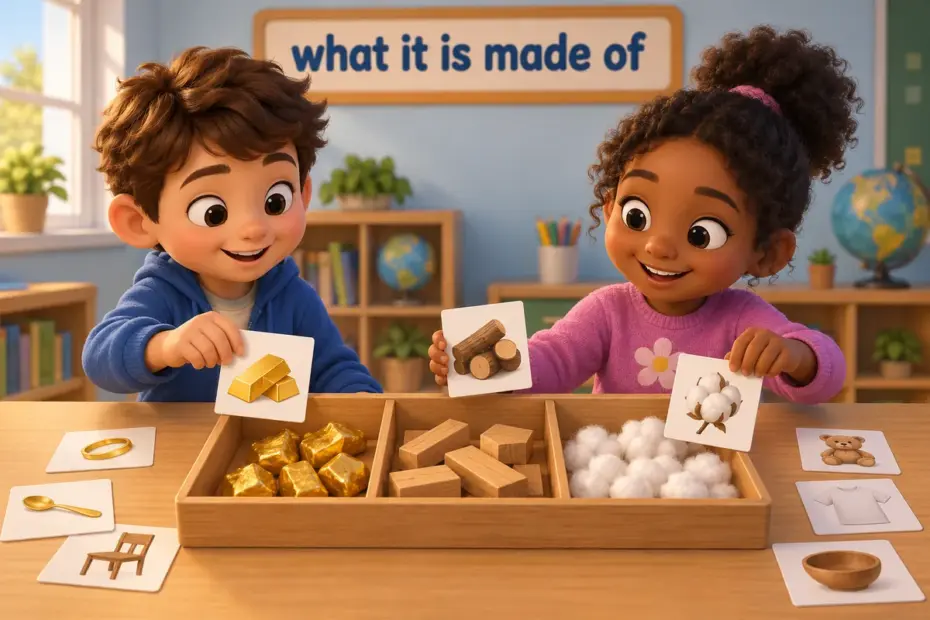
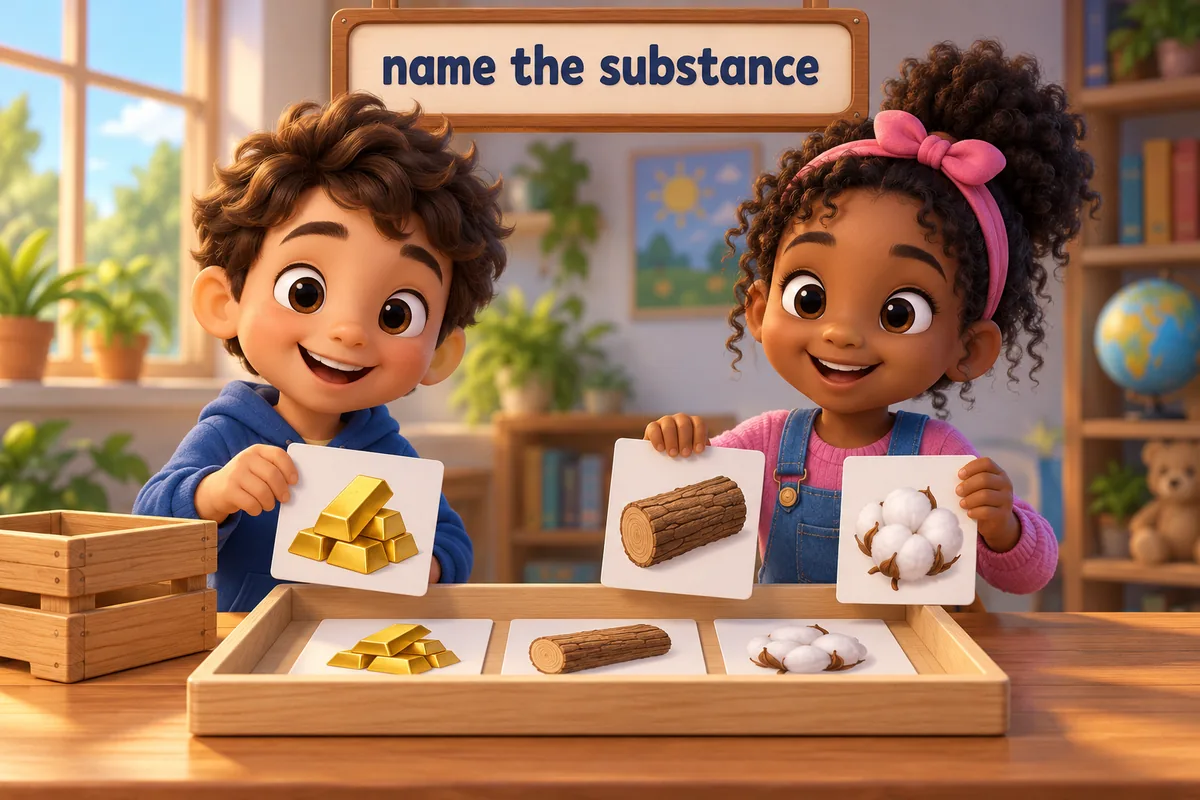
Material nouns in English name the substance something is made from, such as gold, wood, cotton, glass, or water. They are usually uncountable, so the same form covers any amount and no plural -s is added. A measure word such as a piece of wood or two litres of water makes the amount countable.
Material nouns in English at a glance
- A material noun names a substance, such as iron, silk, clay, or plastic.
- Material nouns are usually uncountable and take a singular verb.
- They normally have no plural form, so cotton stands for any quantity.
- A partitive such as a slice of, a bar of, or a litre of makes the amount countable.
- The commonest error is adding -s or a or an directly to the substance.
What are material nouns?
A material noun is a naming word for the matter a thing is made of rather than for a finished object. The noun names the substance in the abstract, without a fixed edge, so the grammar treats it as a mass rather than a single item. Two features define the group: the substance is uncountable, and it can appear either as the thing itself or as a modifier before another noun.
| Material | What it is used for | Example sentence |
|---|---|---|
| gold | jewellery and coins | Gold does not rust. |
| wood | furniture and frames | The chair is made of wood. |
| cotton | clothing and bedding | Cotton grows in warm climates. |
| glass | windows and bottles | Glass can be recycled. |
| leather | shoes and bags | Leather takes years to wear out. |
| iron | tools and bridges | Iron is a strong metal. |
Because the noun names a substance, the sentence makes sense without a or an: water boils, not a water boils. When a writer needs to count a material, a measure word carries the number, so the substance stays singular while the unit becomes plural, as in two bars of gold.
How do you use material nouns in a sentence?
The patterns are narrow and easy to recognise. A material noun stands alone as the subject, follows made of or made from, or sits as a modifier before another noun. The table shows the common frames, and more everyday lines sit in material sentence.
| Pattern | Example | What it signals |
|---|---|---|
| material as subject | Wood floats on water. | the substance is uncountable |
| partitive + of + material | a slice of bread | a unit makes it countable |
| made of + material | a table made of oak | the substance a thing is built from |
| material as modifier | a gold ring | the substance stands before a noun |
| no plural -s | cotton, not cottons | the substance has no plural form |
Material nouns in English: examples across contexts
The same grammar holds whether the sentence belongs to a shop, a science lesson, or a poem. Reading the nouns in different settings makes the uncountable pattern automatic, and a longer set of substances arranged by first letter appears across nouns that start with c and nouns that start with d. The same pattern continues in nouns that start with e, where a few more substances wait.
| Context | Sentence | Why this works |
|---|---|---|
| Classroom | Water freezes at zero degrees. | the material stands as the subject |
| Carpentry | The shelf is made of pine. | made of names the substance |
| Clothing shop | This jacket is pure wool. | the substance appears after the verb |
| Science writing | Copper conducts electricity well. | a material subject takes a singular verb |
| Recipe | Add a spoonful of honey. | a partitive counts the substance |
| Everyday speech | Please pass the salt. | the substance needs no article of number |
| Art class | The sculpture is carved from stone. | from names the source material |
| Travel writing | The path was lined with sand. | the material follows a preposition |
| Chemistry | Iron reacts with oxygen. | one substance acts on another |
| Poetry | Silver threads the evening sky. | the material noun carries an image |
Which noun is a material noun?
The test is simple: ask whether the word names a substance or a countable object. A material noun answers with a substance and refuses a or an, while a count noun answers with an object and takes a plural. Comparing the two side by side makes the difference plain.
| Test | Material noun | Count noun |
|---|---|---|
| Names what? | a substance | an object |
| Takes a or an? | no | yes |
| Takes a plural -s? | no | yes |
| Needs a measure word? | yes, to count | no |
| Example | paper | a sheet of paper |
Context decides how far the uncountable rule reaches. A shop assistant may say two coffees to mean two cups, and a wine list may offer three whites to mean three wines. Those uses count a serving rather than a substance, so the material form stays the default in ordinary writing.
Word forms and grammar of material nouns
The substance often carries a related adjective that describes a thing made from it, and the adjective answers the question of what a thing is made of. The noun stays uncountable, while the adjective sits before the object it describes. The table pairs a few of these families.
| Form | Part of speech | Example |
|---|---|---|
| wood | noun | The table is solid wood. |
| wooden | adjective | She bought a wooden spoon. |
| cotton | noun | This shirt is pure cotton. |
| cotton | adjective | He wore a cotton shirt. |
| gold | noun | Gold was found in the river. |
| golden | adjective | The field turned a golden colour. |
Common mistakes with material nouns
The same errors recur, and each one has a short rule behind the fix.
Mistake 1: adding -s to a substance. Incorrect: She bought two golds. Correct: She bought two bars of gold. Rule: a material noun has no plural, so a measure word carries the number.
Mistake 2: using a or an. Incorrect: He drank a water. Correct: He drank a glass of water. Rule: an uncountable material takes a partitive instead of an article.
Mistake 3: a plural verb. Incorrect: The waters are calm. Correct: The water is calm. Rule: a singular material subject takes a singular verb.
Mistake 4: naming the object as the material. Incorrect: He wore a cotton to the party. Correct: He wore a cotton shirt to the party. Rule: the material modifies a noun; it does not replace it.
Mistake 5: adding a capital letter. Incorrect: I bought some Wood. Correct: I bought some wood. Rule: common material nouns are written with a small letter unless a proper name is involved.
Practice using material nouns
Each item tests one pattern from above, and the answers give the reason.
- Fill in the blank: The window is made of ___. (glass)
- Choose the better phrase: two (irons / bars of iron).
- Correct the error: She poured a
milkinto the cup. - Build a sentence: use a partitive to count a substance you drink.
- Spot the register: which suits a science report, (a) The waters boils or (b) The water boils?
- Fill in the blank: The ring is pure ___. (gold)
Answers
- glass, because made of names the substance a thing is built from.
- bars of iron, because a measure word makes the uncountable noun countable.
- She poured a glass of milk into the cup; an uncountable noun needs a partitive.
- He drank a cup of tea, using a partitive to count the substance.
- (b), because a singular material subject takes a singular verb.
- gold, because the substance stands alone after pure.
The bottom line
Material nouns in English name substances rather than objects, so they stay singular in form and take a singular verb. When a number is needed, a measure word such as a piece of or a litre of turns the material into a countable unit. Learn the substance with its partitive and its adjective, and the uncountable pattern stops causing errors.
Frequently asked questions about material nouns
Are material nouns always uncountable?
Most are uncountable in their normal use, so cotton and iron take no plural. A few substances can become countable when they name a type or a serving, as in fine wines or two coffees. The uncountable form is the default and the countable one is the exception.
Is water a material noun?
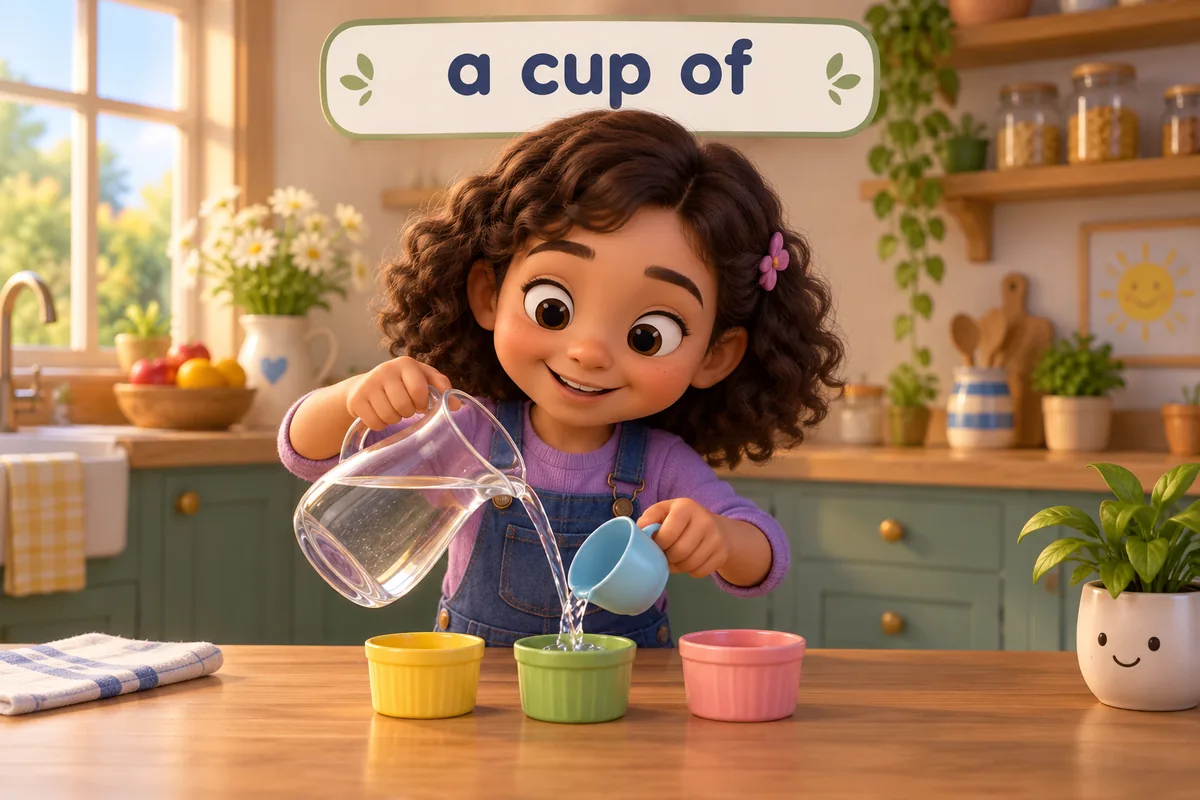
Yes. Water names a substance rather than an object, so it is uncountable and takes a singular verb, as in water is cold. To count it, a speaker adds a measure word such as a cup of water or two litres of water.
What is the difference between a material noun and a concrete noun?
A material noun is a kind of concrete noun. Concrete nouns name anything a person can experience through the senses, and material nouns are the ones that name a substance without a fixed shape, such as clay, wool, or steel. The two overlap rather than compete.
Can a material noun be used as an adjective?
Yes. A material noun often stands before another noun and behaves like an adjective, as in a gold ring or a cotton shirt. In that position it keeps its singular form and simply tells the reader what the object is made of.