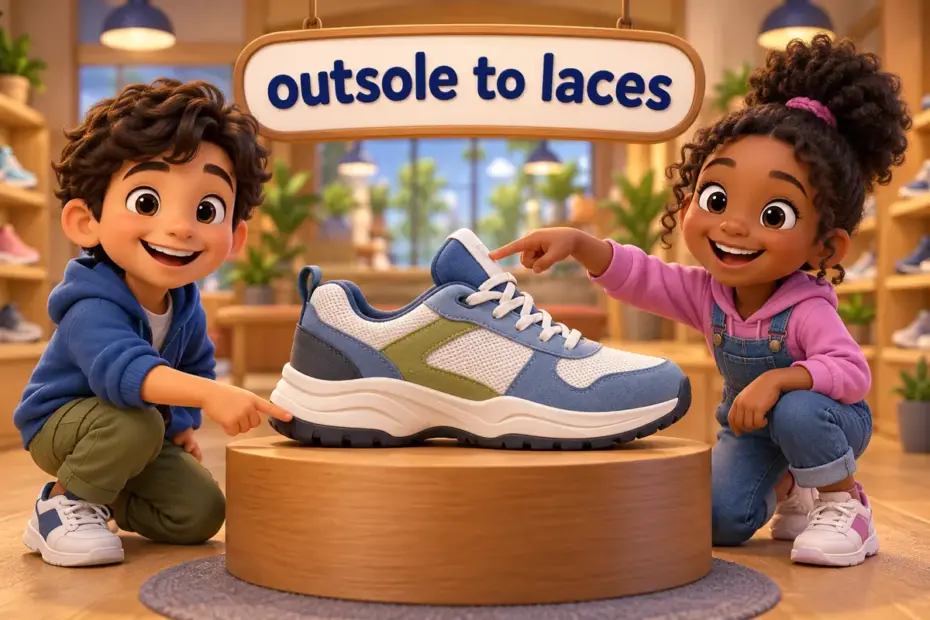
A clear guide to the parts of a shoe with diagram must name the outsole, midsole, upper, tongue and heel that carry a foot through the day. Each part does one job, and together they grip the ground, cushion every step and hold the foot steady.
Parts of a Shoe With Diagram at a Glance
- The outsole is the bottom layer that grips the ground.
- The midsole is the cushion layer that absorbs shock.
- The upper covers the foot and holds it in place.
- The tongue cushions the laces over the instep.
- The heel counter keeps the heel steady at the back.
- The insole is the surface the foot rests on.
What Are the Parts of a Shoe?
The parts of a shoe are the outsole, the midsole, the insole, the upper, the tongue and the heel that supports the back. Each part sits in a fixed place, so a learner can point to it on a labelled side view and name it without hesitating. The table below gives every part its position and its plain-language job.
| Part | Also called | Its main job | Where it sits |
|---|---|---|---|
| outsole | sole | grips the ground and resists wear | the bottom of the shoe |
| midsole | cushion layer | cushions each step and absorbs shock | between outsole and insole |
| insole | footbed | is the surface the foot rests on | inside, above the midsole |
| upper | body | covers and holds the foot | the top of the shoe |
| toe box | toe area | gives the toes room to spread | the front of the upper |
| toe cap | front guard | protects the front from scuffs | over the toe box |
| tongue | padded flap | cushions the laces over the instep | under the laces |
| heel | back block | raises the back and supports the heel | the rear under the heel |
What Does Each Part of a Shoe Do?
Every part of a shoe performs one task, and the list is easier to remember when each task is tied to something you can feel while walking. This table pairs a part with its function and with the quick test that identifies it in your hand.
| Part | Function | How to spot it |
|---|---|---|
| heel counter | holds the heel steady | a stiff panel at the back |
| collar | cushions around the ankle | the padded rim of the opening |
| eyelets | guide the laces | the holes along the throat |
| laces | close the shoe over the foot | the cords across the instep |
| vamp | covers the top of the foot | the front upper between toe and laces |
| quarter | wraps the sides and back | the side panels of the upper |
| lining | wicks moisture and softens contact | the inner layer of the upper |
| shank | supports the arch and stops bending | a stiff strip under the midsole |
How the Parts of a Shoe Work Together
A shoe protects a foot because its parts pass the body’s weight along one path from ankle to ground. Follow a single step through the shoe and the diagram stops looking like a list of labels and starts looking like a sequence. The same habit of naming every mechanism appears in car parts from A to Z.
| Step | Parts involved | What happens |
|---|---|---|
| foot enters | collar, tongue | the foot slides in over the insole |
| laces closed | laces, eyelets | the upper grips the foot snugly |
| weight lands | midsole | the cushion layer absorbs the shock |
| ground contact | outsole | the tread grips and resists wear |
| foot rolls | shank | the stiffener supports the arch |
| push off | toe box, toe cap | the front flexes and springs back |
Parts of a Shoe in Sentences Across Contexts
A term is learned once a writer can drop it into a real sentence. The eight frames below show the same vocabulary working in a shop, a running note and a repair job. Compare the naming of shoe parts with human body parts that start with a.
| Context | Example sentence | Why it works |
|---|---|---|
| shop | The toe box felt tight, so we tried a wider size. | links a part to fit |
| running note | The midsole had flattened after four hundred miles. | ties wear to a part |
| repair job | A loose welt let water reach the insole. | ties a fault to a part |
| exam answer | The outsole grips the ground and resists wear. | states a function in one line |
| coach advice | Lace to the top eyelet so the heel counter holds. | connects lacing to support |
| home talk | These boots have a padded collar for cold walks. | uses the part name naturally |
| product label | The breathable lining keeps the foot dry. | names a part in a selling point |
| news article | A softer midsole reduced impact for long-distance runners. | reports a change and its effect |
Outsole and Midsole: Which Part Cushions?
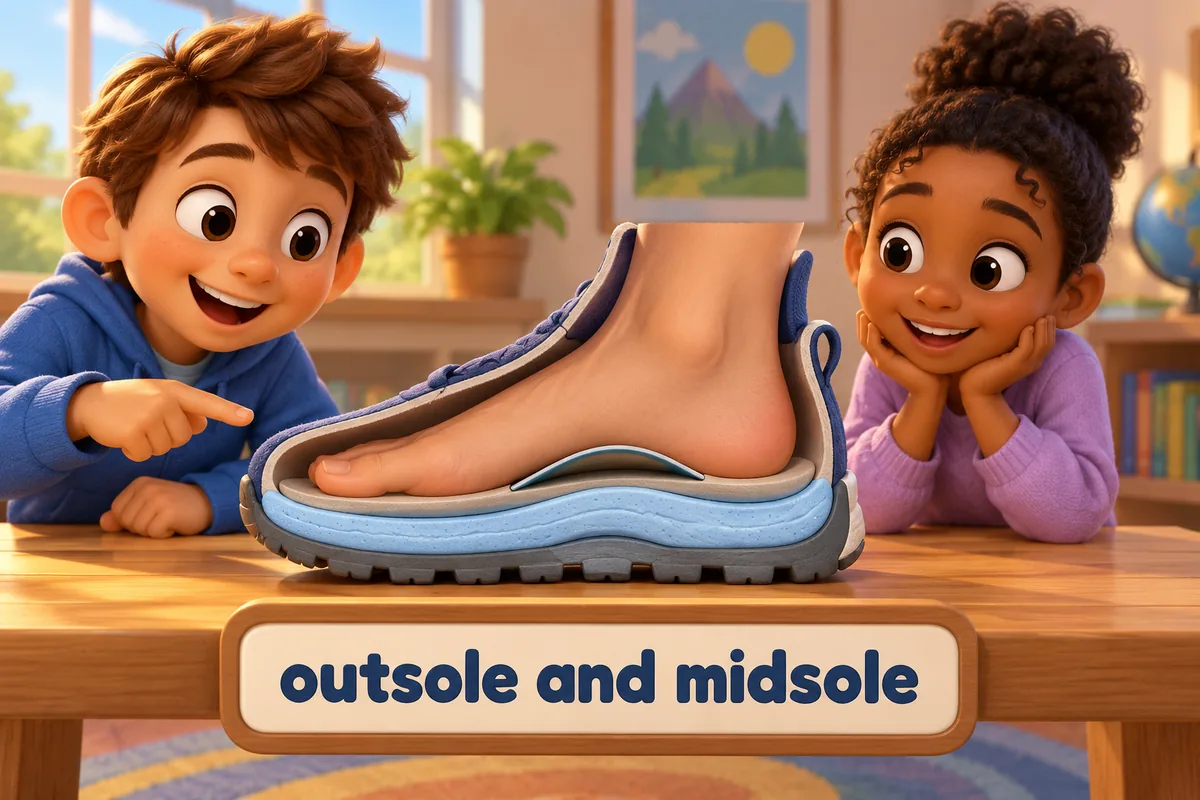
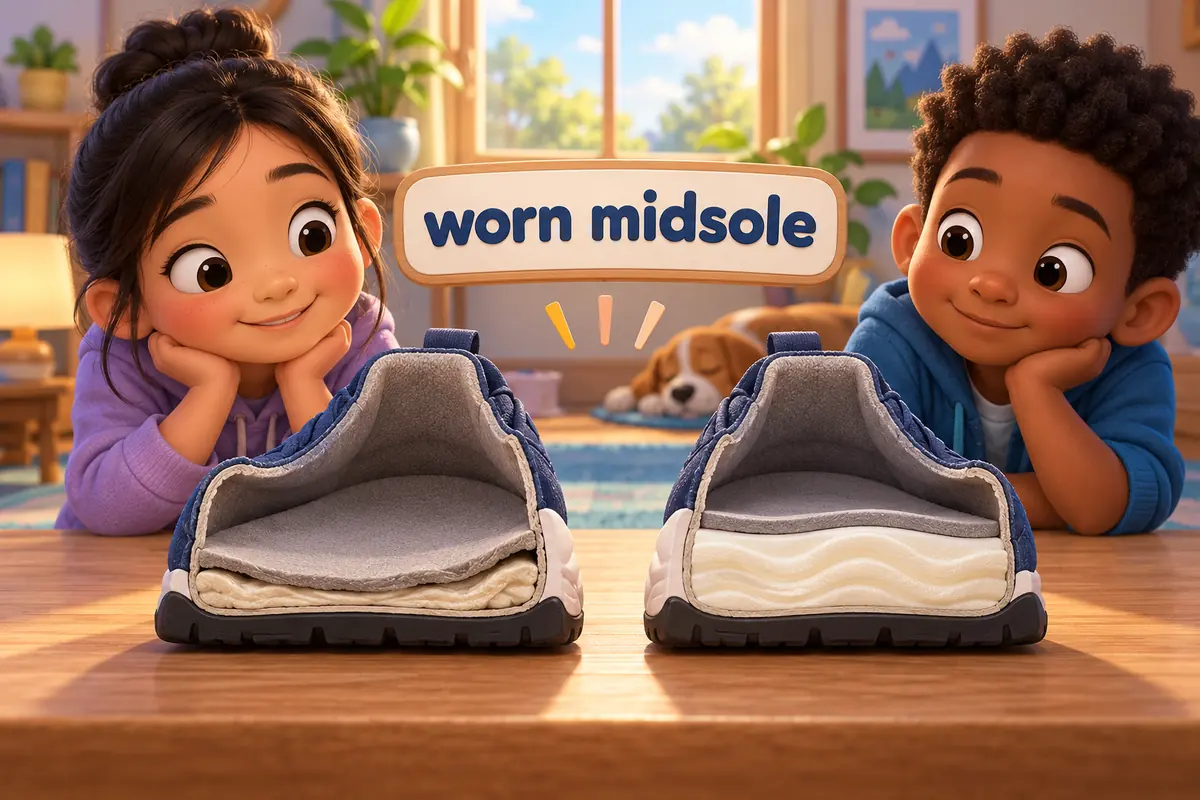
The outsole is the hard bottom layer that grips the ground, while the midsole is the softer layer that cushions each step. The two sit together under the foot, so a worn tread and a tired feeling come from different parts.
| Attribute | Outsole | Midsole |
|---|---|---|
| position | the very bottom | between outsole and insole |
| main job | grip and wear resistance | cushioning and shock absorption |
| material | hard rubber or similar | softer foam or gel |
| what fails first | the tread pattern wears smooth | the foam flattens and loses spring |
| how you notice | slipping on wet ground | a flat, tired feeling in the legs |
The verdict is that the midsole cushions and the outsole grips, so replace a shoe when the midsole has flattened even if the tread still looks fine. One honest limit is worth stating, because shoe design varies. A sandal has almost no upper and no heel counter, while a heavy boot adds a steel shank, so a learner should match the diagram to the type of shoe in front of them.
Key Terms and Word Forms for Shoe Parts
Most shoe vocabulary is noun-based, though a few verbs and adjectives appear in repair notes and reviews. A parallel list sits in human body parts that start with b.
| Term | Part of speech | Example sentence |
|---|---|---|
| shoe | noun | The shoe fitted well at the heel. |
| shoes | plural noun | Two shoes stood by the door. |
| sole | noun | A thick sole cushioned the path. |
| sole | verb | A cobbler can sole the boot again. |
| shoelace | noun | The shoelace came undone. |
| wear | noun | The tread showed even wear. |
| cushioned | adjective | A cushioned insole eased the pressure. |
The pattern continues in human body parts that start with c.
Common Mistakes When Naming Shoe Parts
The midsole grips the ground. The outsole grips the ground, and the midsole cushions. Rule: the outsole touches the floor, the midsole sits above it.
The insole is the same as the midsole. The insole is the surface the foot rests on, and the midsole is the cushion layer below it. Rule: the insole is inside, the midsole is under it.
The tongue is the back of the shoe. The tongue sits under the laces at the front, and the heel counter is at the back. Rule: the tongue pads the instep, not the heel.
The eyelets are the laces. The eyelets are the holes, and the laces are the cords. Rule: eyelets guide, laces fasten.
Two shoe are by the door. Two shoes are by the door. Rule: the plural of shoe adds s.
Practice Using the Parts of a Shoe
- The ____ is the hard bottom layer that grips the ground.
- The ____ cushions each step and absorbs shock.
- Choose the better part: the (tongue / heel counter) keeps the heel steady at the back.
- Correct the error: The midsole grips the ground.
- Build one sentence that names the outsole and the midsole and explains what each does.
- Spot the register: which sentence belongs in a product label, A or B? A: The breathable lining keeps the foot dry. B: The inside bit lets your feet breathe.
Answers
- outsole – it is the bottom layer that grips and resists wear.
- midsole – it cushions each step between the outsole and the insole.
- heel counter – it is the stiff panel that holds the heel steady.
- The outsole grips the ground – the midsole cushions above it.
- A model answer is: The outsole grips the ground while the midsole cushions each step and absorbs shock. – it names both parts and gives each a job.
- A – it uses the correct terms, lining and breathable, in a measured claim.
The Bottom Line
The parts of a shoe with diagram set covers the outsole, midsole, insole, upper, tongue and heel, and each part grips, cushions or holds the foot along one path. The outsole grips and the midsole cushions, while the upper and heel counter keep the foot steady. Learn which layer you replace and which part supports the arch, and both the diagram and the shopping make sense.
Frequently asked questions about shoe parts
What is the difference between the outsole and the midsole?
The outsole is the hard bottom layer that touches the ground and provides grip and wear resistance. The midsole sits just above it and is made of softer foam or gel that cushions each step. One grips, the other absorbs shock.
What is the heel counter for?
The heel counter is the stiff panel at the back of the shoe that wraps around the heel and holds it steady. A firm counter keeps the foot from sliding sideways with each step, which matters for running and for anyone who needs extra stability.
How long do running shoe midsoles last?
Foam midsoles usually lose their spring long before the tread wears through, often after about three hundred to five hundred miles of running. If a shoe feels flat or leaves your legs feeling tired, the midsole has probably already flattened.
What is the toe box and why does it matter?
The toe box is the front part of the upper that gives the toes room to spread and flex. A toe box that is too narrow squeezes the toes and can cause blisters and sore joints, so a comfortable fit should let the toes move freely.