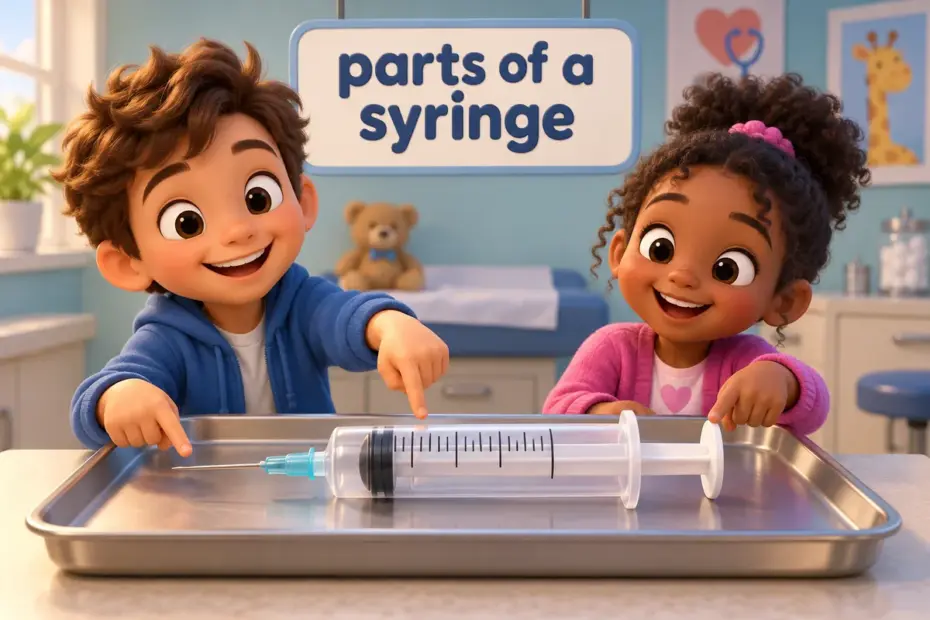
The parts of a syringe are the barrel, the plunger, the tip, and the needle that fits on the end. The barrel holds the liquid, the plunger pushes it out, and the needle delivers it, so each piece works in one clear direction.
Parts of a syringe at a glance
- A syringe has four main parts: the barrel, the plunger, the tip, and the needle.
- The barrel holds the liquid and shows the volume in millilitres.
- The plunger slides inside the barrel to draw liquid in or push it out.
- The tip joins the barrel to the needle, often with a luer lock.
- The commonest error is calling the whole syringe a needle.
What are the parts of a syringe?
A syringe is a pump made of a tube and a sliding plunger that measures and moves liquid. The barrel is the clear tube, the plunger is the rod that fits inside it, and the tip is the narrow opening where a needle or tube attaches. Graduation marks along the barrel show exactly how much liquid is inside at any moment.
| Part | Where it is | What it does | Example sentence |
|---|---|---|---|
| Barrel | The clear tube | Holds and measures liquid | The barrel of a syringe holds five millilitres. |
| Plunger | Inside the barrel | Pushes or pulls the liquid | Press the plunger of a syringe slowly. |
| Piston | The rubber head of the plunger | Makes a tight seal | The piston of a syringe grips the barrel wall. |
| Flange | Top edge of the barrel | Gives the fingers a grip | Rest two fingers under the flange of a syringe. |
| Thumb rest | Top of the plunger | Takes the thumb | Push the thumb rest of a syringe down. |
| Tip | Bottom of the barrel | Joins the needle or tube | The tip of a syringe fits a luer lock. |
| Needle hub | Base of the needle | Screws onto the tip | Twist the needle hub of a syringe into place. |
| Cannula | The thin metal tube | Enters the skin or vial | The cannula of a syringe is very fine. |
| Bevel | The slanted point | Makes a sharp entry | The bevel of a syringe faces upward. |
| Graduation | Along the barrel | Shows the volume | The graduations of a syringe mark each millilitre. |
| Cap | Over the needle | Protects the point | Keep the cap of a syringe on until use. |
How do you use the parts of a syringe in a sentence?
The phrase names one piece and gives it a task. Put the part before of a syringe, or let the syringe own it with an apostrophe, and keep the verb matched to the number of parts you name. The liquid is drawn into the barrel, never into the needle.
| Pattern | Example | What it signals |
|---|---|---|
| the + part + of a syringe | The barrel of a syringe is clear. | names one part |
| a syringe’s + part | A syringe’s plunger moves smoothly. | shows possession |
| plural part + of a syringe | The graduations of a syringe are easy to read. | talks about markings |
| part + verb | The plunger draws the liquid in. | describes a job |
| label + part | The nurse checked the tip first. | medical and lab use |
| part + helps + verb | The flange helps the fingers grip. | explains a function |
Parts of a syringe in context: examples across contexts
The same names appear in a clinic, a laboratory, and a kitchen where cooks use a plastic syringe for icing. A parallel labelled list sits in car parts that starts with a to z.
| Context | Example sentence | Why this works |
|---|---|---|
| Classroom | The teacher asked us to label each part of a syringe. | a school labelling task |
| Clinic note | A five millilitre syringe was used for the dose. | a short clinical record |
| Lab manual | Draw the sample into the barrel slowly. | a practical instruction |
| Patient leaflet | The nurse will attach a fresh needle to the syringe. | a reassuring note |
| Safety poster | Never recap a used needle on a syringe. | a safety rule |
| Pharmacy label | Discard the syringe after a single use. | a disposal rule |
| Exam question | Name the part that measures the volume. | a clear instruction |
| Science article | A syringe works like a piston inside a cylinder. | a technical statement |
| Story | The vet filled the syringe and smiled gently. | simple narrative wording |
| Cooking blog | Fill the syringe with icing and pipe small dots. | an everyday use |
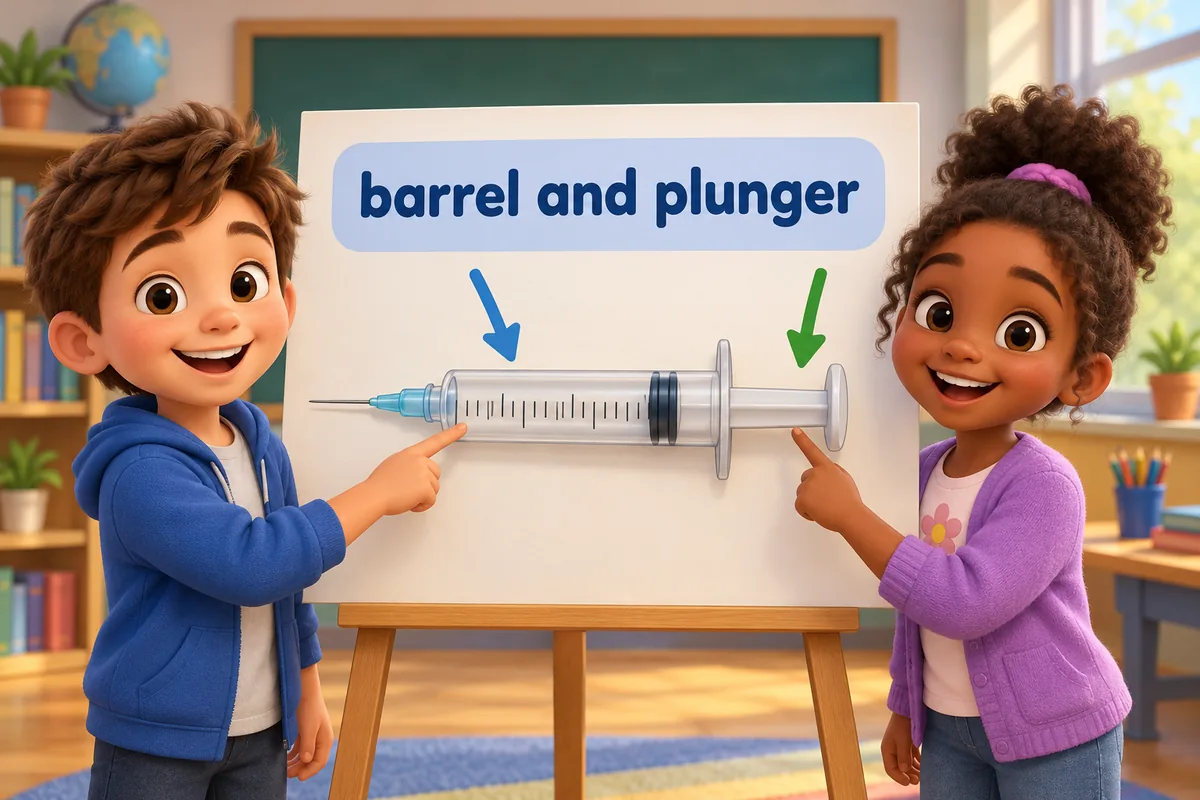
Barrel, plunger, and needle: how the parts differ
Grouping the parts by function makes the device easy to read, because holding, moving, and delivering are three separate jobs. A similar one-name-one-job habit shows in human body parts that start with a.
| Feature | Barrel | Plunger | Needle |
|---|---|---|---|
| Main job | holds the liquid | moves the liquid | delivers the liquid |
| Where it is | the clear tube | inside the barrel | on the tip |
| Direction | measures volume | slides up and down | enters the target |
| Typical material | clear plastic | plastic with a rubber head | steel |
| Diagram label | barrel | plunger | needle |
Word forms and grammar of the parts of a syringe
Most part names are nouns, and the instrument also gives us the verbs draw up and inject. The related noun injection names the act itself. A comparable list of human body parts that start with b shows the same naming habit.
| Form | Part of speech | Example |
|---|---|---|
| syringe | noun | The syringe was sealed. |
| syringes | noun, plural | Both syringes are sterile. |
| barrel | noun | The barrel was full. |
| plunger | noun | The plunger stuck halfway. |
| needle | noun | The needle was capped. |
| inject | verb | Nurses inject the medicine. |
| injection | noun | The injection was painless. |
| draw up | phrasal verb | Draw up the dose slowly. |
| sterile | adjective | Keep the syringe sterile. |
| millilitre | noun | Read the millilitre marks. |
Common mistakes with the parts of a syringe
Mixing the container with the point causes most of the errors, so keep the syringe and the needle apart in your mind.
Mistake 1: needle for syringe. Incorrect: Give the patient a needle of medicine. Correct: Give the patient a syringe of medicine. Rule: the needle is only the point, while the syringe holds the medicine.
Mistake 2: syringe for needle. Incorrect: The syringe went into the skin. Correct: The needle went into the skin. Rule: the needle enters the skin, not the whole syringe.
Mistake 3: the plural syringe. Incorrect: Two syringe were on the tray. Correct: Two syringes were on the tray. Rule: the plural adds es, giving syringes.
Mistake 4: drawing into the needle. Incorrect: Draw the medicine into the needle. Correct: Draw the medicine into the barrel. Rule: liquid is drawn into the barrel, not the needle.
Mistake 5: into with the wrong target. Incorrect: Push the plunger in the barrel quickly. Correct: Push the plunger into the barrel quickly. Rule: into shows movement to the inside, and in shows position.
Practice using the parts of a syringe
- Fill in the blank: The ___ holds the liquid and shows the volume.
- Choose the better word: The liquid enters the skin through the (barrel / needle).
- Correct the error: Two syringe were on the tray.
- Build a sentence: use plunger to say how the liquid is pushed out.
- Spot the register: which line suits a patient leaflet, (a) We jab the syringe in, or (b) The nurse will attach a fresh needle?
- Fill in the blank: Read the ___ marks before you draw up the dose.
Answers
- barrel, because the clear barrel holds and measures the liquid.
- needle, because the needle is the part that enters the skin.
- Two syringes were on the tray; the plural of syringe is syringes.
- The plunger slides inside the barrel to push the liquid out through the needle.
- (b), because a leaflet uses calm, precise wording; jab is too casual.
- graduation, because the graduation marks show the volume in millilitres.

The bottom line
The parts of a syringe work in one direction: the barrel holds and measures the liquid, the plunger draws it in and pushes it out, and the needle delivers it. Read the graduations, because the marks tell you the exact volume rather than a rough guess. Once the three jobs are clear, using a syringe is a matter of steady control.
Frequently asked questions about the parts of a syringe
What are the main parts of a syringe?
A syringe has four main parts: the barrel, the plunger, the tip, and the needle. The barrel is the clear tube that holds the liquid, the plunger slides inside it, the tip joins the barrel to the needle, and the needle delivers the liquid. Graduation marks along the barrel show the volume.
What is the difference between the plunger and the piston?
The plunger is the whole rod you push with your thumb, and the piston is the rubber head at the end of it that fits snugly against the barrel wall. The piston forms the seal that lets the plunger pull liquid in or push it out. Many people use the two names for the whole rod.
Why does a syringe have graduation marks?
The graduation marks along the barrel measure how much liquid is inside, usually in millilitres. They let a nurse or scientist draw an exact dose instead of guessing. Read the marks at eye level, because looking from the side can make the level seem slightly higher than it truly is.
What is a luer lock on a syringe?
A luer lock is the fitting at the tip that holds a needle or tube in place. The plain luer slip simply pushes on, while the luer lock twists and grips so the needle cannot come off under pressure. A secure tip matters whenever fluid is pushed with force.