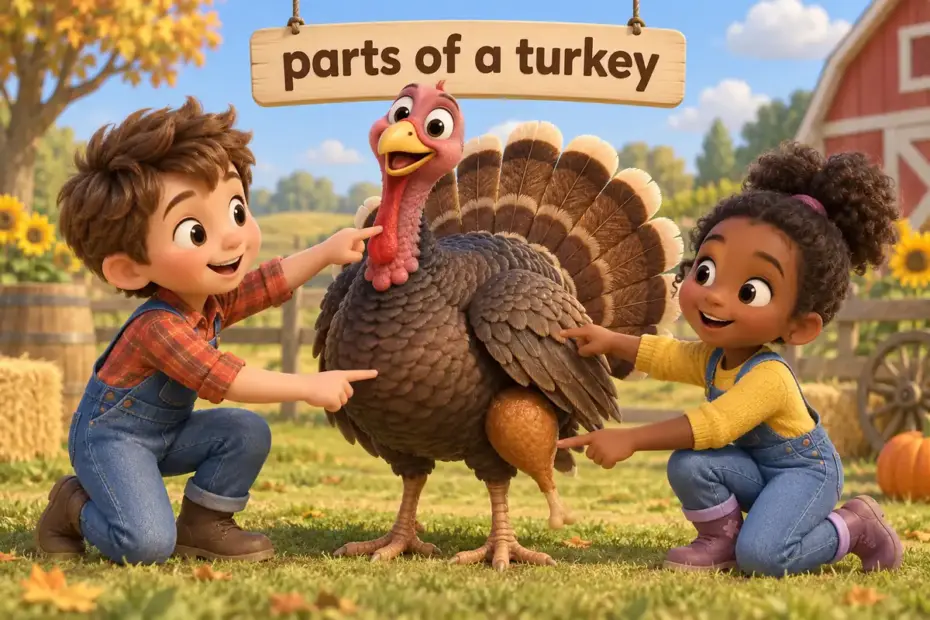
The parts of a turkey are the head, the wattle, the wings, the breast, and the legs that make up the living bird, plus the breast, thigh, wing, and drumstick cuts on the table. The live bird uses its parts to move and display, while cooks divide the same body into named cuts.
Parts of a turkey at a glance
- A turkey has a head, a wattle, a snood, wings, a breast, and legs.
- The wattle is the fleshy flap under the beak, and the snood hangs over it.
- Cooks divide the bird into breast, thigh, wing, and drumstick cuts.
- The drumstick is the lower leg, and the wing has three sections.
- The commonest error is using the country name Turkey for the bird.
What are the parts of a turkey?
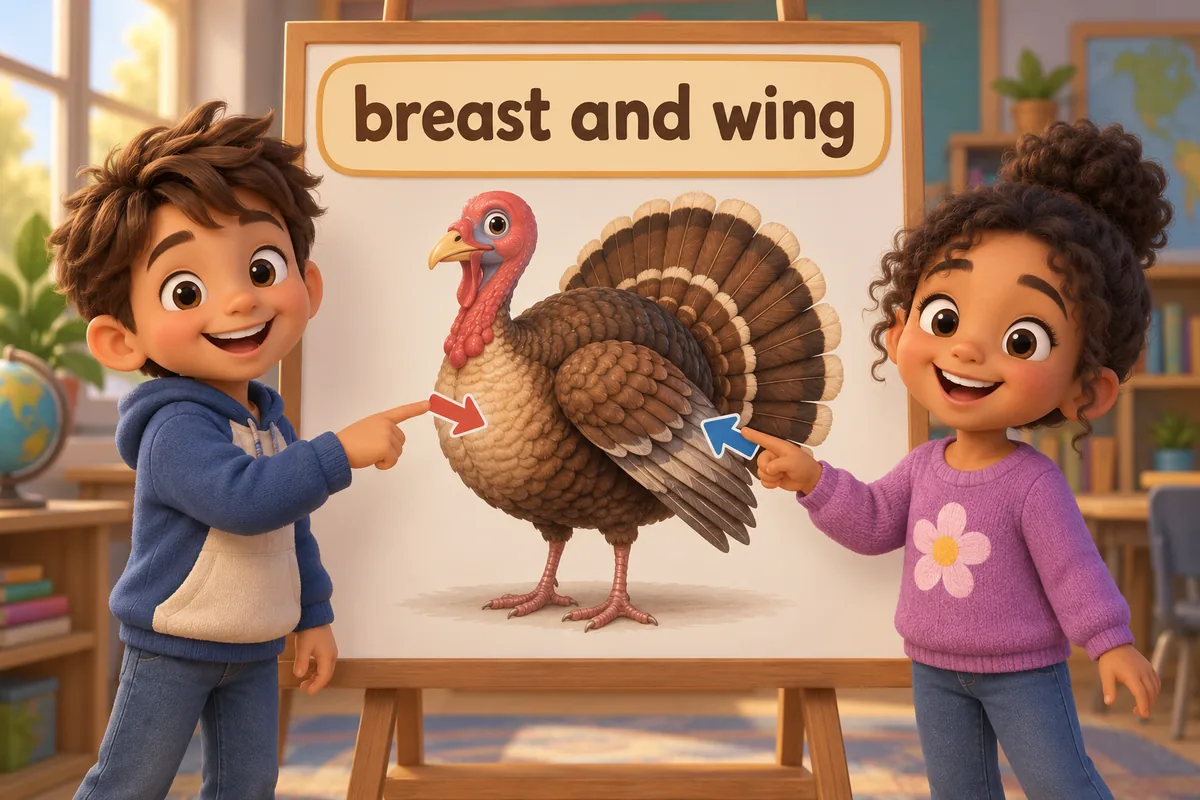
A turkey is a large bird, and its parts can mean either the living body or the meat cuts on a plate. On the bird, the head carries a wattle and a snood, the wings and tail feathers spread for display, and the legs end in scaly feet with a small spur. On the table, the same body is divided into breast, thigh, wing, and drumstick.
| Part | Bird or cut | What it does | Example sentence |
|---|---|---|---|
| Wattle | Bird | The fleshy flap under the beak | The wattle of a turkey turned red. |
| Snood | Bird | The flap over the beak | The snood of a turkey hung down. |
| Head | Bird | Holds the eyes and beak | The head of a turkey has few feathers. |
| Wing | Bird and cut | Lifts the bird; a serving cut | The wing of a turkey has three parts. |
| Tail fan | Bird | Spreads for display | The tail fan of a turkey opened wide. |
| Breast | Bird and cut | The large front muscle; white meat | The breast of a turkey is lean. |
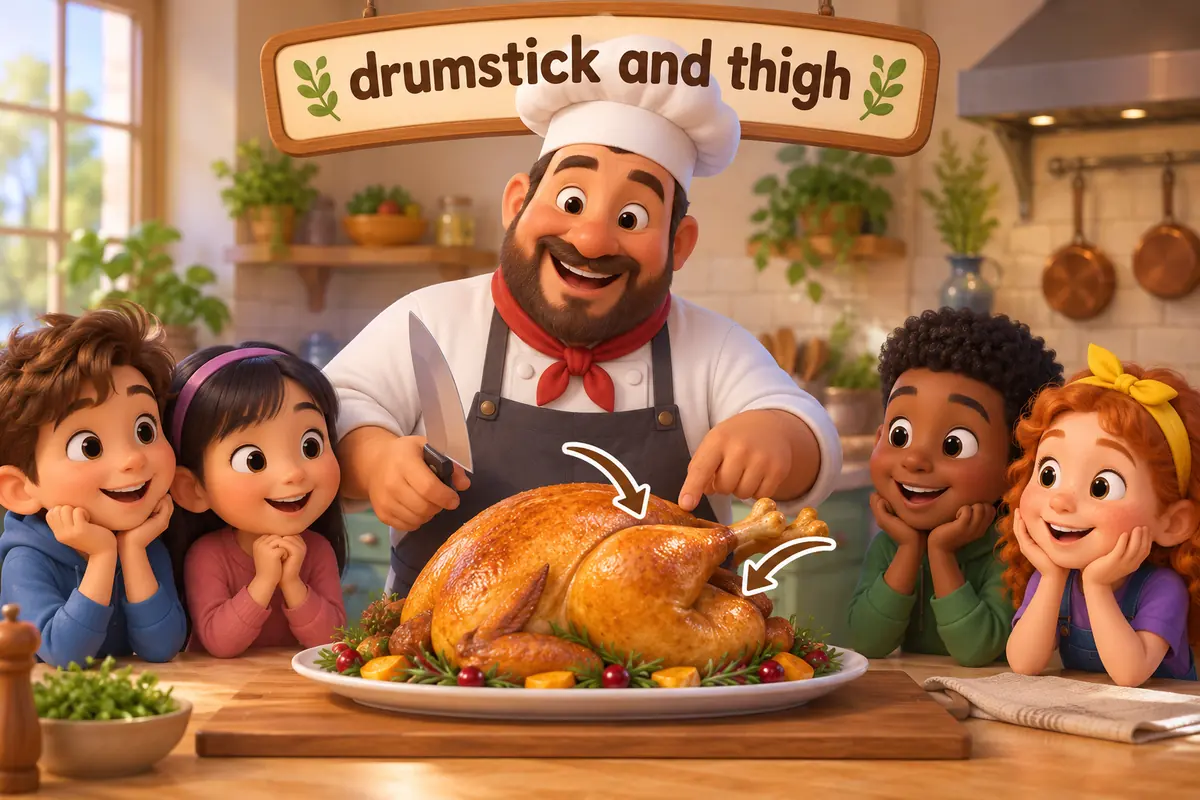
| Thigh | Cut | The upper leg meat | The thigh of a turkey is dark meat. |
| Drumstick | Cut | The lower leg meat | The drumstick of a turkey is easy to hold. |
| Leg | Bird | Stands and walks | The leg of a turkey is strong. |
| Giblets | Cut | The heart, liver, and gizzard | The giblets of a turkey make gravy. |
| Feather | Bird | Keeps the bird warm | The feathers of a turkey are brown. |
| Spur | Bird | A small point on the leg | The spur of a turkey grows with age. |
How do you use the parts of a turkey in a sentence?
The naming phrase puts one part before of a turkey, or lets the turkey own that part with an apostrophe. Match the verb to the number of parts you name, because a pair such as the wings takes a plural verb.
| Pattern | Example | What it signals |
|---|---|---|
| the + part + of a turkey | The breast of a turkey is lean. | names one part |
| a turkey’s + part | A turkey’s wattle was bright. | shows possession |
| plural part + of a turkey | The wings of a turkey are small. | talks about a pair |
| part + verb | The drumstick holds the lower leg. | describes a job |
| label + part | The butcher cut along the breast. | kitchen use |
| part + helps + verb | The feathers help keep the bird warm. | explains a function |
Parts of a turkey in context: examples across contexts
The same names appear in a classroom, a butcher’s counter, and a recipe, and the wording around them changes with the setting. A set of describing words sits in adjectives for turkey.
| Context | Example sentence | Why this works |
|---|---|---|
| Classroom | The teacher asked us to label each part of a turkey. | a school labelling task |
| Science book | The wattle of a turkey hangs below the beak. | a plain factual statement |
| Butcher counter | Slice the breast of a turkey across the grain. | a practical instruction |
| Recipe | Roast until the thigh of a turkey reads 74 degrees. | a cooking step |
| Children’s story | A turkey strutted across the farmyard. | simple narrative wording |
| Farm sign | The turkeys here roam free in the orchard. | a public note |
| Exam question | Name the two cuts from the leg of a turkey. | a clear instruction |
| Menu | Served with roast breast and a drumstick. | a dining description |
| Nature article | The snood of a turkey changes colour with mood. | a descriptive statement |
| Story | They pulled the wishbone from the turkey together. | a family tradition |
Breast, wing, and drumstick: how the cuts differ
Grouping the cuts by where they come from makes carving easy, because the front, the side, and the leg give three different sorts of meat. The same bird also gives the well-known phrase cold turkey, which has nothing to do with the meat.
| Feature | Breast | Wing | Drumstick |
|---|---|---|---|
| On the bird | white front muscle | small paired limb | lower part of the leg |
| Meat colour | white | white with dark tips | dark |
| Typical serving | slices | two small pieces | one piece on the bone |
| Best cooking | roast gently | roast or fry | roast slowly |
| Diagram label | breast | wing | drumstick |
Word forms and grammar of the parts of a turkey
Most part names are nouns, and a young bird has its own word, a poult. The verb gobble names the bird’s call, and the verb baste names what a cook does. A parallel labelled list sits in car parts that starts with a to z.
| Form | Part of speech | Example |
|---|---|---|
| turkey | noun | The turkey is in the oven. |
| turkeys | noun, plural | The turkeys roamed the yard. |
| Turkey | proper noun | Turkey is a country. |
| poult | noun | A young turkey is a poult. |
| gobble | verb and noun | The turkey gobbled loudly. |
| baste | verb | Baste the turkey often. |
| drumstick | noun | Pass me a drumstick. |
| giblets | noun, plural | Rinse the giblets first. |
| wattle | noun | Its wattle was bright red. |
| snood | noun | The snood dangled over the beak. |
Common mistakes with the parts of a turkey
One capital letter and two joined words cause most of the errors, so keep the bird, the country, and the idiom apart.
Mistake 1: Turkey for the bird. Incorrect: The Turkey is a popular bird. Correct: The turkey is a popular bird. Rule: use lowercase for the bird and a capital for the country.
Mistake 2: drumstick as a separate bird. Incorrect: The drumstick is a separate animal. Correct: The drumstick is the lower leg of the bird. Rule: drumstick names one cut of the turkey.
Mistake 3: cold-turkey as one word. Incorrect: He quit cold-turkey the habit. Correct: He quit the habit cold turkey. Rule: cold turkey is an adverb phrase, so it stays two words.
Mistake 4: is for are. Incorrect: The turkeys is in the yard. Correct: The turkeys are in the yard. Rule: a plural subject takes the verb are.
Mistake 5: wattle on the leg. Incorrect: The wattle of a turkey is on its leg. Correct: The wattle of a turkey hangs under its beak. Rule: the wattle is on the head, and the spur is on the leg.
Practice using the parts of a turkey
- Fill in the blank: The ___ is the fleshy flap under the beak of a turkey.
- Choose the better word: Dark meat comes from the (breast / drumstick).
- Correct the error: The Turkey is a popular bird.
- Build a sentence: use giblets to say which small parts go into gravy.
- Spot the register: which line suits a menu, (a) We give you a leg bit, or (b) Served with roast breast and a drumstick?
- Fill in the blank: The fan of tail feathers is used by a turkey to ___.
Answers
- wattle, because the wattle is the fleshy flap under the beak.
- drumstick, because the drumstick is dark leg meat.
- The turkey is a popular bird; use lowercase for the bird.
- The giblets of a turkey, such as the heart and liver, go into gravy.
- (b), because a menu uses precise, appealing wording.
- display, because a turkey spreads its tail feathers to display.
The bottom line
The parts of a turkey name both the living bird and the cuts on the table, so the same body carries two sets of words. Learn the pair on the bird, because the wattle hangs under the beak and the snood lies over it. Once the cuts are clear, carving a turkey becomes simple.
Frequently asked questions about the parts of a turkey
What are the parts of a turkey?
A turkey has a head with a wattle and a snood, a large breast, paired wings, a tail fan, and two legs ending in scaly feet. Cooks divide the same body into cuts: the breast, thigh, wing, and drumstick. Giblets cover the heart, liver, and gizzard.
What is the difference between the wattle and the snood?
The wattle is the fleshy flap that hangs under the beak, and the snood is the flap that lies over the beak. Both change colour with the bird’s mood and blood flow. The wattle is the larger and more obvious of the two, especially on a male turkey.
What cuts come from a turkey?
The main cuts are the breast and the thigh, which are the largest, plus the wing and the drumstick, which is the lower leg. Roasters also keep the giblets and the neck for stock and gravy. Each cut cooks differently because white and dark meat behave in different ways.
Why is dark meat darker than white meat?
Dark meat comes from the leg and thigh, muscles the bird uses to walk and stand, and those muscles carry more of the oxygen-storing protein that makes them look dark. White meat from the breast is used less, so it holds less of that protein and dries out faster in the oven.