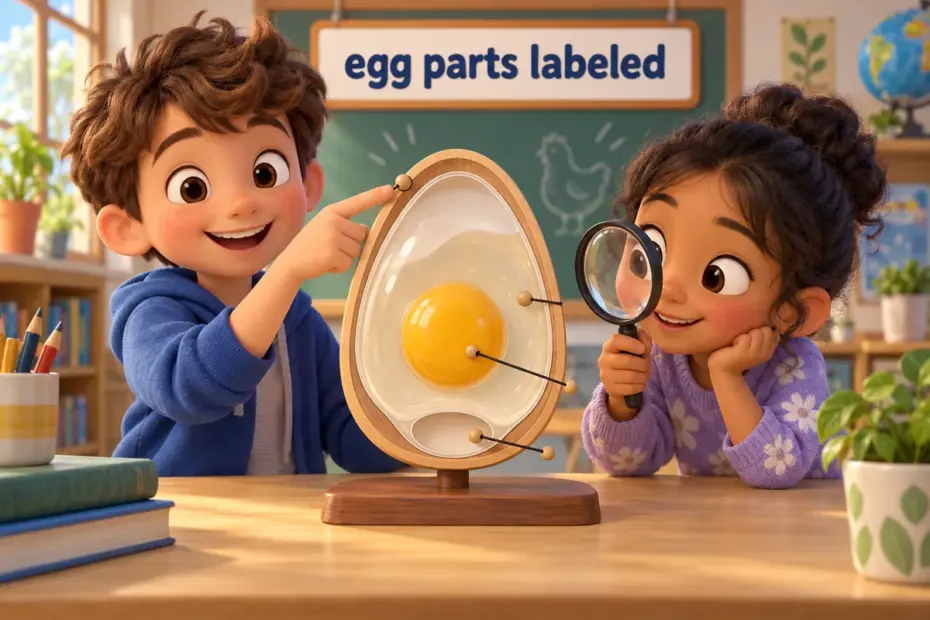
Parts of an egg divide into a shell, two membranes, the albumen, the yolk and a small air cell. Each part has a job: the shell protects the contents, the albumen cushions them, and the yolk supplies food. A fresh egg holds its shape because these layers work together.
Parts of an Egg at a Glance
- An egg has four main parts: the shell, the membranes, the albumen and the yolk.
- The shell is the hard outer layer, made mostly of calcium carbonate.
- The albumen, or egg white, is the clear liquid that cushions the yolk.
- The yolk is the round yellow centre that stores fat and protein.
- The chalaza is the twisted white strand that anchors the yolk in place.
- The air cell at the wide end grows larger as an egg loses moisture.
What are the parts of an egg?
An egg is built from layers, and each layer has a name. The shell wraps the outside, two thin membranes sit just beneath it, the albumen fills most of the inside, and the yolk floats inside the albumen. Small structures such as the chalaza, the germinal disc and the air cell complete the picture.
| Part | Where it sits | What it does |
|---|---|---|
| Shell | Hard outer layer | Protects the contents and lets gases pass through tiny pores |
| Outer shell membrane | Just inside the shell | Works with the inner membrane to seal the egg |
| Inner shell membrane | Around the albumen | Separates at the wide end to form the air cell |
| Albumen (egg white) | Fills most of the shell | Cushions the yolk and adds protein |
| Yolk | Centre of the egg | Stores fat, vitamins and protein for a growing chick |
| Vitelline membrane | Film around the yolk | Holds the yolk together and keeps it round |
| Chalaza | Twisted strands beside the yolk | Anchors the yolk so it stays centred |
| Germinal disc | Small pale spot on the yolk | Where a chick would begin to develop |
| Air cell | Blunt, wide end | Stores air and grows as the egg ages |
| Cuticle (bloom) | Thin coat on the shell | Slows water loss and blocks some bacteria |
What does each part of an egg do?
Every part answers a different need. Protection, cushioning, food, anchoring and air exchange are separate jobs, which is why cooks and biologists name the parts separately rather than calling the whole thing a shell.
| Job | Part responsible | Why it matters |
|---|---|---|
| Protection | Shell and cuticle | Keeps bacteria out while the chick, or the contents, stay safe |
| Cushioning | Albumen | Absorbs knocks so the yolk does not tear |
| Nutrition | Yolk | Feeds a developing chick before it hatches |
| Anchoring | Chalaza | Keeps the yolk away from the shell wall |
| Gas exchange | Shell pores | Lets oxygen in and carbon dioxide out |
| Freshness clue | Air cell | A large air cell shows an egg has been stored a long time |
How do you use egg part words in a sentence?
These words follow a few steady patterns. Most of them are countable nouns that take the when you name a single part, and they often appear after of the egg in definitions.
| Pattern | Example | What it signals |
|---|---|---|
| the + part + of the egg | The yolk of the egg sat in the middle. | Names one part of the whole |
| part + action verb | The chalaza holds the yolk in place. | Describes what a part does |
| adjective + part | A fresh egg has a small air cell. | Adds a quality or a size |
| verb + the + part | Whisk the albumen until it foams. | Uses the part as an object |
| there is / are + part | There are two membranes inside the shell. | Introduces the part in a general statement |

Parts of an Egg in Everyday Contexts
The same vocabulary appears in kitchens, classrooms and markets. Each sentence below uses a genuine part name rather than a vague word such as top or inside.
| Context | Example sentence | Why this works |
|---|---|---|
| Kitchen | Separate the yolk from the albumen before you whisk. | Names the two parts a cook handles |
| Recipe | Beat the albumen to stiff peaks. | Albumen is the exact term for egg white |
| Science classroom | The air cell grows as the egg loses water. | Links a part to a measurable change |
| Farm stall | Look at the air cell to judge how fresh the egg is. | Uses a part as a practical test |
| Biology textbook | The germinal disc marks where development begins. | Uses the precise anatomical name |
| Food label | The product lists albumen as an ingredient. | Shows the industrial name for egg white |
| Everyday talk | She cracked the shell and dropped the whole egg into the pan. | Keeps the common word for the outer layer |
| Word study | We practised the noun egg in a sentence before learning the parts. | Starts vocabulary with the whole object |
Eggs also feed a family of idioms. You can call a kind person a good egg, or describe a scoreless game with a goose egg, and someone dishonest may be labelled a bad egg. None of these expressions names an anatomical part, which is exactly why they confuse learners.
Egg Parts That Are Easy to Confuse
Two pairs cause most of the trouble. One is a pair of near-homophones, and the other is a pair of near-spellings with different meanings.
| Pair | How they differ | Quick test |
|---|---|---|
| yolk / yoke | Yolk is the yellow centre; yoke is a wooden bar for carrying loads. | If it is food, write yolk. |
| albumen / albumin | Albumen is the egg white; albumin is a family of proteins. | If it is an egg, write albumen. |
| shell / shell membrane | The shell is the hard layer; the membranes are soft films inside it. | If it bends, it is a membrane. |
| chalaza / air cell | The chalaza is a strand; the air cell is an empty pocket of air. | If it holds nothing, it is the air cell. |
Naming parts of other objects follows the same habit, which is why a page about the parts of a car uses the same label-and-function pattern you are learning here.
Word Forms and Plurals for Egg Parts
Most part names are ordinary nouns, but a few have plurals that surprise learners. The table below shows the form you should write and one that people often get wrong.
| Form | Part of speech | Example |
|---|---|---|
| yolk / yolks | countable noun | Two yolks sat in one shell. |
| albumen | noun, usually uncountable | Albumen turns white when it cooks. |
| shell / shells | countable noun | Save the shells for the compost. |
| chalaza / chalazae | countable noun with a Latin plural | The chalazae kept the yolk centred. |
| membrane / membranes | countable noun | Two membranes line the shell. |
| crack / cracked | verb and participle | She cracked the shell cleanly. |
Common Mistakes When Naming Egg Parts
These errors appear in student writing every week. Each one below shows the wrong version, the corrected version and the rule that explains the fix.
Incorrect: The yoke of the egg is yellow. Correct: The yolk of the egg is yellow. The egg part is yolk; a yoke is a wooden bar worn across the shoulders.
Incorrect: The albumin is the clear part of the egg. Correct: The albumen is the clear part of the egg. Albumen names egg white, while albumin names a group of proteins.
Incorrect: Cut the egg and look at the yellow. Correct: Cut the egg and look at the yolk. English has a precise noun for the coloured centre, so the vague word is unnecessary.
Incorrect: There are three shell membranes. Correct: There are two shell membranes. An egg has an inner and an outer membrane, not three.
Incorrect: The air cell is the white part. Correct: The air cell is the pocket of air at the wide end. The white part is the albumen, which is a liquid, not a pocket of air.
Practice Using Parts of an Egg Vocabulary
Six short tasks cover the names you have met. Write your answers before you look at the reasoned list below.
- Fill in the blank: The clear liquid around the yolk is the _____.
- Fill in the blank: The twisted strand that anchors the yolk is the _____.
- Choose the better word: A kind person is often called a good (egg / yoke).
- Correct the error: The yoke of the egg sat in the middle.
- Build a sentence: use air cell to explain how to judge freshness.
- Spot the register: which sentence belongs in a science report, and which in a chat message?
Answers
- albumen; it is the technical name for the egg white.
- chalaza; the plural is chalazae, and it holds the yolk centred.
- egg; the idiom is a good egg, and yoke would name a wooden bar.
- The yolk of the egg sat in the middle; yolk is the egg part and yoke is the bar.
- One model answer: A small air cell shows that the egg is still fresh; the pocket grows as moisture leaves the shell.
- The measured sentence about the germinal disc suits a science report; the sentence about the egg in your sandwich suits a message.

The Bottom Line
Learning the parts of an egg gives you the exact words for the shell, the two membranes, the albumen, the yolk, the chalaza and the air cell. The albumen cushions, the yolk feeds and the chalaza anchors, so the three are never interchangeable. Keep the homophones apart: write yolk for the yellow centre and yoke for the wooden bar. Once these names are secure, describing a cracked egg or judging its freshness becomes precise rather than vague.
Frequently asked questions about parts of an egg
What is the white part of an egg called?
The white part of an egg is called the albumen, and cooks call it the egg white. It is a clear liquid when raw and turns solid white when heated. The albumen cushions the yolk and supplies extra protein. In ingredient lists and science writing, albumen is the preferred term because it avoids confusion with the yolk.
How can you tell how fresh an egg is?
The air cell at the wide end is the clue. A very fresh egg has a small air cell because little moisture has escaped. As the egg ages, water leaves through the shell pores and the air cell grows larger. Floating an egg in water tests the same idea, since a larger air cell makes the egg rise.
Is the chalaza safe to eat?
The chalaza is safe to eat. It is simply a twisted strand of egg white that anchors the yolk, so it is made of the same protein as the albumen. Many cooks strain or pick it out for a smoother texture, but it is not a defect and carries no risk when the egg is cooked.
What is the small spot on the yolk?
The small pale spot is the germinal disc. It marks the point where a fertilised egg would begin to develop into a chick, so it appears on every yolk whether or not the egg was fertilised. A fertilised egg is safe to eat and looks almost identical, so the spot is not a sign of anything unusual.