A polite way to ask for money names the amount, gives a reason and offers a date for repayment. Learners who master a soft opener such as “could I possibly borrow” keep friendships intact. “Could I borrow twenty pounds until Friday?” sounds warm and specific.
Polite ways to ask for money at a glance
- Every polite ask names a clear amount rather than a vague sum.
- A soft opener such as could or would lowers the pressure.
- Give the other person a reason and an easy way to say no.
- Always offer a repayment date and keep to it.
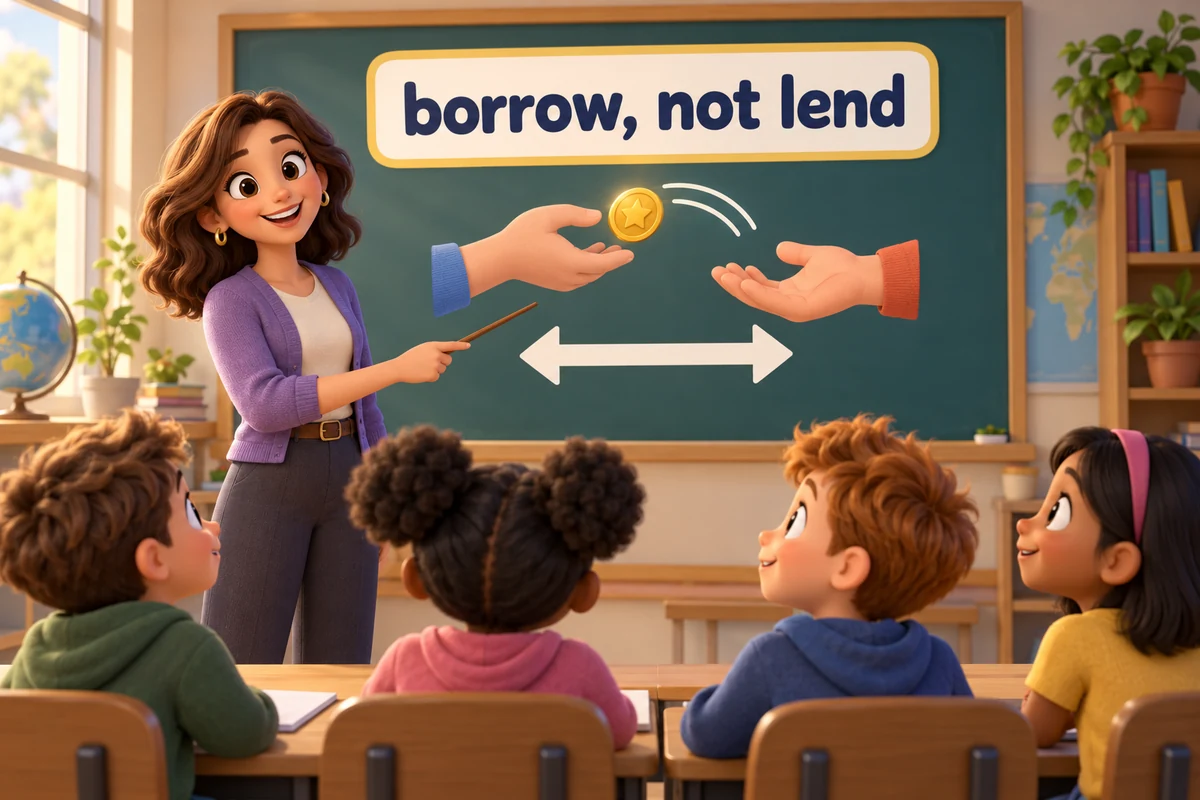
- Borrow means take and repay; lend means give for a time.
A request and a demand can share the same amount and still feel completely different. The wording around the amount does the work, which is why the phrases below matter as much as the figure itself.
What makes a request for money polite?
A request for money is polite when it reduces pressure rather than adding it. Six elements do that work, and a sentence can carry all of them in a single line.
| Element | Why it matters | Example |
|---|---|---|
| Soft opener | lowers the pressure | Could I ask you something? |
| Clear amount | removes vague worry | Could I borrow twenty pounds? |
| Reason | shows it is not casual | My rent is due before payday. |
| Timing | shows respect for their money | I can repay you on Friday. |
| Offer of return | keeps the arrangement fair | I will pay you back on the day. |
| Escape route | protects the friendship | Please say no if this is awkward. |
How do you ask for money politely?
The situation decides the exact phrase. The table matches eight common situations with a line that fits and the reason it works.
| Situation | Polite phrase | Why it works |
|---|---|---|
| Borrowing from a friend | Could I possibly borrow some money until Friday? | soft opener plus a date |
| Asking to be repaid | Would you be able to settle the fifty pounds this week? | frames it as a shared plan |
| Asking for a raise | Could we review my salary at the next meeting? | uses a meeting frame |
| Splitting a bill | Shall we split this evenly? | makes the payment mutual |
| Asking family | Would you mind helping me out this month? | acknowledges the favour |
| Chasing an invoice | Just a friendly reminder about invoice 204. | neutral and specific |
| Paying in parts | Could I pay this in two parts? | offers a clear plan |
| Asking for more time | Would it be all right to pay on the tenth? | asks instead of announcing |
Notice that none of these lines hides the amount or the date. A phrase that stays vague, such as could I borrow something sometime, worries the listener more than a clear figure does.
Polite ways to ask for money: examples across contexts
The same soft patterns appear in very different settings. The table pairs a context with a sentence and the reason it fits.
| Context | Sentence | Why this works |
|---|---|---|
| Message to a friend | Could you lend me a tenner until payday? | casual but still specific and dated |
| Email to a landlord | I would be grateful if I could pay the rent on the fifth. | formal and respectful |
| Workplace | Could we discuss the outstanding invoice today? | neutral business tone |
| Family talk | Would you mind spotting me this month? | warm and informal |
| Text to a sibling | Any chance you could send the money you owe? | gentle but clear |
| Spoken request | Sorry to ask, but could I borrow a little until Friday? | apology plus a date |
| In-store credit | Would it be possible to pay half now? | asks permission, offers a plan |
| Charity appeal | Any support you can give would mean a great deal. | grateful, no pressure |
| Group project | Shall we each send our share today? | makes it mutual |
| Formal letter | I am writing to ask for a short loan. | declares the purpose plainly |
The adjectives for money show how a single describing word changes the tone of a request, more frames sit in the ask for sentence examples, and the plain verb is practised in the ask sentence examples.
Polite request or demand: which one are you making?
The line between a request and a demand is thin but real. The table separates the two on the points a reader notices first.
| Attribute | polite request | demand |
|---|---|---|
| Tone | warm and calm | urgent and tense |
| Opener | could, would, may | give me, you must |
| Wording | names the amount and a date | leaves both vague |
| Response expected | a free yes or no | compliance |
| Effect on the relationship | keeps it strong | strains it |
Choose the request when you value the relationship, and remember that a clear amount and a date carry more weight than any apology.
A handy check is to read your message aloud. If the first three words are give, send or pay, the sentence is a demand; if the first three words are could, would or may, it is a request.
Word forms and grammar of polite requests
The verbs around money cause more slips than the phrases do. This table collects the forms learners need.
| Form | Part of speech | Example |
|---|---|---|
| borrow | verb | Could I borrow ten pounds? |
| lend | verb | Could you lend me ten pounds? |
| loan | noun | He took out a small loan. |
| loan | verb (formal) | The bank loaned the money. |
| repay | verb | I will repay you on Friday. |
| owe | verb | I owe you twenty pounds. |
| settle | verb | Could you settle the bill this week? |
| spot me | idiom (informal) | Could you spot me this month? |
| advance | noun | He asked for an advance on his pay. |
Common mistakes when asking for money
Five errors mark an otherwise good request as rude or confusing. Each one gives the wrong line, the fix, and the rule.
Give me fifty pounds.Could you lend me fifty pounds until Friday? An imperative sounds like an order, not a request.Can I lend money from you?Can I borrow money from you? You borrow from someone and lend to someone.You still owe me. Pay now.Just a friendly reminder that the fifty pounds is due this week. A reminder stays neutral where a command attacks.Everyone thinks you should pay.I wondered whether you could pay your share. Speak only for yourself.I need money ASAP!!!I would be grateful for a short loan this week. Drop the urgency markers and exclamation marks.
Practice asking for money politely
Rewrite or complete the six exercises, then read the answers and the reason for each.
- Make polite: Give me twenty pounds.
- Choose the correct verb: Can I (borrow / lend) your bike for an hour?
- Add a repayment date to: Could I borrow some money?
- Correct the error: Can I lend money from you?
- Build a request using “would you mind” about splitting a bill.
- Softening: The customer email opens with: Send the invoice payment today.
Answers
- Could I possibly borrow twenty pounds until Friday? The soft opener and a date replace the command.
- Borrow. You borrow the bike from its owner; the owner lends it to you.
- Could I borrow some money and repay you by next Friday? The date tells the other person when to expect the money back.
- Can I borrow money from you? Borrow takes from; lend takes to.
- Would you mind splitting the bill with me? The phrase would you mind makes the shared cost a request.
- Could you settle the invoice by the fifth? A question with a date turns an order into a polite reminder.
The bottom line
A polite way to ask for money does three things: it names the amount, gives a reason and offers a date. A soft opener such as could or would keeps the tone warm, and an escape route protects the relationship. Keep borrow and lend straight, and a request for money can stay friendly.
Frequently asked questions about asking for money politely
What is a polite way to ask someone for money?
A polite request uses a soft opener, a clear amount and a date, as in could I possibly borrow twenty pounds until Friday? Adding a reason and an easy way to say no makes it fairer still. The warmth comes from the wording, not from apologising again and again.
How do you ask for a loan without sounding rude?
Frame the loan as a question with a plan attached. Name the amount, explain briefly why you need it, and state when you will repay. Avoid commands such as give me and urgency markers such as now or ASAP, which push the other person until a request feels like pressure.
What is the difference between borrow and lend?
Borrow means to take something from someone and give it back later, so you borrow money from a friend. Lend means to give something to someone for a time, so a friend lends money to you. Mixing the two makes a polite request sound confused.
How do you remind someone to pay you back politely?
Use a neutral reminder that names the amount and a date without blame, such as just a friendly reminder that the fifty pounds is due this week. A question, could you settle it by Friday, is softer than a command. Speak only for yourself rather than for a group.