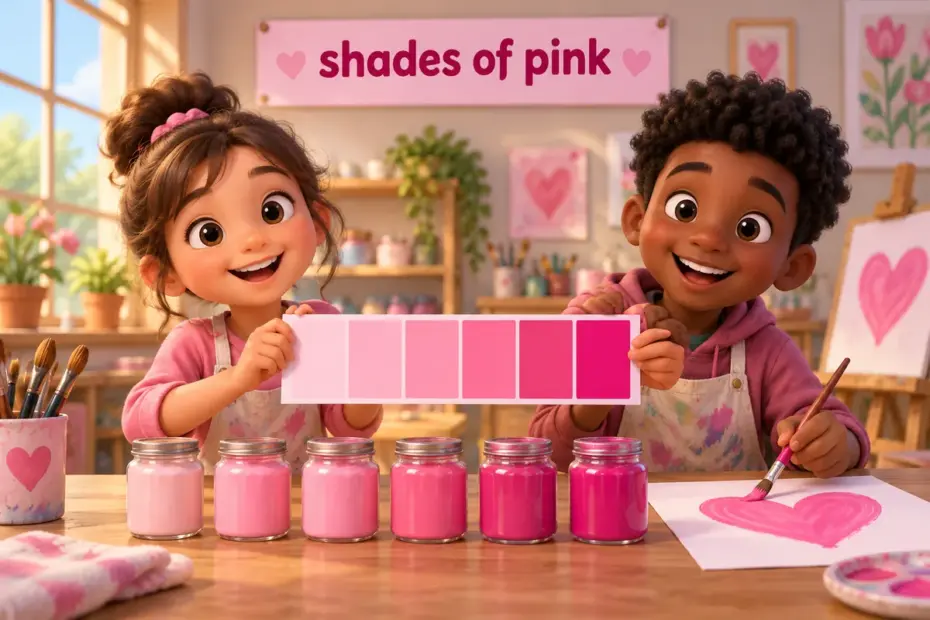
Pink color names with pictures often include baby pink, blush, rose, salmon, coral, hot pink and magenta, and each name points to a different strength of the same colour. Pink itself is a light red, so its names describe how much white or warmth the shade adds.
Pink color names with pictures at a glance
- Pink is a pale red, and its names come from flowers, food and natural objects.
- Soft names such as baby pink, blush and dusty rose describe light, muted shades.
- Strong names such as hot pink, fuchsia and magenta describe bright, saturated shades.
- Shade words work as adjectives, so a blush ribbon and a pink ribbon are both correct.
- The commonest error is using a colour word on its own without a noun to describe.
What does pink mean and how are the names built?
Pink is a pale red, and its many names come from flowers, food and everyday objects. Some names describe how light the shade is, while others describe how warm or how strong it is.
| Shade | Plain meaning | Strength | Everyday example |
|---|---|---|---|
| baby pink | very pale, soft pink | very light | a baby pink blanket |
| blush | soft warm pink | light | a blush wedding ribbon |
| rose | medium pink like the flower | medium | a rose silk scarf |
| salmon pink | pink with an orange tone | medium | a salmon pink shirt |
| coral pink | bright pink with orange | medium to strong | coral pink lipstick |
| hot pink | bold, saturated pink | strong | a hot pink sports bag |
| fuchsia | bright pink with a purple edge | strong | a fuchsia flower |
| magenta | deep pink-purple | strong | a magenta poster |
| dusty rose | muted grey pink | soft | a dusty rose cushion |
| flamingo pink | warm bright pink | strong | flamingo pink wall paint |
| bubblegum pink | light bright pink | light to strong | a bubblegum pink party hat |
Two of these names, fuchsia and magenta, sit between pink and purple, so a speaker may file them under either colour. Everything else stays clearly pink. For more words that describe the colour, the list of adjectives for pink collects them in one place.
How do you use pink color names in a sentence?
Shade words are adjectives, so they describe a noun or stand after the verb be. The table shows the patterns that appear most often.
| Pattern | Example | What it signals |
|---|---|---|
| pink as adjective | a pink dress | the simplest colour use |
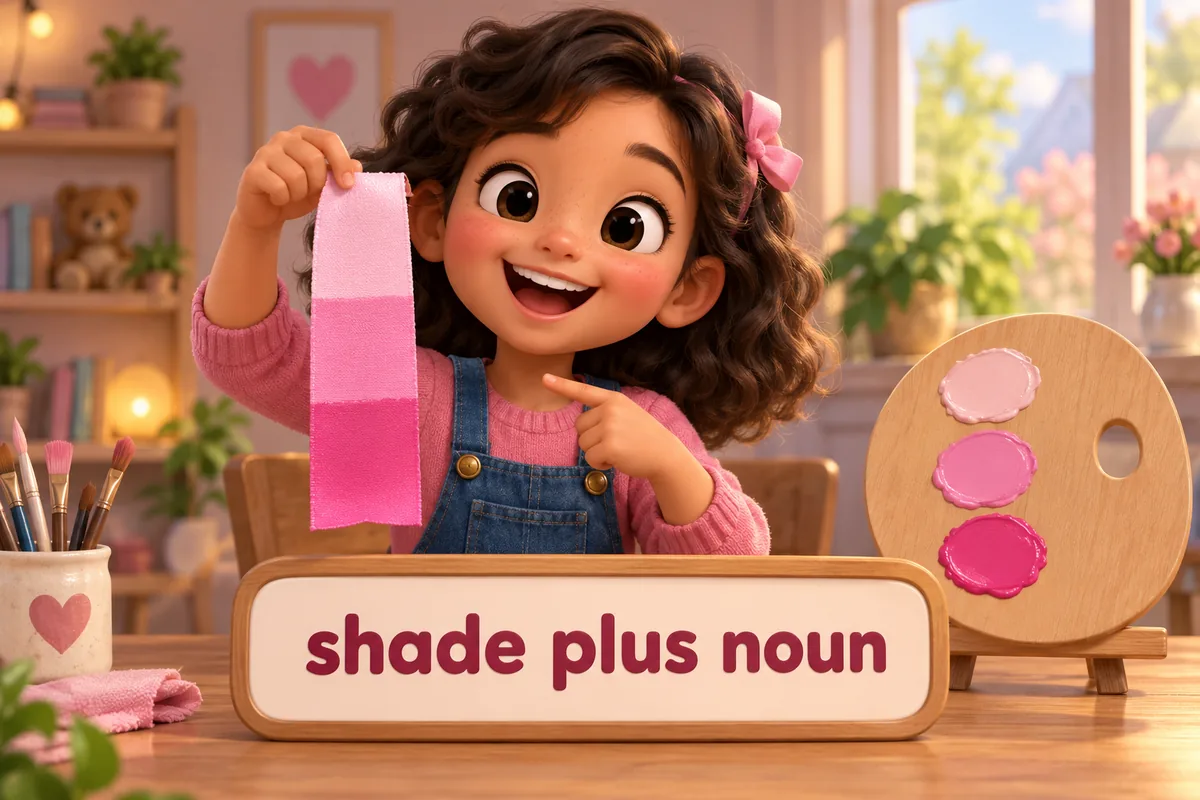
| shade + noun | a blush ribbon | a precise shade as a modifier |
| be + shade | The walls are rose. | describing a whole object |
| shade + of pink | a shade of pink | one tone within the colour |
| verb + pink | The sky turned pink. | a change of colour |
| in the pink | She is in the pink. | an idiom meaning healthy |
| blush as a verb | His cheeks blushed. | the colour as an action |
The idiom in the pink has nothing to do with clothing: it means in good health. Colour words such as rose and blush can also stand alone as adjectives, so a rose ribbon and a pink ribbon are both correct.
Pink color names in sentences across contexts
The names appear in art rooms, shops and gardens, and each setting uses the shade word in a particular way.
| Context | Example sentence | Why this works |
|---|---|---|
| Fashion | She wore a blush dress with grey shoes. | names a soft shade precisely |
| Art class | Mix white into red to make baby pink. | shows how the shade is made |
| Interior design | The nursery walls are dusty rose. | a muted shade as a whole colour |
| Nature writing | The cherry blossoms turned the path pale pink. | a colour change in a scene |
| Greeting card | Sending you a bunch of hot pink tulips. | a bold shade sets a mood |
| Science book | Petals look pink because they reflect red light. | links colour to light |
| Everyday speech | Her new phone case is bright pink. | a plain colour adjective |
| Poem | A rose sky faded to blush at dusk. | a poetic use of shade names |
| Recipe | Fold the mix until it is bubblegum pink. | colour as a cooking clue |
Register decides which name fits. A science book says pink and links it to reflected light, a fashion page says blush, and a party invitation may say bubblegum pink. Colour words behave like other descriptive words, and color adjectives explains the group.
Which word: pink, rose or magenta?
These three names overlap, so the difference lies in warmth, strength and the setting where each one sounds at home.
| Feature | pink | rose | magenta |
|---|---|---|---|
| Meaning | general pale red | pink named after the flower | strong pink-purple |
| Strength | light to strong | medium | strong |
| Warmth | can be cool or warm | warm | cool |
| Typical object | clothes and toys | ribbons and wine | posters and printing ink |
| Register | everyday | slightly literary | technical |
Use pink as the general word, rose when you want a warm, soft tone, and magenta when the shade leans purple and feels bold. The colour also appears in fixed phrases: a pink slip means a notice that a job has ended.
Word forms and grammar of pink words
Most shade names work as both nouns and adjectives, and a few build extra forms.
| Form | Part of speech | Example |
|---|---|---|
| pink | noun or adjective | The pink is too bright. |
| pinks | noun, plural | The garden showed many pinks. |
| pinkish | adjective | The sky had a pinkish glow. |
| rose | noun or adjective | She chose a rose tone. |
| rosy | adjective | His cheeks turned rosy. |
| blush | noun or verb | A blush spread across her face. |
| magenta | noun or adjective | Magenta is a printing ink. |
| fuchsia | noun or adjective | The fuchsia bloomed all summer. |
The verb blush means the colour comes to the face, while a blush is the pink mark on the cheeks. Pinkish is an adjective meaning slightly pink, and it never takes a plural. The plural pinks is rare and names several shades seen together.
Common mistakes with pink color names
Mistake 1: a colour with no noun. Incorrect: He bought a new pink. Correct: He bought a new pink shirt. Rule: a colour adjective needs a noun to describe.
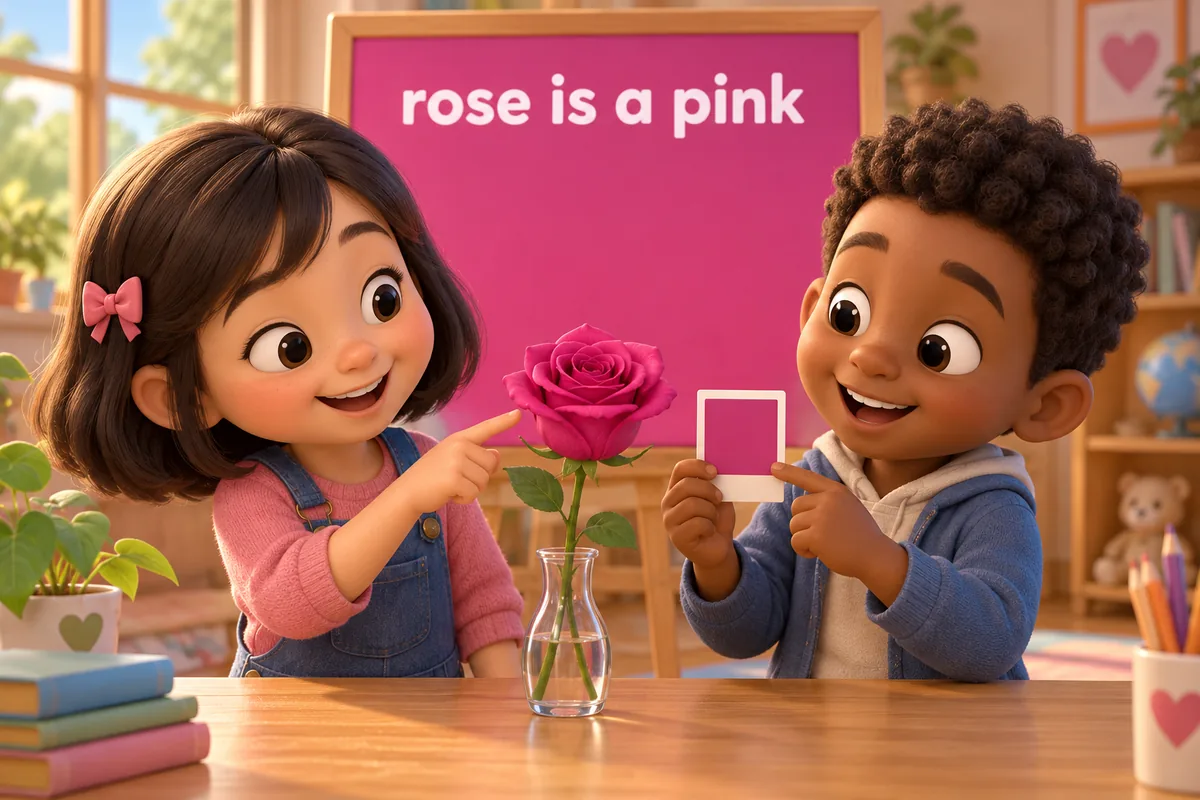
Mistake 2: rose and pink treated as separate colours. Incorrect: Rose and pink are completely different colours. Correct: Rose is a shade of pink. Rule: rose names one tone within pink.
Mistake 3: capitalising a shade name. Incorrect: The wall is Hot Pink. Correct: The wall is hot pink. Rule: ordinary colour names use lowercase letters.
Mistake 4: colour after the noun. Incorrect: a dress pink Correct: a pink dress. Rule: a colour adjective comes before the noun.
Mistake 5: the spelling of fuchsia. Incorrect: fuschia Correct: fuchsia. Rule: the word keeps a ch in the middle.
Practice using pink color names
- Fill in the blank: Mixing white with red makes ___ pink.
- Choose the better word: A soft muted pink is (hot pink / dusty rose).
- Correct the error: He bought a new pink.
- Build a sentence: use coral to describe a warm bright top.
- Spot the register: which suits a paint label, (a) kinda pinkish, or (b) coral pink, warm tone?
- Fill in the blank: A notice that a job has ended is a pink ___.
Answers
- baby, because adding white to red produces a very pale pink.
- dusty rose, because dusty rose is a muted, grey-toned pink.
- He bought a new pink shirt; a colour word needs a noun to describe.
- She chose a coral top for the warm weather.
- (b), because a paint label uses a precise shade name and tone.
- slip, because a pink slip is the fixed phrase for a job notice.
For the colour word itself, pink in a sentence shows more of the same patterns.
The bottom line
Pink color names with pictures run from the palest baby pink to the boldest magenta, and each name fixes a shade so readers can picture it. Rose, blush and dusty rose are soft tones, while hot pink and magenta are strong. Choose the shade word that matches the strength you mean.
Frequently asked questions about pink color names
What is the difference between pink and magenta?
The difference is warmth and strength: pink is a general light red, while magenta is a strong pink-purple that leans cool. Printers treat magenta as a primary ink, so it appears in technical writing as well as in everyday colour talk.
Is fuchsia the same as pink?
Fuchsia is a bright pink with a strong purple edge, so it is a shade of pink rather than a separate colour. The name comes from the fuchsia flower, and English spells the word with a ch in the middle.
What does it mean to be in the pink?
To be in the pink means to be in good health, not to be wearing the colour. The phrase is old and informal, and it usually appears in a sentence such as my grandmother is in the pink after her rest.
How many shades of pink are there?
Pink has no fixed total because people keep naming new shades after flowers, food and objects. Common lists show ten to twenty well-known names, including baby pink, blush, rose, salmon, coral, hot pink and magenta. Any single list is therefore only a snapshot of the shades in use at one time.