Back down means to stop defending a position or withdraw a demand once it meets resistance. To use back down in a sentence, name the person or group that yields and the issue they yield over: “The council backed down over the parking charge.” The phrase is intransitive, so no object ever follows the particle.
Back down at a glance
- Back down is an intransitive phrasal verb: the forms are back down, backed down and backing down, and it has no passive.
- The particle is fixed, so back a threat down is not English; the two words move as one unit.
- Typical subjects are a person, a company, a government, a union or a team under pressure.
- Common collocations are back down over a plan, back down on a promise and refuse to back down.
- The commonest learner error is adding a direct object, as in she backed down the argument.
What does back down mean?
Back down is a phrasal verb meaning to stop defending a position or abandon a demand when it meets resistance. The Cambridge entry for back down records that core sense of yielding, and two shades of it matter when you build a sentence: withdrawing a claim you made, and giving way in a confrontation. Neither shade implies that the person was wrong, only that they stopped pushing. Where a side gives way completely and formally, capitulate is the stronger verb, because it usually ends the dispute rather than pausing it.
| Sense | Plain meaning | Example sentence |
|---|---|---|
| Withdraw a demand | Stop insisting on something you asked for | The union backed down over the overtime rule. |
| Give way in a confrontation | Stop resisting a challenge from someone | The older boy backed down when the referee walked over. |
| Reverse a decision | Abandon a plan after objections | The council backed down and kept the library open. |
One limitation is worth stating plainly. Back down is not the same as lose. A negotiator can back down on one clause and still win the wider deal, and a government can back down over a fee without admitting that its policy was wrong. The verb describes the retreat, not the verdict.
How do you use back down in a sentence?
The verb never takes an object, so the subject is the only person named: somebody backs down. The particle stays glued to the verb, which means you cannot separate the two words or move the particle to the end. Five patterns cover almost every real sentence, and the negative refuse to back down is the one that appears most.
| Pattern | Example | What it signals |
|---|---|---|
| back down | The manager backed down at once. | The subject yields, and nothing follows the particle. |
| back down over + issue | Both sides refused to back down over pay. | Names the dispute rather than the person. |
| back down on + promise | He backed down on his pledge to resign. | Points to the specific commitment dropped. |
| refuse to back down | She refused to back down despite the pressure. | The negative form reads as resolve, not weakness. |
| back down from + challenge | The club backed down from the legal challenge. | A retreat from a confrontation that was already planned. |
Do not confuse back down with back off: you back off to stop pressuring somebody, but you back down to abandon your own position. Because the particle cannot move, the only question in a sentence is whether a subject yields, not where an object goes.
Back down in a sentence: examples across contexts
Back down keeps one meaning while the setting changes the stakes. The ten sentences below run from a playground to a boardroom, and each names the pressure that produced the retreat.
| Context | Example sentence | Why this works |
|---|---|---|
| Classroom | The class backed down from the dare when the teacher returned. | A mild setting shows that a confrontation can be trivial. |
| Workplace email | Management backed down over the new shift pattern after two meetings. | Over names the issue, which is the commonest collocation. |
| News report | The minister backed down on the toll increase within a day. | A public figure plus a deadline reads as straight reporting. |
| Negotiation | The buyer refused to back down on the delivery date. | Refuse to back down signals resolve rather than weakness. |
| Sports commentary | The captain never backed down from the challenge. | Back down from marks a contest that was already set. |
| Business writing | The supplier backed down on its price rise. | On points to the specific term that was dropped. |
| Politics | The party backed down over the health levy. | Over names the policy at the centre of the dispute. |
| Parenting | The child backed down once the rule was repeated. | A calm adult response ends the standoff. |
| Conversation | I thought he would argue, but he backed down. | The bare form is the one heard in speech. |
| History essay | The empire backed down rather than risk a wider war. | The verb captures a strategic retreat without drama. |
A retreat so complete that no position remains is better described with withdraw, which covers pulling out of a place or an arrangement as well as a debate.
Back down vs retreat, capitulate and back off
Four expressions describe giving ground, and each marks a different finish. retreat is a physical or strategic pull-back; capitulate is a formal surrender; back off is releasing pressure on somebody else; back down is abandoning your own position after opposition.
| Attribute | back down | retreat | capitulate |
|---|---|---|---|
| Core job | Abandon a position under pressure | Move back from danger or a contest | Surrender on stated terms |
| Who acts | A person, firm or government | An army, team or group | A defeated side |
| Ends the dispute | Sometimes | No | Usually |
| Takes an object | Never | Never | Never |
| Register | Neutral, common in news | Neutral to formal | Formal |
Where the retreat includes admitting a point, concede is the precise verb. Verdict: choose back down when someone stops defending a position, retreat when they physically or strategically pull back, and capitulate when the surrender is total and formal.
Word forms and grammar of back down
Back down is a phrasal verb, so it inflects on the verb and keeps the particle. Related phrasal verbs with the same base behave differently, which is why learners mix them up.
| Form | Part of speech | Example |
|---|---|---|
| back down | phrasal verb, base form | They will back down if we hold firm. |
| backed down | phrasal verb, past | The firm backed down after the review. |
| backing down | phrasal verb, present participle | Nobody enjoys backing down in public. |
| back-down | noun, rare | The back-down was reported as a climbdown. |
To back out is to withdraw from an agreement you already made, a different act from abandoning a position in a dispute. That difference is the reason the two phrasal verbs never swap places in careful writing.
Common mistakes with back down
- Incorrect:
She backed down the argument.Correct: She backed down from the argument. Rule: Back down is intransitive, so it never takes a direct object; use from to name what is abandoned. - Incorrect:
He has back down on his promise.Correct: He has backed down on his promise. Rule: The past participle is backed, formed on the verb rather than on the particle. - Incorrect:
The crowd backed down the speaker.Correct: The crowd backed down after the speaker answered. Rule: You cannot back another person down; the subject is always the one who yields. - Incorrect:
back a threat downCorrect: back down from a threat. Rule: The particle is fixed and cannot split from the verb. - Incorrect:
The government backed down itself.Correct: The government backed down. Rule: The verb is already intransitive, so no reflexive pronoun is needed.
Practice using back down
Work through the six items, then read the reasons that sit with the answers.
- Fill the gap: The company finally ______ over the booking fee.
- Choose the better word: When the pressure became personal, the witness (backed down / backed off).
- Correct the error: The team backed down the challenge.
- Build a sentence: use refuse to back down about a class election promise.
- Spot the register: which belongs in a news report — the minister backed down on the levy, or the minister totally caved?
- Rewrite the preposition: He backed down from his demand. Keep the meaning but change one word.
Answers
- backed down — over names the issue at the centre of the retreat.
- backed off — the witness stopped pressuring someone, so back off fits; back down would mean abandoning a position.
- The team backed down from the challenge — the verb needs from before what is abandoned.
- Model answer: The candidate refused to back down on the promise to add a crossing.
- The minister backed down on the levy — a report avoids totally and the word caved.
- He backed down over his demand — over and from both name what is given up.
The bottom line
Use back down in a sentence when somebody stops defending a position or drops a demand after resistance, and keep the phrase intransitive. Two details decide most sentences: the particle is fixed, so nothing can split it, and back down reports a retreat rather than a defeat. To describe the opposite, choose to persist.
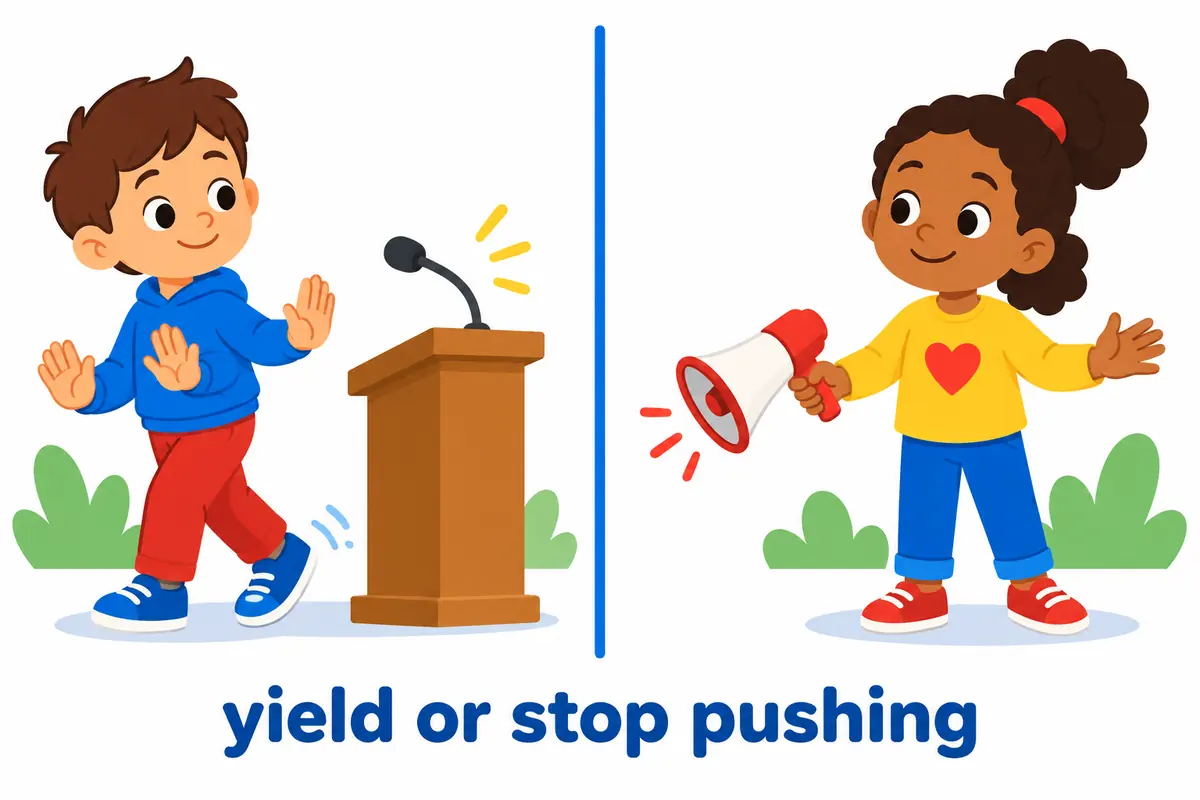
Frequently asked questions about back down
Is back down one word or two?
Back down is written as two words when it is the verb, as in they backed down. The noun is rare and usually hyphenated in the phrase a back-down, but most writers prefer climbdown for that meaning, so the two-word verb is the form you will normally need.
Can you back someone down?
No. Back down is intransitive, so you cannot back another person down. When one side pressures the other into giving way, the party who yields is still the subject: the manager backed down. To describe applying the pressure, use press, push or back off instead.
What is the difference between back down and back off?
Back down means abandoning your own position, while back off means stopping pressure on someone else. A negotiator who drops a demand backs down; a heckler who stops shouting backs off. The shared base verb is the only thing the two phrases have in common.
Does back down mean the same as give up?
Not exactly. Back down is narrower, because it always involves a position that someone else is challenging. Give up is broader and can describe abandoning a hobby, a search or an attempt with nobody opposing you. Use back down only when resistance causes the retreat.
Have you ever found yourself in a situation where you had to back down from a challenge or confrontation? This common expression, “back down,” refers to the act of withdrawing or retreating, often due to fear, pressure, or a realization of being overpowered.
When someone decides to back down, they choose to step away from a conflict or disagreement to avoid further escalation. It can signify a surrender or acknowledgment of defeat, but also a strategic retreat to prevent further confrontation. The phrase is widely used in various contexts, from personal relationships to business negotiations, to describe the action of yielding to avoid conflict.
7 Examples Of Back Down Used In a Sentence For Kids
- Back down from the slide carefully.
- Be brave and don’t back down from trying something new.
- Let’s encourage each other and not back down from challenges.
- It’s okay to ask for help if you feel like you need to back down.
- Sometimes we need to take a step back before we back down.
- Remember to take deep breaths when you feel like you want to back down.
- We can work together as a team so no one has to back down alone.
14 Sentences with Back Down Examples
- Back down from challenges and strive to overcome obstacles.
- In a debate, it is important to present your arguments confidently and not back down.
- Don’t back down from standing up for what you believe in.
- When it comes to negotiating grades with professors, it’s essential not to back down.
- Back down from risky behavior that could jeopardize your academic career.
- Always be ready to defend your ideas and opinions without backing down.
- It’s important for college students to have a strong resolve and not back down in tough situations.
- When faced with criticism, it’s crucial to handle it gracefully without backing down.
- College is a time to push yourself out of your comfort zone and not back down from new experiences.
- It’s easy to feel overwhelmed by the workload, but don’t back down from the challenge.
- In group projects, it’s important for everyone to contribute equally and not back down from their responsibilities.
- Stand up for yourself and your peers, and don’t back down in the face of injustice.
- When it comes to pursuing your dreams, don’t back down no matter how difficult the path may seem.
- College life can be filled with uncertainties, but it’s important to stay strong and not back down from pursuing your goals.
How To Use Back Down in Sentences?
Back Down means to retract or withdraw from a position or claim that has been taken. It is often used in situations where someone is changing their mind or giving in to pressure.
When using Back Down in a sentence, it typically follows a subject and verb. For example:
– “After realizing he was wrong, he backed down from his argument.”
– “The boss finally backed down and agreed to the employees’ demands.”
– “She refused to back down from her beliefs, despite the opposition.”
It is important to note that Back Down is a phrasal verb, which means it is made up of multiple words that function as a single unit with a specific meaning. It is not appropriate to separate the words “back” and “down” when using this phrase.
Back Down can also be used in different tenses, such as:
– Present: “He always backs down from a challenge.”
– Past: “She backed down after realizing her mistake.”
– Future: “If he continues to argue, he will eventually back down.”
Overall, using Back Down in a sentence is a way to convey the idea of retracting or relenting in a situation. By understanding how to properly use this phrase, you can effectively communicate your message in English.
Conclusion
In conclusion, the examples of sentences with “back down” illustrate instances where individuals choose to retreat from a confrontation or decision. These examples highlight scenarios where people concede or withdraw from a position to avoid conflict or difficulties. “Back down” signifies a willingness to compromise, show humility, or reassess one’s stance in order to de-escalate a situation. Understanding when to back down can be a valuable skill in maintaining relationships, resolving disputes, or preventing unnecessary tension.
By examining how “back down” is used in different contexts, it becomes apparent that this phrase carries connotations of compromise, humility, and conflict resolution. Whether in personal interactions or professional environments, knowing when to back down can lead to smoother communication, cooperation, and a more amicable outcome.