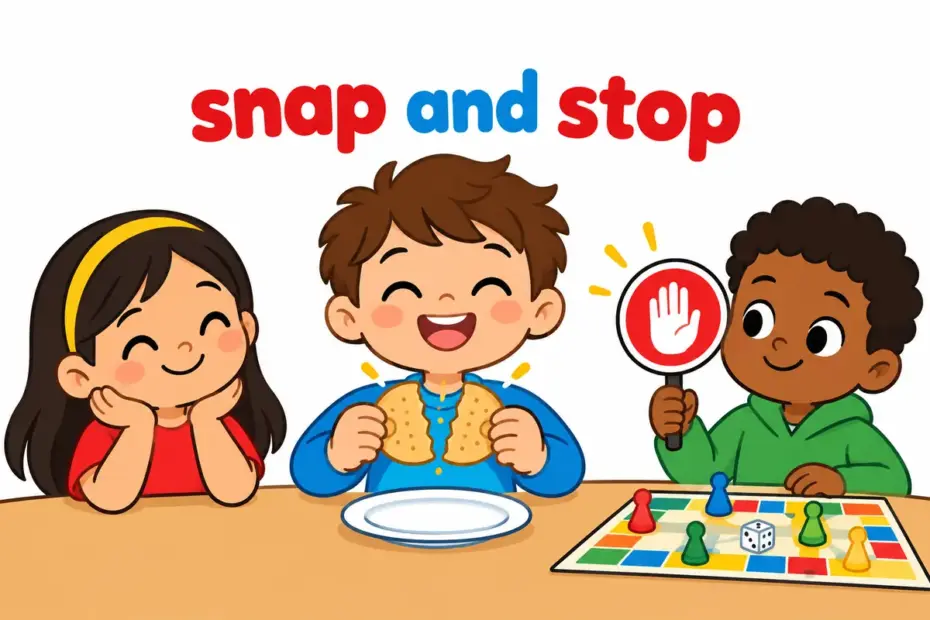
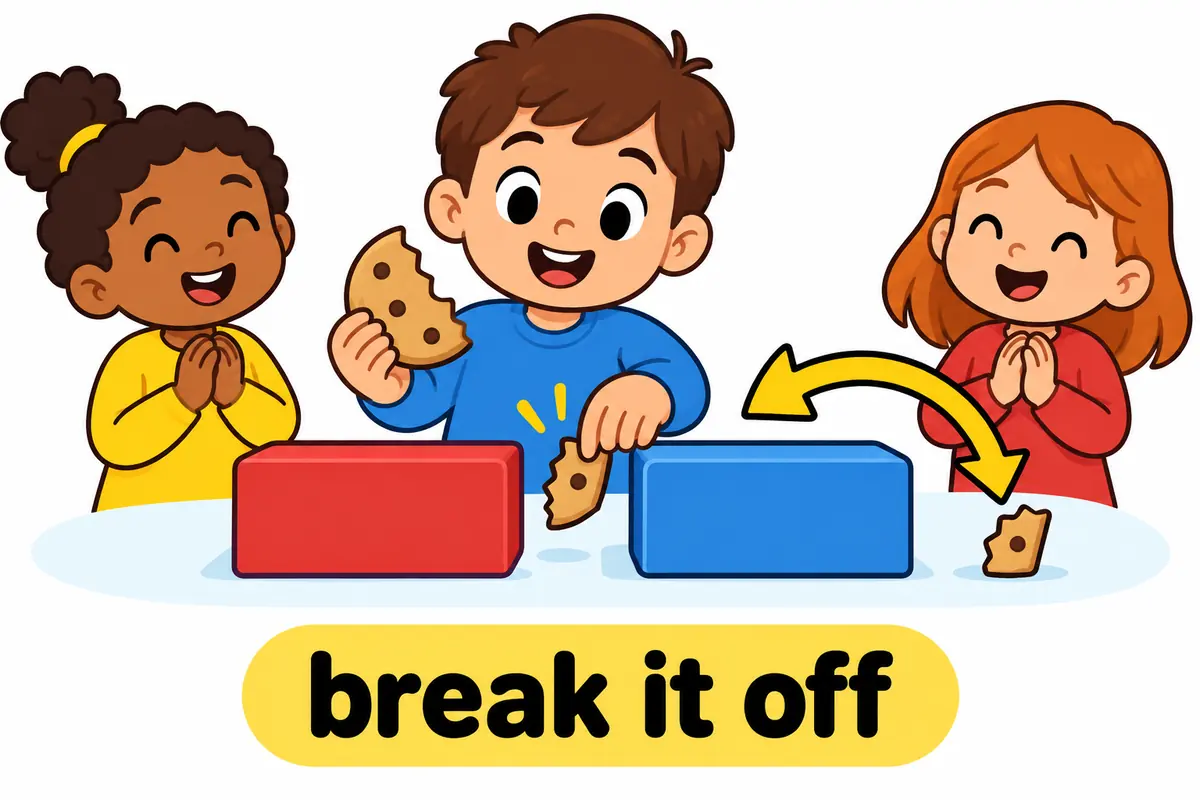
Break off is a phrasal verb meaning to separate a piece, to stop suddenly, or to end something before it is finished. To use break off in a sentence, name what stops or what is separated: “She broke off the engagement in June.” The object may sit between the two words, so “break it off” is equally correct.
Break off at a glance
- Break off is a separable phrasal verb.
- Its forms are break off, breaks off, broke off, broken off and breaking off.
- With a piece, the object may follow off or sit between break and off.
- With talks or an engagement, it means stop before completion.
- Used intransitively, a part can break off by itself, as a branch does in wind.
- The commonest error is the irregular past, writing breaked for broke.
What does break off mean?
Break off is a phrasal verb meaning to detach a piece or to stop an activity abruptly. The Cambridge entry for break off lists both the physical sense and the sense of ending talks or relations suddenly, and it records the intransitive use as well. The object after the phrase decides which reading a reader takes.
| Sense | Plain meaning | Example sentence |
|---|---|---|
| Separate a piece | remove a part by breaking it | He broke off a corner of the bread. |
| Stop speaking | pause suddenly mid-sentence | She broke off when the phone rang. |
| End abruptly | stop talks, relations or an engagement | The two sides broke off talks. |
| Detach by itself | come away from the whole | A branch broke off in the wind. |
| Separate from a group | leave a larger body or party | A faction broke off from the party. |
Break off always carries a note of abruptness, so it is the wrong verb for a planned, orderly ending. A meeting that simply reaches its close is ended or concluded; one that stops in the middle is broken off. In formal writing about a tidy separation, sever fits relations and detach fits a physical part.
How do you use break off in a sentence?
Separability is the key fact. With a piece or a tie, the object can move; without an object, the part simply comes away. The object never appears after from, which marks a group rather than a thing.
| Pattern | Example | What it signals |
|---|---|---|
| break off + object | He broke off a piece of chocolate. | Separate a part; the object may also sit between the words. |
| break + object + off | He broke a piece off. | The separated order proves the phrase is separable. |
| break off + talks or ties | The union broke off negotiations. | End a process abruptly before it is finished. |
| break off, no object | The handle broke off. | A part detaches by itself; the verb is intransitive. |
| break off from + group | The group broke off from the main party. | Separate from a larger whole; from is fixed. |
One caution follows from the two orders. “Broke off a piece” and “broke a piece off” mean the same, but “broke off talks” and “broke talks off” differ in rhythm, and only the second sounds spoken. Where the object is a pronoun, English forces it between the words: write “break it off”, never “break off it”.
Break off in a sentence: examples across contexts
The phrase changes weight with its object. Each row shows where break off belongs and why.
| Context | Example sentence | Why this works |
|---|---|---|
| Kitchen | She broke off a square of chocolate for each child. | The physical sense separates a small part from a whole. |
| News report | The two governments broke off talks after one day. | It records a sudden halt to a formal process. |
| Fiction | He broke off in the middle of a sentence. | No object is needed when speech simply stops. |
| Relationship | They broke off the engagement last spring. | It marks an abrupt end to a commitment. |
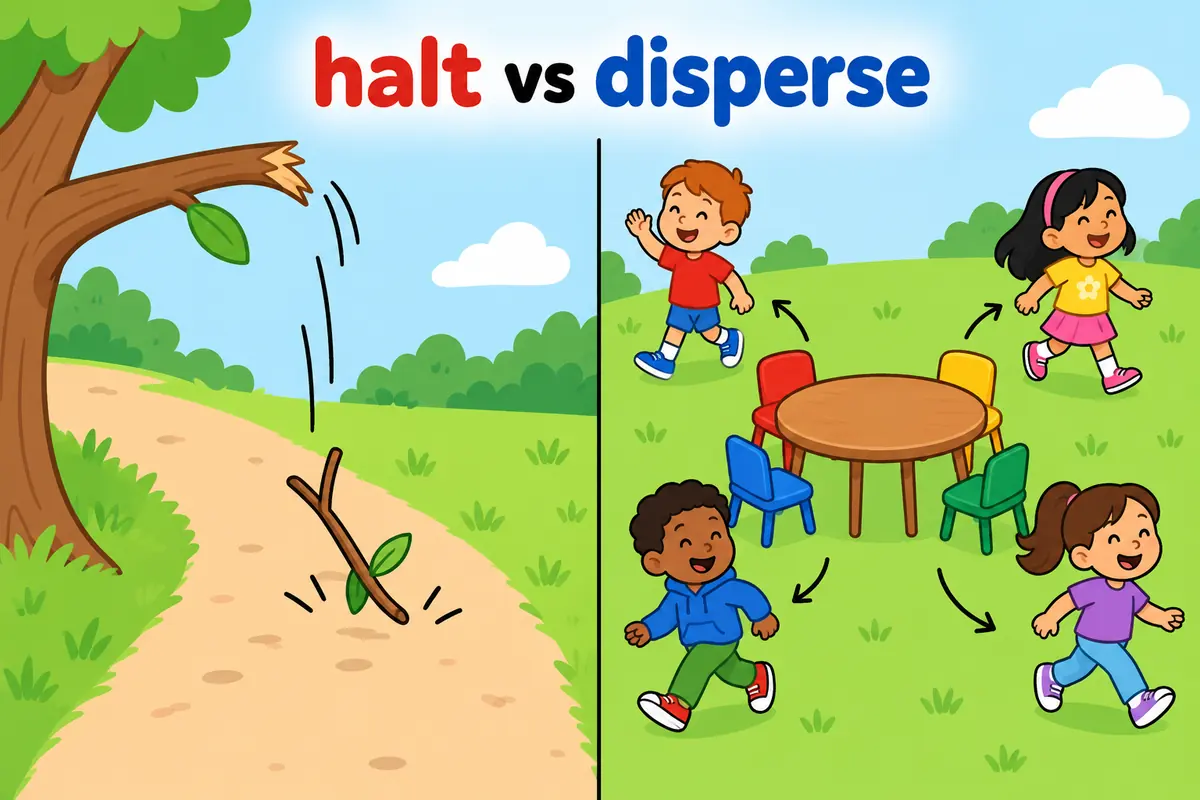
| Gardening | A dry twig broke off and fell to the path. | The intransitive form shows a part coming away alone. |
| Politics | A small faction broke off from the main party. | The from phrase marks separation from a group. |
| Workplace | We had to break off the meeting for a fire drill. | It explains an interruption the speaker did not plan. |
| Sports report | The striker broke off contract talks overnight. | It signals a sudden breakdown in negotiation. |
| Technical writing | The connector can break off if it is bent. | The passive risk is clear in the intransitive sense. |
| Conversation | Let us break off here and resume tomorrow. | It closes a session at a natural but early point. |
Where a break is planned rather than sudden, a plainer verb serves better. To separate parts is neutral, to resume is the natural partner of breaking off, and to attach is its exact opposite when a piece is joined again.
Break off vs break up
Both phrases end something, which is why learners reach for the wrong one. The difference is what ends and how.
| Attribute | Break off | Break up |
|---|---|---|
| Core meaning | stop a process or take away a piece | end a union or disperse a group |
| What ends | talks, a sentence, an engagement | a couple, a crowd, a meeting |
| Abruptness | sharp and unfinished | often mutual or gradual |
| Other sense | a part snaps away | a signal breaks into pieces |
| Typical object | a single item or a negotiation | a relationship or a gathering |
Use break off when something stops before it is complete, and break up when something that held together comes apart. Talks are broken off; a couple breaks up. The same base verb carries the other common partner, break down, which means a machine fails or a system collapses.
Word forms and grammar of break off
The verb is irregular, and the family of break-verbs splits sharply by particle.
| Form | Part of speech | Example |
|---|---|---|
| break off | base phrasal verb | Do not break off the discussion yet. |
| breaks off | third person singular | He breaks off whenever he is interrupted. |
| broke off | simple past | They broke off the match at half time. |
| broken off | past participle | The talks have been broken off. |
| breaking off | present participle | Breaking off the deal cost them dearly. |
| break off from | fixed phrase plus from | One region broke off from the union. |
The base verb carries several unrelated partners: break up ends a relationship, and break in enters by force, so the particle alone decides the meaning. The reversed particle appears elsewhere too: to back off is to retreat, not to detach a piece.
Common mistakes with break off
- Incorrect: The pipe breaked off in the frost. Correct: The pipe broke off in the frost. Rule: break is irregular, with broke as the past and broken as the participle.
- Incorrect: The talks have been break off. Correct: The talks have been broken off. Rule: a passive needs the participle broken, not the base form.
- Incorrect: Break off it before it snaps. Correct: Break it off before it snaps. Rule: a pronoun object must sit between break and off.
- Incorrect: The union broke off from the negotiations. Correct: The union broke off the negotiations. Rule: from marks separation from a group, not an end to talks.
- Incorrect: They will break off the meeting as planned at five. Correct: They will end the meeting as planned at five. Rule: break off implies a sudden stop, not a scheduled one.
- Incorrect: A shale piece broke itself off the cliff. Correct: A shale piece broke off the cliff. Rule: the intransitive verb already means it came away, so no reflexive pronoun is needed.
Practice using break off
Seven exercises. Decide whether a piece is separated or a process stopped, then check the reason in each answer.
- Fill in the blank: She ______ ______ a corner of the biscuit for her brother.
- Choose the better word: The partners (broke off / broke up) the merger talks after an hour.
- Correct the error: Break off it before the branch falls.
- Build a sentence: describe someone stopping in the middle of a speech.
- Spot the register: which sentence belongs in a formal report, “Talks were broken off” or “Talks got broken off”?
- Fill in the blank: One small group ______ ______ from the main club last year.
- Correct the error: The rope breaked off under the strain.
Answers
- broke off. The object follows off, and the past tense shows the completed action.
- broke off. A negotiation stops mid-way; break up would mean a group or couple came apart.
- Break it off before the branch falls. A pronoun must go between the verb and the particle.
- She broke off in mid-sentence. No object is needed when speech simply stops.
- The first. Formal reports avoid the informal got passive.
- broke off. The from phrase marks separation from a larger group.
- The rope broke off under the strain. The irregular past is broke, not breaked.
The bottom line
Break off in a sentence is a separable phrasal verb that means to detach a piece, to stop speaking, or to end talks, ties or an engagement abruptly. The object may follow off or sit between break and off, and a pronoun must take the middle slot. Choose end or separate when the break is orderly, and break up when a group or couple comes apart.
Frequently asked questions about break off
Is break off a separable phrasal verb?
Yes. In the sense of separating a piece or a tie, the object may follow off or go between break and off, as in “broke off a piece” and “broke a piece off”. A pronoun is forced into the middle, so “break it off” is correct and “break off it” is not.
What is the past tense of break off?
The past tense is broke off and the past participle is broken off. Break is irregular, so breaked is never correct. A completed act is “they broke off the talks”, and a passive result is “the talks were broken off” or “the talks have been broken off”.
Does break off mean the same as break up?
No. Break off stops something that is still underway, such as talks, a sentence or an engagement, and it also means detaching a piece. Break up ends a relationship or disperses a group, and it often suggests something coming apart rather than being halted. The objects rarely overlap.
Can you break off a conversation?
Yes. To break off a conversation is to stop it before it reaches its natural end, often because of an interruption or a decision. The phrase can take the conversation as an object, as in “we broke the conversation off”, or stand alone, as in “she broke off suddenly”. Both are standard.
Have you ever heard the term “break off” in a conversation or while reading a text and wondered what it means? To break off typically refers to the action of separating, disconnecting, or ending something abruptly or forcefully.
In various contexts, to break off can imply the interruption of a physical object or a relationship. This phrasal verb can describe halting a conversation, stopping a process, or even severing a piece from a whole.
7 Examples Of Break Off Used In a Sentence For Kids
- Break off a piece of your favorite snack for your friend.
- Remember to break off a small part of your chocolate to share.
- Break off a flower from the garden to give to your mom.
- Can you break off a piece of paper for me, please?
- Let’s break off a tiny bit of the crayon to draw with.
- It’s important to break off a small piece of the cookie to save for later.
- Don’t forget to break off a little piece of the pencil when you sharpen it.
14 Sentences with Break Off Examples
- Break off all relationships that are not healthy or beneficial for your mental well-being.
- It’s important to break off studying and take short breaks in between to avoid burnout.
- Don’t hesitate to break off conversations that are making you uncomfortable or causing distress.
- Sometimes it’s necessary to break off from social media and focus on your studies.
- Remember to break off from your group study sessions if they are becoming unproductive or distracting.
- It’s okay to break off from extracurricular activities if they are causing you too much stress.
- Make sure to break off from your phone and other distractions during important lectures or seminars.
- Try to break off from negative thought patterns that can affect your mental health.
- Take the time to break off from your routine and explore new hobbies or activities.
- If you feel overwhelmed, it’s okay to break off from your coursework and seek help from a counselor or mentor.
- It’s crucial to break off from toxic friendships or relationships that are holding you back.
- Don’t be afraid to break off from your study group if they are not motivating you to do your best.
- Remember to break off from your busy schedule and take time for self-care and relaxation.
- Sometimes it’s necessary to break off from your part-time job to focus on your academics during exam season.
How To Use Break Off in Sentences?
To use Break Off in a sentence, start by identifying the action you want to describe as breaking off. This could be a relationship, a piece of something, or a conversation. Next, find the subject of the action – the person or thing that is doing the breaking off. Finally, choose the appropriate tense for your sentence depending on whether the action is happening now, has already happened, or will happen in the future.
For example:
– Present tense: “She decides to break off her engagement before the wedding.”
– Past tense: “I broke off a piece of the chocolate bar and shared it with my friend.”
– Future tense: “They are planning to break off negotiations if their demands are not met.”
Remember, when using Break Off in a sentence, it is important to make sure that the context is clear so that the reader or listener understands what is being broken off. You can provide additional information or details to help clarify the situation.
With practice, you will become more comfortable with using Break Off in your sentences and be able to convey your thoughts and ideas effectively.
Conclusion
In summary, “break off” refers to the act of separating or discontinuing something. This phrase can be used in various contexts, such as ending a relationship, terminating a conversation, or even physically detaching a part from something else. For example, “They decided to break off their engagement,” “Let’s break off for now and continue the discussion tomorrow,” or “She accidentally broke off a piece of the puzzle.”
Understanding the usage of “break off” in different situations can help communicate clearly and effectively. Whether it’s about splitting from a commitment, interrupting a dialogue, or causing a physical separation, incorporating this phrase into one’s vocabulary allows for concise and precise expression of actions involving detachment or cessation.