
Hearken is an old verb meaning to listen carefully or to give serious attention to a warning, request or call. To use hearken in a sentence, pair it with to and name what is heard: “The board refused to hearken to the parents’ complaint.” The word survives in formal, literary and journalistic writing rather than everyday speech.
Hearken at a glance
- Hearken is an intransitive verb; its forms are hearkens, hearkened and hearkening.
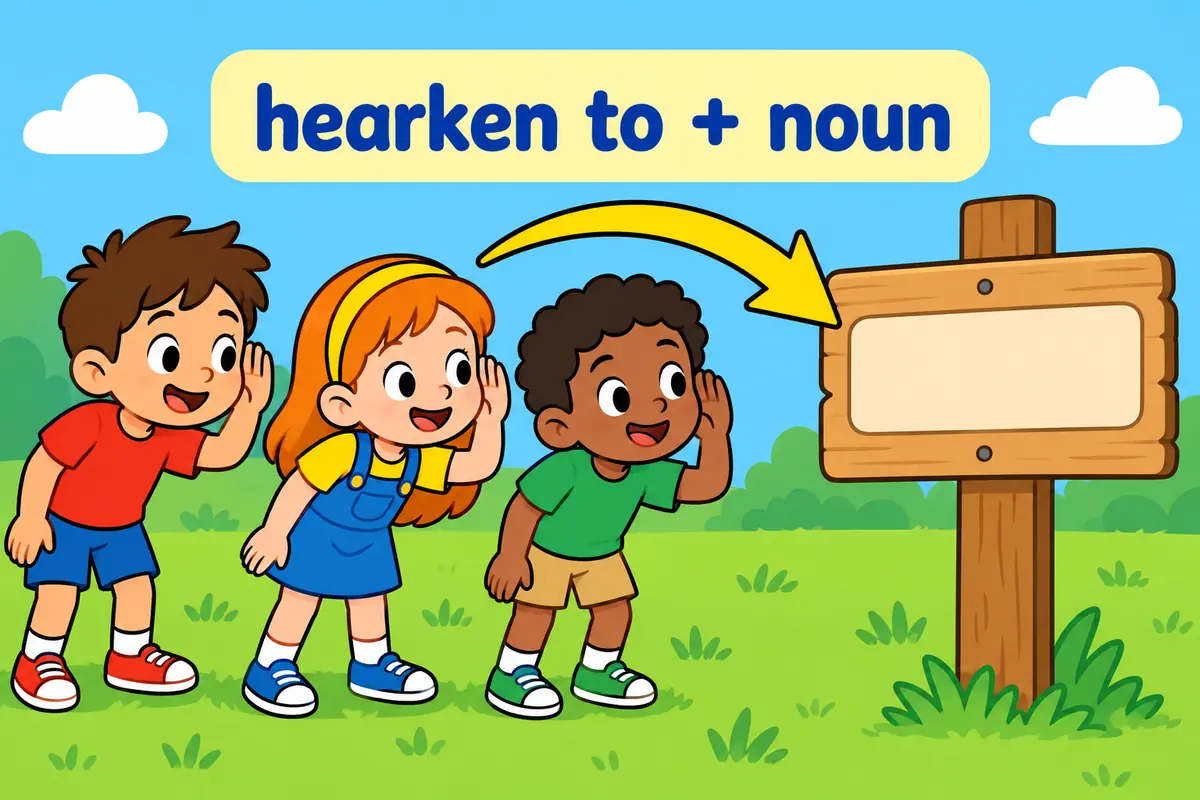
- The dominant pattern is hearken to plus a noun: hearken to advice, hearken to a warning.
- A second fixed use is hearken back to, meaning to recall an earlier time or style.
- The usual subjects are people, councils and courts, or writers and historians in hearken back to.
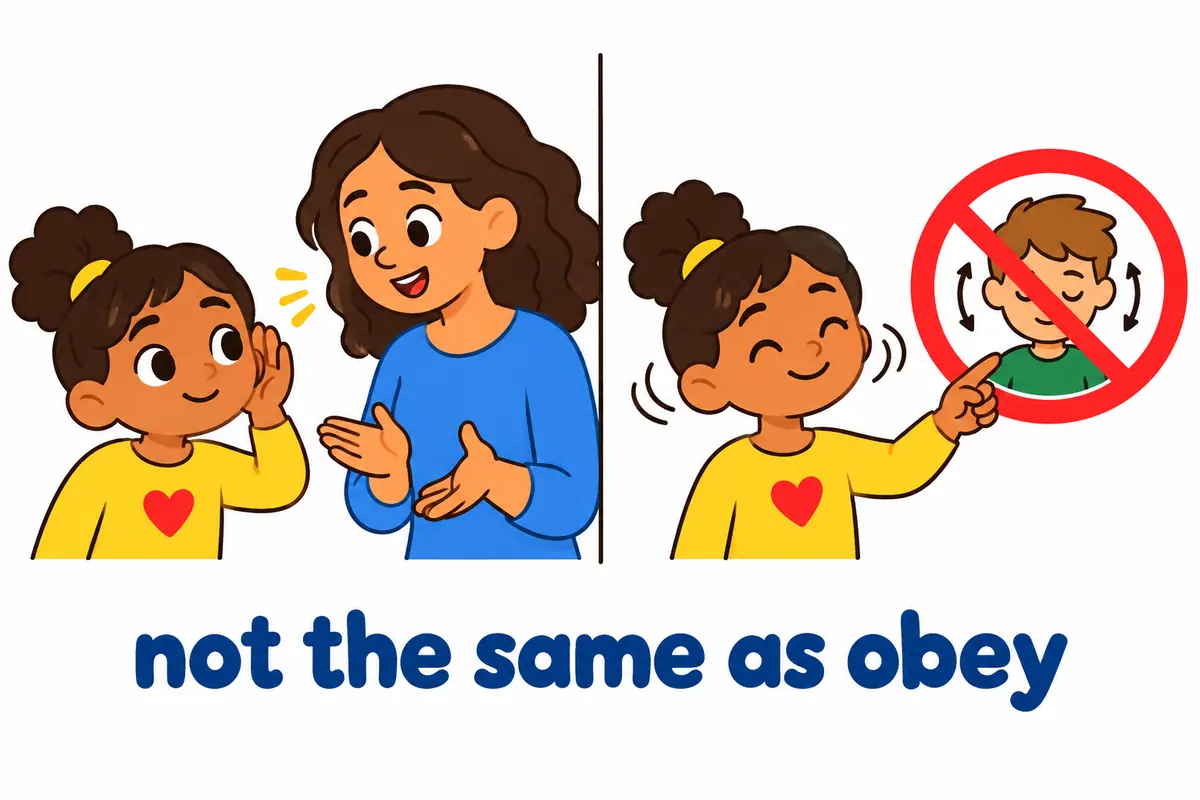
- The commonest error is treating hearken as a synonym for obey, when it only means to listen.
What does hearken mean?
Hearken is an intransitive verb meaning to listen attentively or to give heed to what is said. The Cambridge entry for hearken records this listening sense, and it is the one that matters today: the verb describes the act of paying attention, not the act of agreeing. In older texts it also appears as a bare imperative, “Hearken!”, calling a crowd to silence.
| Sense | Plain meaning | Example sentence |
|---|---|---|
| Listen and heed | Give careful attention to words or a warning | The villagers hearkened to the shepherd’s warning. |
| Recall an earlier time | Return in style or spirit to the past | The design hearkens back to the steam age. |
One limitation is worth stating plainly. Hearken does not mean obey, and it does not name hearing by accident: it records deliberate attention, so a person can hearken to advice and still reject it. Its shorter cousin hark survives today mainly in one old Christmas carol.
How do you use hearken in a sentence?
Hearken takes no direct object, so a sentence needs the preposition to before whatever is heard. Three patterns cover almost every real use, and the first is by far the most common.
| Pattern | Example | What it signals |
|---|---|---|
| hearken to + noun | The committee hearkened to the residents. | Attention given to a person, plea or warning. |
| hearken (bare imperative) | Hearken, and you will understand. | An archaic or literary call for silence. |
| hearken back to + noun | The festival hearkens back to medieval fairs. | A deliberate echo of an earlier period. |
Writers who want the modern, neutral version of the same idea reach for heed the warning, which fits direct speech far better and carries no archaic flavour.
Hearken in a sentence: examples across contexts
Hearken barely changes meaning, but its tone shifts with the setting. The nine sentences below keep the same verb while moving from a classroom to a history essay, and each names what is heard.
| Context | Example sentence | Why this works |
|---|---|---|
| Classroom | The teacher asked the class to hearken to the safety rules before the trip. | A formal verb suits an instruction from an adult. |
| Workplace email | Managers did not hearken to the maintenance team, and the roof leaked. | Names the ignored warning, which explains the consequence. |
| News report | The council hearkened to days of protest and scrapped the scheme. | A public body as subject matches the word’s formal tone. |
| Literature | “Hearken,” said the old sailor, “and I will tell you a true tale.” | The bare imperative reproduces older narrative style. |
| Public speech | We must hearken to the scientists who warned of the flood. | The verb lends gravity to a public argument. |
| Legal writing | The tribunal hearkened to the claimant’s evidence before ruling. | Attention, not obedience, is what the verb records. |
| History essay | The new law hearkens back to a charter signed in 1215. | The hearken back to sense marks an echo of the past. |
| Music review | The melody hearkens back to folk songs of the last century. | The same pattern applies to style, not only to events. |
| Conversation | “Just hearken to this,” she said, half joking. | In speech the word appears only as a deliberate arch choice. |
Hearken vs listen
Hearken overlaps with listen and is interchangeable with it almost never, because the two words sit in different registers. Listen is the everyday verb; hearken is the literary one. The opposite of hearkening is not speaking but disregarding what is said.
| Attribute | hearken | listen |
|---|---|---|
| Core act | Give careful heed | Receive sound with attention |
| Register | Archaic, literary, formal | Neutral, everyday |
| Object | Needs to before the thing heard | Can take to or stand alone |
| Frequency | Rare, mostly in fixed phrases | Extremely common |
| Typical subject | Councils, courts, crowds, writers | Anyone |
| Implies obedience | No, only attention | No, only attention |
Verdict: choose listen in everyday writing, and keep hearken for lines that gain from an old, formal weight.
Word forms and grammar of hearken
The verb inflects regularly, but it has no everyday noun, so writers who need one reach for hear or attention instead of inventing a new form.
| Form | Part of speech | Example |
|---|---|---|
| hearken | verb, base form | They will not hearken to reason. |
| hearkens | verb, third person singular | She hearkens to every rumour. |
| hearkened | verb, past and past participle | The king hearkened to his advisers. |
| hearkening | verb, present participle | The crowd stood hearkening in the square. |
| hearken back | fixed verb phrase | The design hearkens back to older models. |
| no common noun | no everyday noun form | Use attention where a noun is required. |
Common mistakes with hearken
- Incorrect:
The students hearkened the teacher.Correct: The students hearkened to the teacher. Rule: Hearken is intransitive, so it needs to before the thing heard. - Incorrect:
Soldiers must hearken orders.Correct: Soldiers must hearken to orders. Rule: The preposition to carries the object this verb cannot take directly. - Incorrect:
He hearkened the engine get louder.Correct: He heard the engine get louder. Rule: Hearken cannot take a that-clause; use hear for physical sound. - Incorrect:
The bread will hearken in the oven.Correct: The bread will harden in the oven. Rule: Harden means to become hard; hearken means to listen.
Practice using hearken
Work through the six items, then check the reasoning rather than only the answer.
- Fill the gap: The mayor refused to ______ to the petition.
- Choose the better word: In a chat with a friend you would say (listen / hearken) to this song.
- Correct the error: The crew hearkened the captain’s final order.
- Build a sentence: use hearken to about a warning nobody took seriously.
- Spot the register: which suits a formal toast – We hearken to the wisdom of our elders, or We listen to old people?
- Rewrite with the fixed phrase: The new logo recalls the company’s first badge. Use hearken back to.
Answers
- hearken – the verb needs to before the thing heard.
- listen – hearken is too archaic for a casual chat.
- The crew hearkened to the captain’s final order – hearken is intransitive.
- Model answer: The town council hearkened to the engineer’s warning about the dam.
- We hearken to the wisdom of our elders – the archaic verb matches a formal toast.
- The new logo hearkens back to the company’s first badge – the fixed phrase points to the past.
The bottom line
Use hearken in a sentence when you want an old, formal verb for listening with attention, and always give it the preposition to. Two points decide most sentences: hearken is intransitive, so it cannot take a direct object, and it records attention rather than obedience. For everyday writing, listen is the safer choice, while hearken back to remains a tidy way to point at the past.
Frequently asked questions about hearken
Is hearken still used today?
Hearken survives mainly in fixed phrases such as hearken to and hearken back to. Journalists use hearken back to when describing a revival of an older style, and public speakers use hearken to for extra weight. Outside those settings it sounds archaic, so modern writing usually prefers listen.
What is the difference between hearken and hark?
Hark and hearken share an old root and a listening sense. Hark is the shorter form and now appears almost only in set calls such as the one in a Christmas carol. Hearken is the fuller verb and keeps a small working life in hearken to and hearken back to.
Does hearken take an object?
No. Hearken is intransitive, so it does not take a direct object. The thing that is heard follows the preposition to, as in hearken to a warning. Omitting to, as in hearken the warning, is the mistake learners make most often with this word.
What does hearken back to mean?
Hearken back to means to recall, imitate or return to something from the past. A building may hearken back to an older style, or a rule may hearken back to an earlier law. Here back is part of the fixed phrase and cannot be dropped without changing the meaning.
Have you ever come across the word “hearken” in your reading and wondered what it means? In a nutshell, “hearken” is a verb that implies listening or paying attention to something.
Derived from Old English, “hearken” is often used in a more formal or poetic context to emphasize the act of carefully listening or taking heed of what is being said. It signifies a sense of attentiveness and consideration, urging the listener to truly tune into the message being conveyed.
7 Examples Of Hearken Used In a Sentence For Kids
- Hearken to the sound of the birds chirping outside.
- Can you hearken to the music playing in the background?
- Let’s hearken to the teacher’s instructions carefully.
- We must hearken to our parents when they speak to us.
- Hearken to the rain tapping on the window pane.
- Hearken to the wind blowing through the trees.
- It is important to hearken to safety rules at all times.
14 Sentences with Hearken Examples
- Before making any important decisions, hearken to the advice of your professors.
- Hearken to the wise words of your seniors who have already gone through the college experience.
- It is important to hearken to the feedback given by your peers to improve your academic performance.
- Before submitting your assignments, hearken to the guidelines provided by your professors.
- Hearken to the guest speakers who come to campus to share their insights and experiences.
- It is crucial to hearken to the instructions given by the exam invigilators during your exams.
- Hearken to the campus announcements for important updates about events and deadlines.
- Before joining any clubs or societies, hearken to the information provided during the orientation sessions.
- Hearken to the online resources available for additional study materials and resources.
- When faced with challenges, hearken to the counseling services provided by the college for support.
- Hearken to the career guidance sessions offered by the placement cell for valuable insights into future opportunities.
- It is advisable to hearken to the academic regulations set by the college to avoid any penalties.
- Hearken to the recommended reading list provided by your course instructors for a deeper understanding of the subject.
- Before embarking on any projects, hearken to the project guidelines given by your mentors.
How To Use Hearken in Sentences?
To use Hearken in a sentence, follow these steps:
-
Identify the appropriate context: Determine the topic or situation where you want to use the word “hearken.” This could be while discussing listening, paying attention, or following advice.
-
Understand the meaning: Hearken means to listen, pay attention, or take heed of something. It often implies giving careful consideration to a message or suggestion.
-
Construct your sentence: Create a grammatically correct sentence that includes the word “hearken” at the appropriate place. For example, “I always hearken to my grandmother’s wise advice.”
-
Check for clarity: Make sure that the sentence makes sense and conveys the intended meaning clearly. You can ask yourself if the sentence effectively communicates the idea of listening or paying attention.
-
Practice using the word: Incorporate “hearken” into your conversations, writing, or daily interactions to become more comfortable with using it naturally.
-
Seek feedback: Ask for feedback from friends, teachers, or language partners on how you use the word “hearken” in a sentence. This can help you refine your usage and understanding.
Remember, the word “hearken” is more formal and literary compared to everyday language. It can add a touch of sophistication to your writing or speech. Practice using it in various contexts to become more confident in utilizing this unique term.
Conclusion
In conclusion, the examples of sentences with the word “hearken” demonstrate how this old-fashioned term is used in contemporary writing to convey a sense of listening, paying attention, or obeying. Whether it is in a literal or figurative context, “hearken” adds a touch of formality and seriousness to a statement, making it stand out from more common synonyms like “listen” or “pay attention.”
By exploring different examples of how “hearken” is used, we can appreciate its unique role in language and the nuances it brings to communication. Its presence in literature and everyday language serves as a reminder of the rich history and diversity of the English language, showcasing how even uncommon words can add depth and flair to our expressions.