Nonchalant in a Sentence: Meaning & Examples
Nonchalant describes someone who appears calm, relaxed and casually unconcerned, and you use nonchalant in a sentence to describe a cool manner. A nonchalant shrug hides strong feeling: “She gave a nonchalant wave and walked on.” The adjective usually follows a linking verb or names a manner in a noun phrase.
Nonchalant at a glance
- Nonchalant is an adjective; its adverb is nonchalantly and its noun is nonchalance.
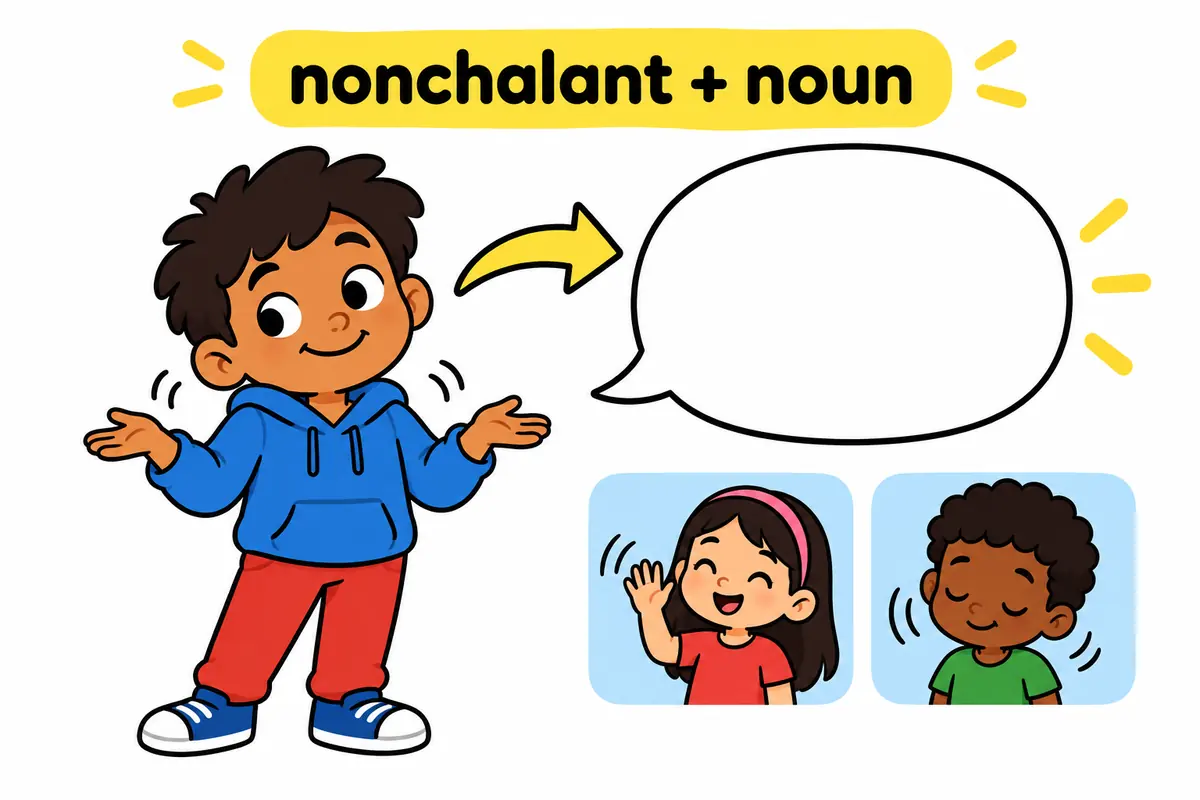
- The dominant pattern is a nonchalant plus a noun, as in a nonchalant shrug.
- The word can describe real calm or a deliberately feigned indifference.
- Common collocations are nonchalant attitude, nonchalant shrug and nonchalant manner.
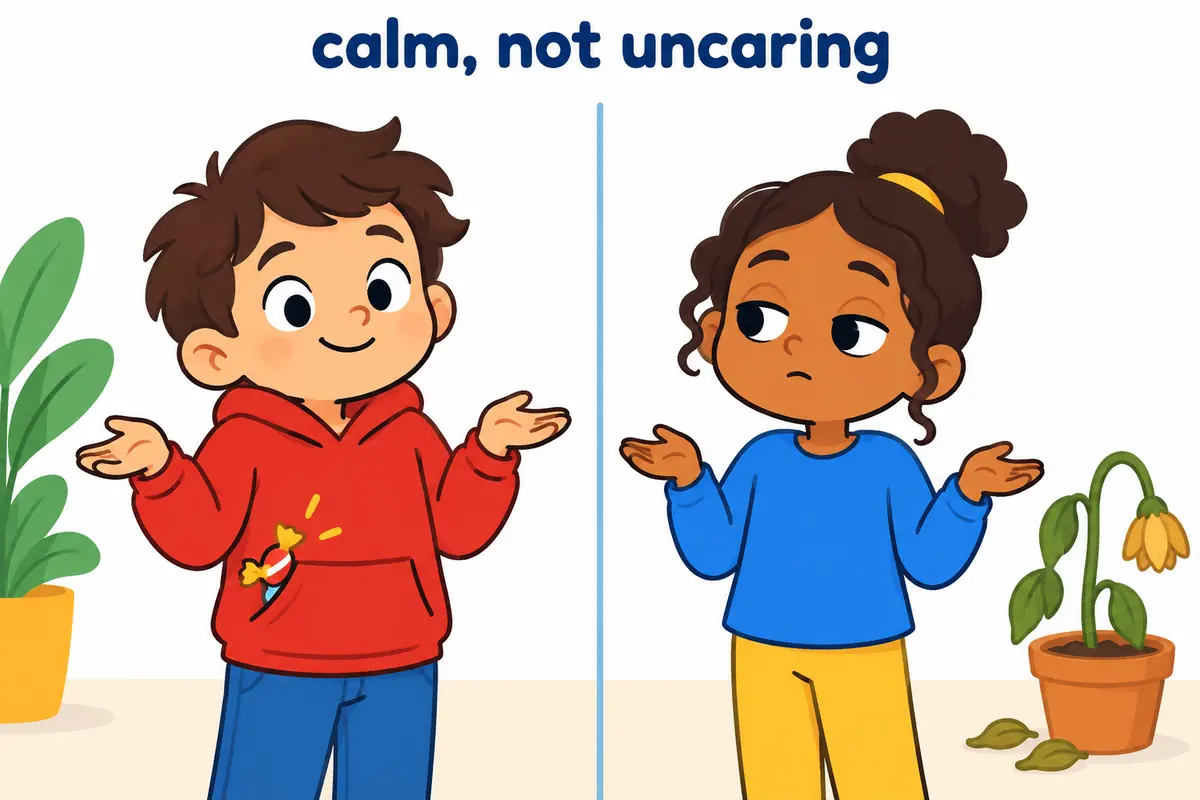
- The usual learner error is using nonchalant for someone who genuinely does not care.
What does nonchalant mean?
Nonchalant is an adjective meaning calm, relaxed and casually unconcerned, often in a way that looks deliberately cool. The Cambridge entry for nonchalant stresses the absence of worry or excitement, and that outward calm is the heart of the word: a nonchalant reply sounds untroubled, whether or not the speaker feels that way. A second, weaker use describes studied indifference that borders on not caring, which is why a teacher may call a student nonchalant about deadlines. Where the calm is admirable, composed under pressure is the more exact praise; where the ease is informal rather than cool, a casual tone fits better. Nonchalant is the wrong choice when you mean openly rude, because it describes manner rather than behaviour.
The word works by contrast. A nonchalant reaction only reads as cool because the moment calls for worry, so the adjective needs an audience and a stake. Put the same shrug in front of a broken window and it becomes negligence; put it in front of a surprise party and it becomes charm. That is why writers almost always name what the person is being nonchalant about, and why the preposition about does so much of the work.
| Sense | Plain meaning | Example sentence |
|---|---|---|
| Calm and unbothered (neutral) | Relaxed, showing no worry | He gave a nonchalant nod and kept reading. |
| Feigned coolness (approving) | Deliberately casual and stylish | She delivered the news in a nonchalant drawl. |
| Careless indifference (disapproving) | Unconcerned when concern is expected | The report was nonchalant about the delay. |
How do you use nonchalant in a sentence?
Nonchalant attaches to a person’s manner, not to a task. It sits before a noun to label the manner or after a linking verb to describe the person, and it almost always takes about when a topic follows.
| Pattern | Example | What it signals |
|---|---|---|
| a nonchalant + noun | a nonchalant shrug | Labels a manner or gesture. |
| be + nonchalant | He was nonchalant about the loss. | Comments on attitude. |
| nonchalant + about + noun | nonchalant about the result | Names what should worry them. |
| seem, sound or act + nonchalant | She tried to sound nonchalant. | Signals effort behind the calm. |
| more or less + nonchalant | He seems less nonchalant now. | Compares degrees of calm. |
The pattern seem, sound or act plus nonchalant is the most revealing, because it admits that the calm is a performance. A sentence that says she tried to sound nonchalant tells the reader two things at once: the manner is cool, and the effort is visible. That gap between surface and feeling is where most of the word’s narrative power comes from.
Nonchalant in a sentence: examples across contexts
The same calm reads differently in a news report, a novel and a performance review, so the sentence must show who is watching.
| Context | Example sentence | Why this works |
|---|---|---|
| Fiction | She met the news with a nonchalant shrug. | Shows hidden feeling through gesture. |
| Conversation | He acted nonchalant, but his hands were shaking. | Contrasts manner with evidence. |
| Workplace email | Let us stay nonchalant about the delay and focus on the fix. | Sets a calm tone for the team. |
| News report | The champion seemed nonchalant before the final. | Hints at confidence. |
| Performance review | Her nonchalant approach reassured the client. | Praises composure under pressure. |
| Parenting | Do not be nonchalant about a fever. | Warns that calm can become neglect. |
| Sports writing | He jogged back with a nonchalant wave. | Frames coolness as style. |
| Student report | The pupil was nonchalant about the missed deadline. | Notes a worrying attitude. |
| Film criticism | The hero’s nonchalant charm carries the opening scene. | Judges screen presence. |
| Interview | Stay nonchalant, and the horse will settle. | Uses calm as practical advice. |
| Job interview | Try to look nonchalant without seeming bored. | Balances composure and interest. |
| Diary entry | I felt nonchalant about the whole exam, and that worried me. | Shows self-awareness about detachment. |
Nonchalant vs indifferent
Nonchalant and indifferent both describe a lack of visible reaction, but they start from different places. Nonchalant is about style and composure, and it can hide real feeling; indifferent to the outcome is about feeling itself, and it reports that nothing matters. A nonchalant person may care deeply and hide it, while an indifferent person simply does not.
| Attribute | Nonchalant | Indifferent |
|---|---|---|
| Where it lives | Manner and outward style | Inner attitude |
| What it signals | Calm, cool, unbothered | No interest or concern |
| Can hide feeling | Yes, it is often a mask | No, it states the feeling |
| Typical pairing | a nonchalant shrug, reply or wave | indifferent to praise, pain or results |
| Tone | Often admiring or wry | Usually neutral or critical |
| Register | Common in fiction and reviews | Common in general and formal writing |
Choose nonchalant for cool composure, and indifferent when genuinely nothing matters. If the calm sits uneasily with a situation, unconcerned about the risk is the plainer warning, and when the person keeps an emotional distance, detached from the group describes it more exactly.
The two words also differ in what they promise next. After nonchalant, a reader expects a reveal, because the calm is usually a cover. After indifferent, a reader expects no reveal at all, because there is nothing underneath to uncover. That is why novelists reach for nonchalant and analysts reach for indifferent, and why swapping them flattens a sentence.
Word forms and grammar of nonchalant
The family is small and regular, but the forms do different jobs. The noun nonchalance names the quality of appearing calm, as in her nonchalance impressed the panel. The adverb shrugged nonchalantly describes how an action is done, and both keep the same root without changing meaning. Only nonchalant can follow a linking verb, so a sentence needs to choose between the adjective and its adverb carefully.
| Form | Part of speech | Example |
|---|---|---|
| nonchalant | adjective | a nonchalant manner |
| nonchalantly | adverb | He shrugged nonchalantly. |
| nonchalance | noun | Her nonchalance impressed the panel. |
Spelling trips up some writers, because the adjective ends in ant while the noun ends in ance. A quick test is to ask what is doing the job in the sentence: if the word describes a person or manner, use nonchalant, and if it names the quality as a thing, use nonchalance. The adverb is the safest form when an action is being described, since it can never be confused with the adjective.
Common mistakes with nonchalant
- Incorrect: He was nonchalant to the news. Correct: He was nonchalant about the news. Rule: the adjective takes about, never to.
- Incorrect: She is a very nonchalance student. Correct: She is a very nonchalant student. Rule: nonchalance is the noun, so it cannot modify another noun.
- Incorrect: The nurse was nonchalant about the patient’s pain, which was kind. Correct: The nurse was nonchalant about the patient’s pain, which seemed careless. Rule: nonchalant can imply not caring when care is expected.
- Incorrect: He answered nonchalant. Correct: He answered nonchalantly. Rule: use the adverb to modify a verb.
- Incorrect: Nonchalant means lazy. Correct: Nonchalant means casually calm. Rule: the word describes composure, not idleness.
- Incorrect: She remained nonchalantly during the storm. Correct: She remained nonchalant during the storm. Rule: after remain use the adjective, not the adverb.
- Incorrect: He is nonchalant of danger. Correct: He is nonchalant about danger. Rule: the adjective pairs with about, never of.
Practice using nonchalant
- Fill in the blank: He tried to look ______ as the results were read out.
- Fill in the blank: Her ______ wave suggested the criticism did not touch her.
- Correct the error: They were nonchalant to the warnings.
- Choose the better word: He is completely (nonchalant / indifferent) to whether the team wins, because he never cared.
- Build a sentence: use nonchalant before a noun to describe a gesture.
- Spot the register: which sentence belongs in a story, “He acted like he did not care” or “He adopted a nonchalant air”?
Answers
- nonchalant, because it describes his manner after the linking verb look.
- nonchalant, because it labels the wave as casually calm.
- Change to to about: They were nonchalant about the warnings.
- indifferent, because he genuinely never cared, so no feeling is hidden.
- Model answer: She gave a nonchalant nod and left the room.
- The story sentence is literary; the other is conversational.
The bottom line
Nonchalant describes a calm, cool manner that may or may not match what a person feels, so you use nonchalant in a sentence to show composure rather than to report the truth about someone’s feelings. It takes about before a topic, as in nonchalant about the result, and its noun is nonchalance. Choose indifferent when nothing genuinely matters, and composed when the calm deserves praise. The watching audience, not the word, decides whether the calm looks admirable or careless.
Frequently asked questions about nonchalant
Is nonchalant a compliment?
It often is, because composure under pressure is admired and a nonchalant reply can seem impressively cool. The same word turns critical when the calm appears misplaced, as in a nonchalant response to a serious warning. Listeners judge the fit between the manner and the moment, so context decides the tone.
Does nonchalant mean rude?
Not by itself. Nonchalant describes a relaxed, unbothered manner, and it carries no insult unless someone treats a serious matter lightly. A nonchalant greeting can be charming, while a nonchalant reaction to bad news can look heartless. If you mean openly rude, say rude or dismissive instead.
Can nonchalant describe a thing rather than a person?
It usually describes a person or a person’s manner, because the word needs someone to look calm. You can stretch it to a gesture, a wave or a reply, as in a nonchalant shrug, and to writing that adopts the same cool tone. An object such as a chair is rarely nonchalant, because objects cannot appear unbothered.
What is the difference between nonchalant and nonchalance?
Nonchalant is the adjective, so it describes someone or their manner, as in a nonchalant wave. Nonchalance is the noun, so it names the quality itself, as in her nonchalance surprised everyone. The adverb nonchalantly describes how an action is performed, so the three forms match adjective, noun and adverb jobs.