Year vs Annum: When to Use Each in Writing
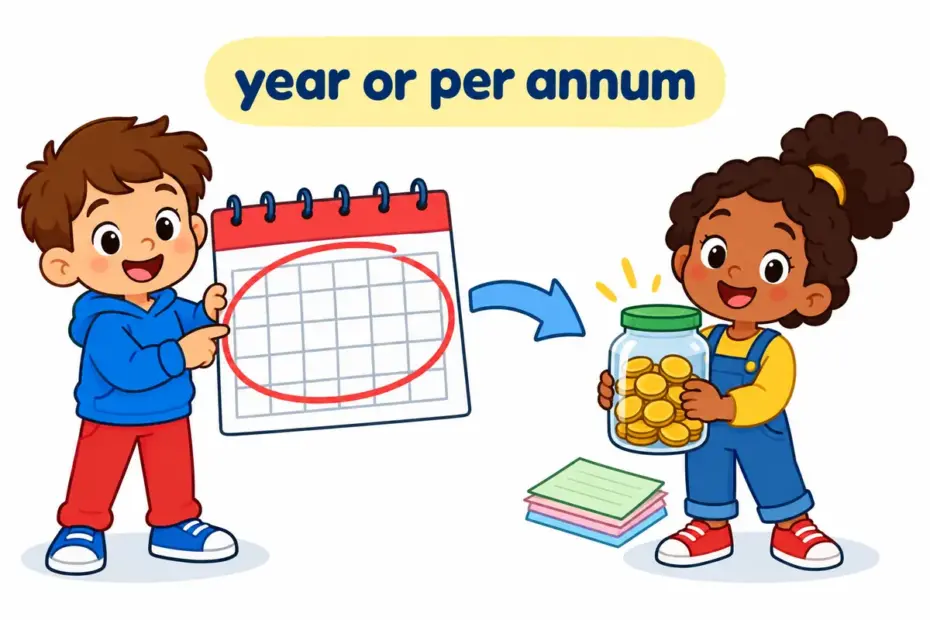
Year vs annum is a choice between plain English and a fixed Latin phrase: use year for almost everything, and reserve per annum for rates and amounts in formal financial or legal writing. A salary of 60,000 dollars per annum means the same as 60,000 dollars a year, but only one belongs in a contract.
Year vs annum at a glance
- Year is a common countable noun; its plural is years.
- Per annum is a fixed Latin phrase meaning for each year.
- Annum on its own is not used as an ordinary English noun.
- Year is neutral in register; per annum is formal, financial and legal.
- The commonest error is writing annum as if it were a countable noun.
Year vs annum compared
The master table below sets the two words against the criteria that decide real sentences.
| Criterion | Year | Annum (per annum) |
|---|---|---|
| Register | Neutral, used everywhere | Formal, financial and legal |
| Grammar | Countable noun with the plural years | Fixed Latin form inside per annum |
| Meaning | Any twelve-month period or calendar unit | For each year, expressed as a rate |
| Typical position | Stands alone or after an article | Follows a figure or a percentage |
| Common companions | this year, next year, a good year | 60,000 dollars per annum, 5 per cent per annum |
| Everyday example | She has lived here for a year. | The fee is 200 dollars per annum. |
| Can it be plural? | Yes, years | No plural in English usage |
The rule is simpler than the table suggests: choose year for almost everything, and use per annum only when a figure or rate is being stated in a formal document, where the word annum still survives.
What does year mean?
Year is a countable noun naming a period of twelve months, or a calendar period counted from January to December. The Cambridge entry for year records both the unit of time and the calendar period, and the same noun covers a school year, a financial year and a person’s stage of study. A run of ten years is a decade, and a calendar year runs from the first of January to the thirty-first of December.
| Sense | Plain meaning | Example sentence |
|---|---|---|
| A unit of time | Twelve months, or 365 days | The bridge took four years to build. |
| A calendar period | A named year such as 1999 | The company moved here in the year 2005. |
| A cycle or stage | A school or financial year | She is in her final year at secondary school. |
What does annum mean?
Annum is Latin for year, and modern English keeps it almost entirely inside the phrase per annum, which means for each year and works as a rate. The Cambridge entry for annum shows it only in that fixed expression. Annum never takes an English article or a plural, so you write per annum, not an annum or two annums.
| Form | Meaning | Example |
|---|---|---|
| per annum | For each year, as a rate | The rent is 18,000 dollars per annum. |
| annum alone | Not used in ordinary English | Avoid an annum ago; write a year ago. |
| p.a. | Abbreviation of per annum | The post pays 45,000 dollars p.a. |
Because annum is Latin, it carries the weight of a legal or financial convention. That weight is the whole reason to use it, and also the reason to avoid it everywhere else.
How do you use year and annum in a sentence?
Year behaves like any countable English noun, while per annum behaves like a preposition phrase glued to a number.
| Pattern | Example | What it signals |
|---|---|---|
| year as a countable noun | The course takes one year. | A duration or calendar unit |
| years for a span | She worked there for ten years. | A length of time |
| be + number + years old | He is twelve years old. | Age, never a rate |
| amount + per annum | The fee is 500 dollars per annum. | A yearly rate |
| percentage + per annum | Interest grows at 4 per cent per annum. | An annual rate of change |
| amount + per year | The fee is 500 dollars per year. | The same rate in neutral register |

Year vs annum in a sentence: examples across contexts
Each example below shows the same idea of a year settled by a different register.
| Context | Example sentence | Why this works |
|---|---|---|
| Everyday talk | She has lived here for a year. | The plain noun states a duration. |
| News report | The company had its best year since 2019. | A calendar period is compared. |
| Finance | Membership costs 40 dollars per annum. | A formal yearly fee is stated. |
| Legal document | Interest accrues at 3 per cent per annum. | A rate is fixed in a contract. |
| Academic writing | The course lasts one academic year. | A division of study is named. |
| Business report | The licence renews per annum at the same fee. | Formal renewal terms are given. |
| School | He is in his final year at secondary school. | A stage of schooling is described. |
| Contract | The rent is 18,000 dollars per annum, payable monthly. | A rate is stated formally. |
| Personal writing | We try to visit once a year. | Frequency is given in plain English. |
The pattern is consistent across every row. When the sentence gives a length of time or a calendar period, it uses year; when it gives an amount or a percentage for each year, a formal document uses per annum.
Which should you use?
Five common situations map to a firm recommendation.
| Situation | Use | Example |
|---|---|---|
| Writing to a friend or family | year | We meet once a year. |
| Stating a salary, fee or rent | per annum | 60,000 dollars per annum |
| Giving an interest or growth rate | per annum | 5 per cent per annum |
| Naming a school or calendar period | year | the school year |
| Any standalone noun | year | a difficult year |
If a number is followed by the idea of each year as a rate, a contract, prospectus or loan agreement calls for per annum. Everywhere else, year is correct and per annum sounds inflated.
Word forms and grammar of year and annum
Year inflects like any English noun, while annum has no English inflections at all.
| Form | Part of speech | Example |
|---|---|---|
| year | noun, singular | a year of hard work |
| years | noun, plural | ten years of service |
| yearly | adjective and adverb | a yearly review; reviewed yearly |
| annual | adjective | the annual report |
| annually | adverb | The fee is charged annually. |
| per annum | adverbial Latin phrase | 200 dollars per annum |
| annum | Latin noun, only in per annum | Not used alone in English. |
The adjective annual and the adverb annually are the plain alternatives to per annum. A yearly review and an annual review mean the same thing, and both read naturally where per annum would sound stiff outside a rate.
The register ladder
The same yearly idea climbs a ladder of formality, and each rung has a settled home. The table orders six ways of saying for each year, from the plainest to the most formal.
| Rung | Expression | Example | Where it belongs |
|---|---|---|---|
| Plainest | a year | We meet once a year. | Everyday speech and writing |
| Neutral | per year | The fee is 500 dollars per year. | Business prose and emails |
| Adjective | annual | the annual report | Reports and headings |
| Adverb | annually | The fee is charged annually. | Policies and notices |
| Latin phrase | per annum | 60,000 dollars per annum | Contracts and prospectuses |
| Abbreviation | p.a. | 45,000 dollars p.a. | Tight tables and invoices |
Moving one rung too high is the common error: per annum in a birthday card, or a plain year in a lease where the figure needs a rate. The ladder makes the switch visible, because each rung already has a home.
Common mistakes with year and annum
Incorrect: The project took three annum. The project took three annum. Correct: The project took three years. Annum is not a countable English noun, so it has no plural.
Incorrect: She is ten per annum. She is ten per annum. Correct: She is ten years old. Per annum states a rate, not a person’s age.
Incorrect: He lived there per annum. He lived there per annum. Correct: He lived there for a year. Per annum expresses a yearly rate, not a duration.
Incorrect: The rent is 1,000 dollars per year annually. The rent is 1,000 dollars per year annually. Correct: The rent is 1,000 dollars per annum. Never stack per year and annually; choose one.
Incorrect: The interest is 4 per cent for annum. The interest is 4 per cent for annum. Correct: The interest is 4 per cent per annum. The fixed phrase uses per, never for.
Incorrect: We meet per annum. We meet per annum. Correct: We meet once a year. Per annum belongs with figures and rates, not with ordinary frequency.
Practice using year and annum
Six tasks mix gap-fills, word choices and error repairs.
- Fill in the blank: The membership fee is 200 dollars per _____.
- Choose the better word: She waited three [years / annum] for a reply.
- Correct the error: The loan charges 6 per cent annum.
- Correct the error: He is in his final annum at school.
- Build a sentence: write a contract sentence using the phrase per annum.
- Spot the register: which sentence belongs in a job advert? (a) We pay 50,000 dollars per annum. (b) We pay 50,000 dollars every year.
Answers
- annum, because the phrase is per annum and states a yearly fee.
- years, because a duration needs the countable noun.
- The loan charges 6 per cent per annum, because the fixed phrase uses per.
- He is in his final year at school, because annum is not used as a standalone noun.
- Model answer: The licence fee is 1,200 dollars per annum, payable in advance.
- Sentence (a), because a formal advert stating a rate favours per annum.
The bottom line
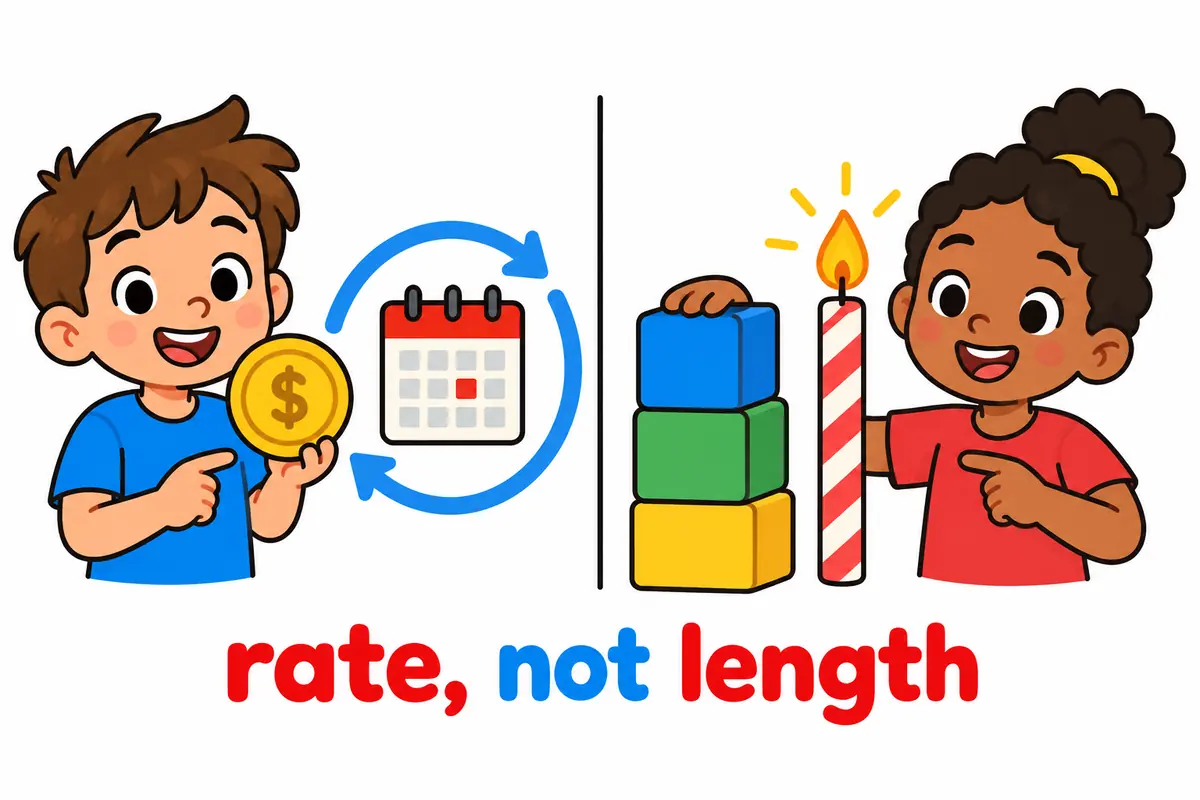
The year vs annum choice comes down to register and grammar: use year for lengths of time, ages and calendar periods in ordinary writing, and reserve per annum for a rate after a figure in formal financial or legal text. Annum is never a standalone English noun, so a plural such as annums has no place. When in doubt, year is the safe and plain choice.
Frequently asked questions about year vs annum
Is annum a word on its own?
Annum is a real word, but modern English keeps it almost entirely inside the fixed phrase per annum. You will not normally use it alone with an article or in a plural. For every ordinary meaning of a year, the English noun year is the correct choice.
What does per annum mean?
Per annum is Latin for for each year, and it works as a rate. A salary of 60,000 dollars per annum means that 60,000 dollars is paid for every year of work. It always follows a figure or a percentage in formal writing.
Can I write per year instead of per annum?
Yes. Per year is the plainer equivalent and reads well in most business writing. Per annum suits contracts, prospectuses and legal documents, where the formal Latin phrase is the established convention rather than a flourish. For an email to a colleague, per year is almost always the better choice.
Should I use annually or per annum?
Annually is an adverb attached to an action, as in the fee is charged annually. Per annum attaches to an amount or a rate, as in a fee of 200 dollars per annum. The two are not interchangeable inside one clause.