
Adjectives for integrity include honest, principled, upright, sincere, ethical, and trustworthy when describing a person’s conduct. The closest choices refer to truthfulness or commitment to principles; reliable, loyal, and kind describe related traits but do not prove integrity alone. Integrity also means wholeness in structural or data contexts, so the best adjective depends on context.
Integrity adjectives at a glance
- Closest moral synonyms: honest, truthful, upright, honorable, and principled.
- Useful neighboring qualities: reliable, loyal, accountable, and courageous; each adds a different idea.
- Evidence matters: connect a character word to an observed action or repeated record.
- Context changes the meaning: academic, structural, and data integrity do not all describe a person’s morals.
- Keep the original alphabetical tables as a broad word bank: some entries are modifiers or loosely related words rather than precise synonyms.

The complete original vocabulary list, tables, examples, and links appear below. The guide after that source material explains how to choose a precise adjective without treating every listed word as interchangeable.
When it comes to integrity, there are a lot of adjectives that can be used to describe it. Here are just a few:
honest, honorable, just, moral, principled, reliable, sincere, true, trustworthy.
These are just a few of the many adjectives that can be used to describe integrity. Integrity is an important trait to possess, and there are a lot of positive things that come with it.
adjectives for integrity
When it comes to having integrity, there are a lot of adjectives that can be used to describe someone who has this trait. Some of these adjectives include honest, trustworthy, reliable, and principled.

If you’re looking for a list of adjectives to describe someone with integrity, you’ve come to the right place. Here are 20 adjectives that accurately describe someone with integrity:
- Honest
- Truthful
- Sincere
- Authentic
- Genuine
- Dependable
- Trustworthy
- Reliable
- Principled
- Moral
- Ethical
- Upstanding
- Righteous
- Virtuous
- Good
- Kind
- Honorable
- Respectable
- Commendable
a | b
| Absolute | Academic | Actual |
| Anti | Architectural | Artistic |
| Average | Belgian | Binary |
| Bodily |
c
| Celebrated | Certain | Civic |
| Clear | Cognitive | Commemorative |
| Commercial | Competitive | Compulsory |
| Concrete | Conscientious | Conscious |
| Corporate | Courageous | Critical |
| Cultural |
d | e
| Democratic | Devoted | Disinterested |
| Doubtful | Eccentric | Ecclesiastical |
| Ecological | Editorial | Electoral |
| Eminent | Emotional | Environmental |
| Epistolary | Essential | Ethical |
| European | Evident | Extraordinary |
| Extreme |
f | g | h
| Fair | Financial | Fine |
| Firm | Fiscal | Fouled |
| Future | Greater | Greek |
| Historical | Honest | Honourable |
| Human |
i
| Impassive | Impeccable | Incorruptible |
| Independent | Inflexible | Innate |
| Institutional | Intellectual | Intereststhe |
| Internal | International | Inviolable |
| Irreproachable |

j | k | l | m
| Jealous | Journalistic | Judicial |
| Known | Lofty | Loyal |
| Manifest | Manly | Mechanical |
| Mental | Modular | Moral |
n | o
| Native | Natural | Nervous |
| Noblest | Notable | Official |
| Organic | Original | Outstanding |
| Overall |
p
| Perfect | Physical | Placea |
| Primal | Primitive | Professional |
| Proud | Psychical | Purest |
r
| Racial | Real | Referential |
| Revolutionary | Rigid | Round |
s
| Scholarly | Scientific | Scrupulous |
| Servian | Severe | Sexual |
| Spiritual | Spotless | Stainless |
| Starched | Statutory | Sterling |
| Stern | Strictest | Strong |
| Structural | Sweet |

t | u
| Technical | Territorial | Theological |
| Thorough | Tremendous | Unassailable |
| Unblemished | Undeviating | Undoubted |
| Unfailing | Unimpeachable | Unimpeached |
| Unlimited | Unquestionable | Unquestioned |
| Unselfish | Unshaken | Unspotted |
u | v | w
| Unsullied | Unsuspected | Unsuspecting |
| Unswerving | Untainted | Untarnished |
| Unvarying | Usual | Utmost |
| Visual | Watchful |
When it comes to describing someone with integrity, words hold immense power. They have the ability to paint a vivid picture of an individual’s character, values, and actions. In this article, I’ll delve into the world of adjectives that perfectly capture the essence of integrity. From steadfast to honorable, these words not only define integrity but also inspire and motivate us to embody it in our own lives. So, let’s explore the adjectives that can truly illuminate the path to living a life of integrity.
Integrity is a quality that we all aspire to possess, and it is often considered the cornerstone of moral character. But what exactly does it mean to be a person of integrity? In this article, I’ll take you on a journey through a collection of adjectives that encapsulate the essence of integrity. These words not only describe the characteristics of an individual with unwavering principles but also provide a roadmap for cultivating integrity within ourselves. So, let’s dive into the world of adjectives that magnify the power of integrity and inspire us to be the best versions of ourselves.
How to Describe Integrity? – Different Scenarios
Integrity is a multifaceted trait that can be described using various adjectives. In different scenarios, integrity may manifest itself in different ways. Let’s explore how we can describe integrity in different situations:
1. Personal Integrity
When it comes to personal integrity, we can use adjectives such as:
- Honest: Being honest means always telling the truth, even when it’s difficult.
- Trustworthy: A trustworthy person can be relied upon to keep their promises and be loyal.
- Responsible: A responsible individual takes ownership of their actions and is accountable for their choices.
- Courageous: Demonstrating courage implies standing up for what is right, even in the face of adversity.
- Authentic: An authentic person is true to themselves and consistent in their words and actions.
2. Professional Integrity
In a professional setting, integrity can be described using adjectives like:
- Reliable: A reliable individual is punctual, meets deadlines, and consistently delivers high-quality work.
- Ethical: Upholding ethical principles and moral values is an essential aspect of professional integrity.
- Transparent: Being transparent means conducting oneself with openness and honesty, especially in business dealings.
- Accountable: Taking responsibility for one’s actions and outcomes is a sign of professional integrity.
- Diligent: A diligent person demonstrates a strong work ethic and puts in the necessary effort to achieve their goals.
3. Social Integrity
Integrity also extends to our interactions with others. Some adjectives that can describe integrity in social scenarios include:
- Empathetic: Being empathetic means showing understanding and compassion towards others.
- Respectful: A respectful individual treats others with courtesy and values their feelings and opinions.
- Fair: Acting with fairness ensures equal treatment and consideration for all individuals.
- Inclusive: An inclusive person embraces and includes others, regardless of their differences.
- Kind: Demonstrating kindness involves being compassionate, helpful, and caring towards others.
Read: Adjectives for Bones: Examples and Descriptive Words
As we can see, integrity manifests differently in various aspects of life. By embodying these adjectives, we can cultivate a strong sense of integrity and inspire those around us to do the same. Remember, integrity is not just a word but a way of living that brings out the best in us and fosters trust and respect in our relationships.
Describing Words for Integrity in English
Integrity is a quality that we all strive to possess. It is an essential part of our moral character and shapes how we interact with others and the choices we make. Describing integrity using adjectives not only helps to define the concept, but also inspires and motivates us to embody it in our own lives. Here are some adjectives that capture the essence of integrity:
- Honest: Being honest means telling the truth and acting in a sincere and trustworthy manner. It means being transparent and having integrity in both words and actions.
- Principled: A principled person adheres to a set of moral values and beliefs. They have strong principles that guide their behavior and make decisions based on what they believe is right.
- Reliable: A reliable person is someone who can be counted on. They fulfill their commitments, meet deadlines, and follow through on their promises. They inspire trust and confidence in others.
- Responsible: Responsibility is a key aspect of integrity. A responsible person takes ownership of their actions, acknowledges their mistakes, and learns from them. They understand the importance of accountability.
- Courageous: Courage is an integral part of integrity. It takes courage to stand up for what is right, even in the face of adversity. A person with integrity displays courage by doing the right thing, even when it is difficult.
- Fair: Fairness is an important component of integrity. A fair person treats others impartially, without favoritism or bias. They believe in justice and equality and strive to ensure fairness in their interactions.
- Authentic: An authentic person is true to themselves and others. They are genuine and sincere in their words and actions. They don’t pretend to be someone they’re not and are comfortable embracing their true selves.
- Ethical: Acting ethically is a hallmark of integrity. An ethical person follows a code of conduct and makes decisions based on what is morally right. They prioritize doing the right thing over personal gain.
- Dependable: A dependable person is reliable and trustworthy. They can be relied upon to fulfill their obligations and be there for others when needed. They are consistent and steadfast in their actions.
Read: Describing Words for Thursday – Examples and Adjectives
Adjectives for Integrity
Integrity is an important quality that we all strive to possess. It serves as the cornerstone of moral character and contributes to building trust and respect in our relationships. In this section, I will explore different adjectives that can be used to describe integrity, both in a positive and negative context. Let’s dive in!
Positive Adjectives for Integrity
Integrity is often associated with positive traits and actions. Here are ten adjectives that describe integrity in a positive light, along with example sentences:
| Adjective | Definition | Example Sentence |
|---|---|---|
| Reliable | Consistently trustworthy | She always keeps her promises. She is a reliable friend. |
| Honest | Truthful, sincere | He always tells the truth, even when it’s difficult. |
| Ethical | Acting in accordance with moral principles | He made an ethical decision based on what was right, not what was easy. |
| Genuine | Authentic, sincere | Her compliments are genuine, and you can tell she means them. |
| Trustworthy | Dependable, deserving of trust | You can trust him with your secrets; he’s trustworthy. |
| Principled | Guided by a set of moral values | She stands up for what she believes in; she’s principled. |
| Transparent | Open and honest, without hidden motives | He provides clear and transparent explanations for his actions. |
| Accountable | Taking responsibility for one’s actions | She takes accountability for her mistakes and learns from them. |
| Respectable | Admirable, deserving of respect | He conducts himself in a respectable manner, even in challenging situations. |
| Loyal | Faithful and committed | She is a loyal friend who always supports those around her. |
These adjectives paint a picture of integrity as a positive and desirable trait in individuals.
Negative Adjectives for Integrity
While integrity is typically viewed in a positive light, it is important to acknowledge negative aspects as well. Here are five adjectives that describe integrity in a negative context, along with example sentences:
| Adjective | Definition | Example Sentence |
|---|---|---|
| Dishonest | Not truthful, lacking integrity | He was caught lying about his whereabouts; he’s dishonest. |
| Deceptive | Misleading, not straightforward | She used deceptive tactics to gain an unfair advantage. |
| Unscrupulous | Unethical, lacking morals | He will do anything to get ahead; he’s unscrupulous. |
| Manipulative | Influencing others for personal gain | She manipulates others to get what she wants. |
| Untrustworthy | Not deserving of trust | He has a history of breaking promises; he’s untrustworthy. |
Even though these adjectives describe negative aspects of integrity, it’s important to recognize them to maintain ethical behavior and foster trust.
Integrity is a trait that affects various aspects of our lives, and using these adjectives helps us understand and talk about it more effectively. By embodying the positive adjectives and avoiding the negative ones, we can cultivate a strong sense of integrity in our own lives and inspire others to do the same. So let’s strive to be reliable, honest, and trustworthy individuals who bring out the best in ourselves and those around us.
Read: Style Adjectives: Describing Words with Examples
Synonyms and Antonyms With Example Sentences
Synonyms for Integrity
When it comes to describing integrity, there are several synonyms that can be used to highlight this important quality. Here are some key synonyms to expand your vocabulary:
| Synonym | Definition | Example Sentence |
|---|---|---|
| Honesty | The quality of being truthful and trustworthy | John’s honesty shone through as he admitted his mistake. |
| Trustworthiness | The trait of being reliable and dependable | Lisa’s trustworthiness made her the perfect candidate. |
| Reliability | The consistency in fulfilling commitments | Sarah’s reliability made her an asset to the team. |
| Transparency | The openness and clarity in actions and motives | The company’s transparency builds trust with customers. |
Antonyms for Integrity
While it’s important to know the positive attributes that describe integrity, it’s equally important to recognize the opposite qualities. Here are some antonyms for integrity, providing a contrast to the positive characteristics:
| Antonym | Definition | Example Sentence |
|---|---|---|
| Dishonesty | The lack of truthfulness and reliability | Mark’s dishonesty led to the downfall of his business. |
| Untrustworthiness | The quality of being unfaithful or undependable | Mike’s untrustworthiness made it difficult to rely on him. |
| Unreliability | The lack of consistency and dependability | The unreliability of the vendor caused delays in the project. |
| Opacity | The lack of transparency and openness in actions | The government’s opacity raised concerns among citizens. |
Being able to recognize the synonyms and antonyms for integrity is important for understanding the different aspects of this important trait. By striving to embody the positive synonyms and avoiding the negative antonyms, we can cultivate a strong sense of integrity in our own lives and inspire others to do the same.
Understanding the importance of integrity is crucial in building strong relationships and fostering trust. Throughout this article, we have explored a range of adjectives that describe the characteristics of a person with integrity. From honesty and trustworthiness to reliability and transparency, these qualities form the foundation of a person’s moral compass.
By recognizing the synonyms and antonyms associated with integrity, we gain a deeper understanding of the positive and negative aspects that shape our behaviors and actions. It is essential to cultivate a strong sense of integrity in our own lives, as it not only impacts our personal growth but also inspires others to do the same.
As we strive to be individuals of integrity, let us remember that it is a continuous journey of self-reflection and improvement. By embodying these adjectives and consistently practicing them in our daily lives, we can create a positive ripple effect in our communities and contribute to a more honest and trustworthy society.
Integrity is not just a word; it is a way of life that defines who we are and how we interact with the world around us. Let us embrace these adjectives for integrity and strive to live with unwavering honesty, trustworthiness, reliability, and transparency.
Final verdict
When it comes to integrity, there are a lot of different adjectives that can be used to describe it. Some of the most common include honest, trustworthy, and reliable. However, there are many other adjectives that can also be used to describe someone with integrity.
Some of these include principled, upstanding, and honorable. No matter what adjectives you use, one thing is for sure, and that is that integrity is a very important character trait to have.
What do adjectives for integrity describe?
For a person, integrity usually means honesty joined with strong moral principles. Cambridge Dictionary also records a second sense: the quality of being whole and complete. In ordinary character descriptions, the most useful adjectives therefore point to truthfulness, principled decisions, fairness, sincerity, or trustworthy conduct—not simply to a pleasant personality (Cambridge Dictionary, “integrity”).
Ethics Unwrapped at the University of Texas at Austin describes integrity as acting in accordance with principles that include honesty, fairness, and decency. Its emphasis on consistent moral action explains why a single convenient label is weaker than a concrete example: “She disclosed the error even though it delayed the project” gives a reader evidence for calling her honest or principled (UT Austin, Ethics Unwrapped: Integrity).
Which adjectives are closest synonyms for moral integrity?
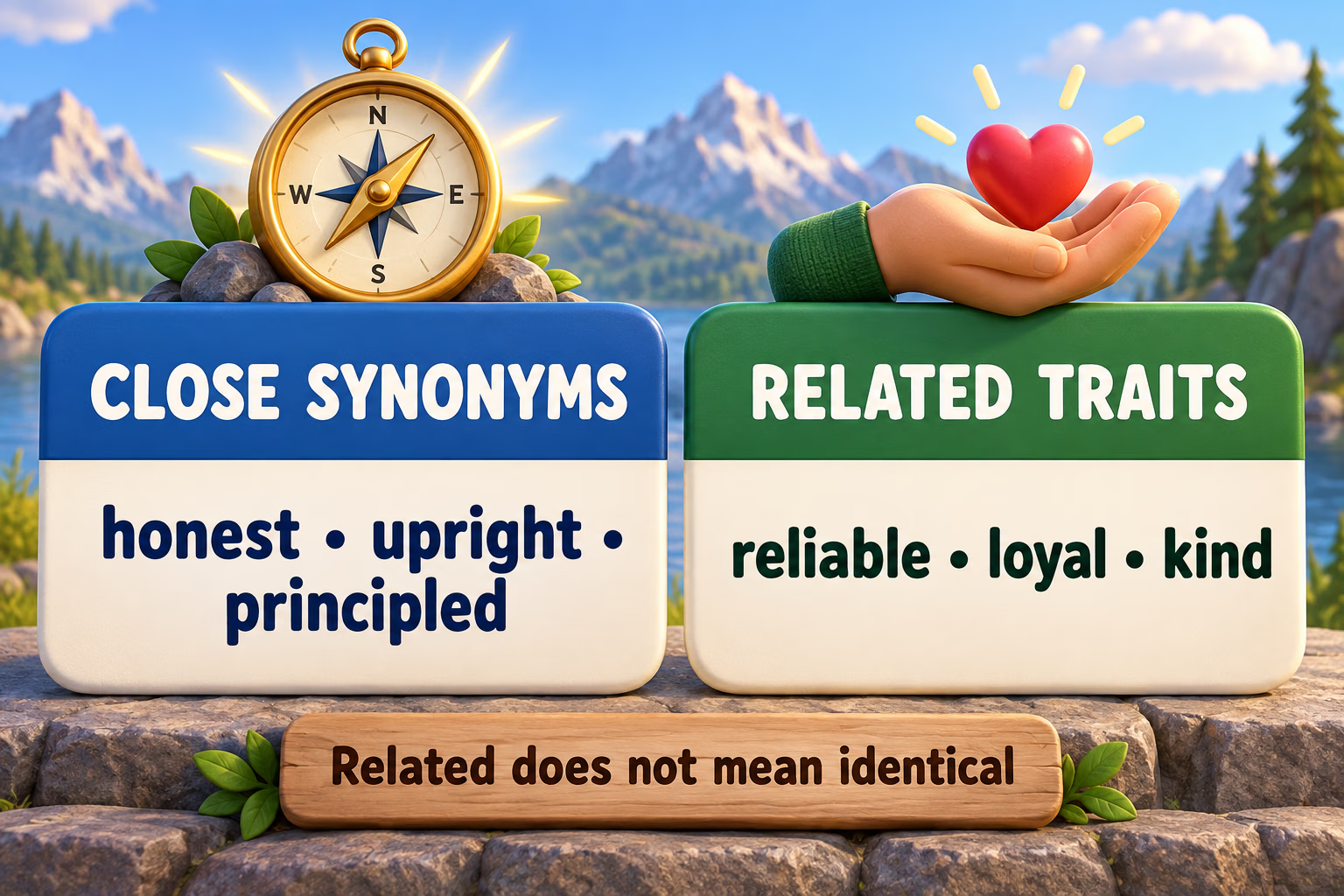
Honest, truthful, upright, honorable, and principled are among the closest choices when integrity means moral character. They overlap, but each stresses a different part of that character; select the word that matches the action described.
| Adjective | What it emphasizes | Example |
|---|---|---|
| Honest | Truthfulness and fair dealing. | “The honest cashier reported the extra payment.” |
| Truthful | Statements that accurately represent what someone knows. | “He gave a truthful account of what he had seen.” |
| Principled | Decisions guided by stated moral standards, including when those standards are inconvenient. | “The principled editor refused to hide the correction.” |
| Upright | Formal praise for morally respectable conduct. | “Neighbors described the upright volunteer as fair and dependable.” |
| Honorable | Conduct regarded as deserving respect because it is fair or ethical. | “She made the honorable choice to credit the whole team.” |
| Sincere | Genuine expression rather than feigned feeling or belief. | “His sincere apology named the mistake and its impact.” |
| Ethical | Consistent with moral principles or a relevant professional code. | “The ethical researcher explained how the data were collected.” |
| Trustworthy | Worthy of trust based on conduct and follow-through. | “The trustworthy treasurer documented each payment.” |
| Scrupulous | Careful to follow moral or professional standards. | “A scrupulous reviewer separated evidence from assumption.” |
Cambridge’s thesaurus groups words such as honesty, honor, probity, uprightness, rectitude, sincerity, and decency with the moral sense of integrity. These are useful near-synonyms, not perfect substitutes in every sentence: sincerity is about genuineness, while rectitude is formal and often sounds elevated (Cambridge Thesaurus: integrity).
Which related traits are not exact synonyms?
Reliable, loyal, kind, and courageous can support a positive description, but each names a distinct quality. The distinction prevents a sentence from claiming more than its evidence shows.
| Related adjective | What it says | What it does not establish by itself |
|---|---|---|
| Reliable | A person or thing can generally be counted on. | That the person is truthful in every situation. |
| Loyal | Someone remains committed to a person, group, or cause. | That the cause or action is fair or ethical. |
| Kind | Someone shows consideration or care. | That the person follows moral principles consistently. |
| Courageous | Someone faces difficulty or risk bravely. | That the choice being defended is honest or just. |
| Accountable | Someone accepts responsibility and can explain decisions. | That every decision was correct or free of bias. |
| Authentic | Someone seems genuine rather than artificial or imitative. | That the person’s conduct is fair or truthful. |
| Good | A broad, context-dependent positive evaluation. | Which specific quality or behavior is being praised. |
For example, a loyal employee might defend a colleague without checking the facts; loyalty describes allegiance, while integrity requires attention to truth and fairness too. A reliable person may arrive on time and keep promises, but reliability alone does not tell you how that person handles a conflict of interest. Use one adjective for each quality the evidence supports.
How can you choose an accurate adjective?
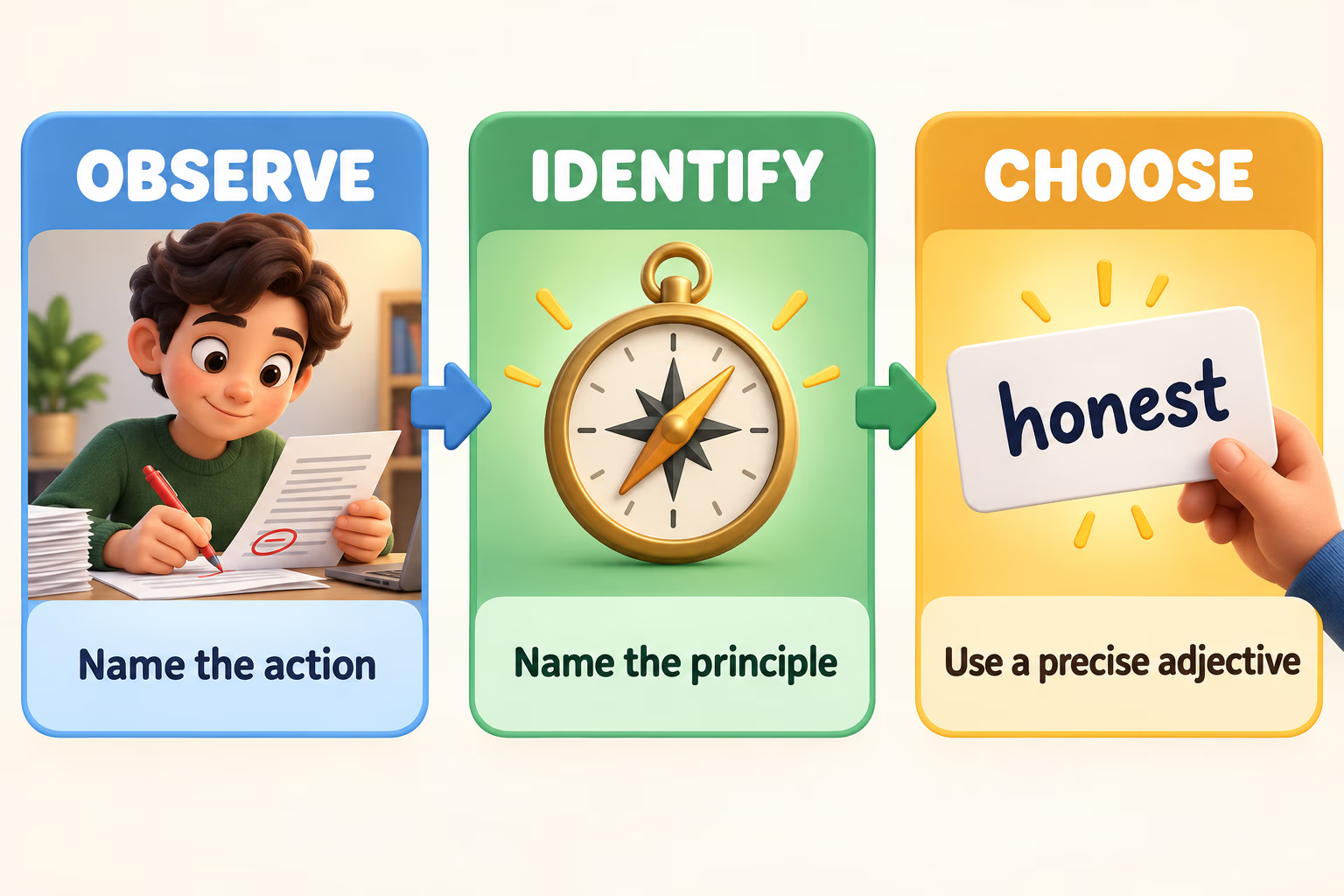
Choose the adjective by naming the conduct first, then identifying the quality that conduct demonstrates. This four-step method works for essays, character writing, workplace feedback, and short descriptions.
- State the observable action. Write what the person said, decided, or did; avoid guessing at hidden motives.
- Identify the principle involved. Was the action about telling the truth, treating people fairly, honoring a commitment, or accepting responsibility?
- Pick the narrowest matching adjective. Use truthful for an accurate account, principled for a decision guided by values, and accountable for owning the consequences.
- Add scope and context. A single incident can support a description of that action; a repeated pattern is stronger evidence for a stable character trait.
| Less precise | More precise | Why the revision helps |
|---|---|---|
| “Mira is perfect.” | “Mira corrected the budget after finding an error in her own figures.” | Names a verifiable action instead of making an absolute judgment. |
| “Owen is loyal, so he has integrity.” | “Owen is loyal to his team and disclosed the mistake that affected its report.” | Separates allegiance from truthfulness and gives evidence for each. |
| “The reviewer was disinterested.” | “The disinterested reviewer had no personal stake in the outcome.” | Clarifies that disinterested means impartial or without personal advantage in this formal use, not bored. |
| “The manager is dishonest.” | “The manager reported a sales figure that the signed records did not support.” | States the specific discrepancy and avoids turning an allegation into a broad personal verdict. |
Cambridge Dictionary uses disinterested for someone who is not personally involved and can act fairly. The word is useful when discussing impartial judgment, but it is not a general synonym for integrity: lack of personal stake is only one condition that may help a decision-maker judge fairly (Cambridge Dictionary, “disinterested”).
Which adjectives describe a lack of integrity?
Dishonest, deceitful, corrupt, hypocritical, and unscrupulous directly criticize conduct or character. Use these strong negative terms only when the evidence and context justify them; for a one-time event, describe what happened instead of turning it into a permanent label.
- Dishonest means not truthful or fair in a relevant situation.
- Deceitful suggests deliberate misleading or concealment.
- Corrupt commonly refers to dishonest conduct, especially misuse of entrusted power or position.
- Hypocritical describes a mismatch between professed standards and actual behavior.
- Unscrupulous describes someone willing to ignore moral limits to get an advantage.
By contrast, nervous, eccentric, jealous, doubtful, and quiet do not mean that a person lacks integrity. They refer to feelings, behavior, confidence, or style. The original alphabetical tables contain a wide range of words; check the part of speech and meaning before treating any entry as an antonym.
When describing behavior, a concrete action is usually more fair and useful than a label. Our guide to adjectives for behavior offers related language for describing specific actions and attitudes.
Why do academic, structural, and data integrity differ?
They use the same noun in different domains. Academic integrity concerns trustworthy scholarly work and learning practices; structural integrity concerns whether a structure remains sound; and data integrity concerns protection against unauthorized or accidental changes. These modifiers describe the kind of integrity being discussed, not the moral character of an individual by themselves.
Academic integrity
The International Center for Academic Integrity frames academic integrity as a commitment, even in difficult circumstances, to six values: honesty, trust, fairness, respect, responsibility, and courage. For students and researchers, useful descriptors include honest, fair, responsible, transparent, and careful when those words match documented practice. Examples include crediting sources, distinguishing quoted work from original analysis, and reporting limitations instead of presenting uncertain findings as settled facts (ICAI, Fundamental Values of Academic Integrity).
Do not treat one mistake as proof that a whole person or institution is “without integrity.” Policies define specific expectations, and context matters: citation conventions, permitted collaboration, and disclosure rules vary by course, publication, or institution. When a question is about a real assignment or investigation, consult the applicable policy rather than assuming that one adjective decides the matter.
Structural or architectural integrity
In the whole-and-complete sense of integrity, structural or architectural integrity refers to the soundness or wholeness of a building, bridge, artwork, or system. Cambridge illustrates the sense with “architectural integrity”; a structure described as sound or intact is not being praised for moral virtue. The appropriate words depend on what is being evaluated: stable, intact, sound, coherent, or undamaged may be clearer than a character adjective.
Data integrity
The National Institute of Standards and Technology defines data integrity in terms of whether data have been altered in an unauthorized manner since creation, transmission, or storage. This is a technical property, not a claim that the original data were accurate, complete, unbiased, or private. Data could remain unchanged and still contain an error that was present from the start; integrity and accuracy answer different questions (NIST Computer Security Resource Center: data integrity).
In technical writing, use unaltered, intact, consistent, or tamper-evident only when the method or evidence supports that description. Words such as moral, honest, upright, and principled apply to conduct, not to whether a database record changed. The adjective before integrity identifies the domain; the adjective after it should describe a property that can actually be checked.
How do you use integrity adjectives in a sentence?
Use an integrity adjective with an action, decision, standard, or record that makes its meaning clear. A compact sentence can still show the evidence behind the description.
- Personal essay: “I acted honestly by correcting the source citation before submitting the report.”
- Character description: “The principled captain refused to claim credit for another player’s work.”
- Workplace note: “The accountable analyst documented the conflict of interest and recused herself from that decision.”
- Academic context: “The responsible student marked borrowed language and identified the source.”
- Technical context: “The audit checked whether stored records had changed without authorization.”
For a resume or recommendation, avoid unsupported superlatives such as impeccable, flawless, or perfectly honest. A specific example—correcting a mistake, keeping a documented commitment, or disclosing a conflict—lets the reader judge the quality for themselves. For writing about trust and close relationships, see our related guide to adjectives for relationships.
Common mistakes when describing integrity
- Calling every positive adjective a synonym. Kindness, courage, loyalty, and dependability can accompany integrity, but none proves it alone.
- Using “righteous” as neutral praise. It can imply moral certainty or self-righteousness, so it may sound judgmental in everyday writing.
- Using “uncompromising” without context. It may praise consistency, but it can also suggest inflexibility; say which principle was maintained and why.
- Calling someone “impeccable.” The word sounds absolute. Prefer a bounded claim such as “a careful record of accurate disclosures” when that is what the evidence shows.
- Mixing up disinterest and apathy. In formal use, a disinterested reviewer has no personal stake; an uninterested reviewer is not interested.
- Using technical modifiers as character words. Academic, architectural, structural, and data integrity refer to fields or properties; they do not automatically describe a person’s virtue.
Conclusion
The best adjectives for integrity are precise enough to show what kind of integrity you mean. For moral character, begin with honest, truthful, principled, upright, honorable, or sincere, then connect the choice to an observable action. Treat reliable, loyal, kind, and courageous as related qualities with their own meanings. In academic, structural, and data contexts, name the relevant standard or property instead of using a character word as a substitute.
Frequently asked questions about adjectives for integrity
What is the best adjective for a person with integrity?
Principled is a strong choice when someone consistently acts according to moral standards; honest is more specific to truthfulness. The best word depends on the evidence: describe an accurate statement as truthful, a fair decision as ethical, and a pattern of values-led conduct as principled.
Is “reliable” a synonym for “honest”?
No. Reliable means dependable or consistent enough to be counted on, while honest means truthful or fair. A person may be dependable in one role without the word alone establishing how that person handles honesty, fairness, or conflicts of interest.
Does “loyal” mean someone has integrity?
Not by itself. Loyal means committed to a person, group, or cause; that commitment can be admirable, but it does not show whether the person is truthful or whether the cause is ethical. Add a separate adjective or example when you mean both loyalty and integrity.
Is “disinterested” positive or negative?
In formal contexts, disinterested is usually positive when it means impartial because someone has no personal stake in a decision. It does not mean bored; uninterested is the ordinary word for lacking interest. A disinterested role still needs fair methods and sound evidence.
What is the difference between moral and data integrity?
Moral integrity is about honesty and adherence to ethical principles. Data integrity is a technical property concerning unauthorized or accidental changes to information. Data integrity does not by itself prove that the original information was true, complete, or unbiased.
Can “architectural” describe a person’s integrity?
Usually no. In architectural integrity, the adjective identifies a building or design context and integrity means wholeness or preservation. To describe a person’s moral character, choose a word such as honest, principled, upright, or ethical and support it with relevant conduct.


