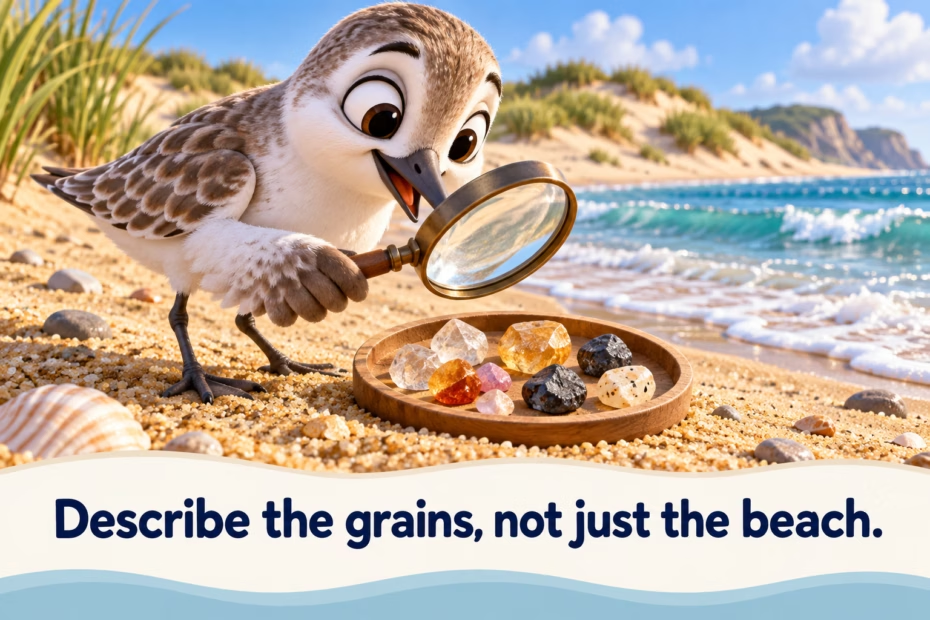
Adjectives for sand work best when they name a visible or felt feature: grain size, texture, color, moisture, or setting. Fine, coarse, gritty, damp, and golden can all fit, but each tells the reader something different.
- Size: fine, medium, coarse, powdery.
- Texture and shape: gritty, smooth, angular, rounded.
- Color and material: pale, golden, black, shell-rich.
- Conditions: dry, damp, wet, windblown, sun-warmed.
Sand is a grain-size category rather than one particular rock. The National Park Service gives the common range as about 1/16 millimeter to 2 millimeters; beach sand may contain quartz, other minerals, shell fragments, or mixtures. That variation is why specific observations are more useful than a generic word such as beautiful.

Which adjectives describe sand most accurately?
Start with the property you can observe, then choose the narrowest word that remains true. Coarse describes larger grains; it does not automatically mean the surface feels rough. Gritty describes a noticeable grainy feel, while rough is a tactile judgment that can depend on moisture and the mix of particles.
| What you notice | Useful adjectives | Example |
|---|---|---|
| Grain size | very fine, fine, medium, coarse, very coarse | Fine sand sifted through the narrow gap between the boards. |
| Size variation | well-sorted, poorly sorted, mixed-grain | The well-sorted sand had grains of similar size. |
| Grain shape or feel | angular, rounded, gritty, smooth, grainy | Rounded grains slipped easily between her fingers. |
| Moisture | dry, damp, wet, waterlogged | Damp sand held the imprint of a shell. |
| Color | pale, white, golden, reddish, dark | Dark mineral streaks crossed the pale beach. |
| Movement or setting | drifting, shifting, windblown, sun-warmed | Windblown sand gathered against the dune grass. |
How do fine, medium, and coarse sand differ?
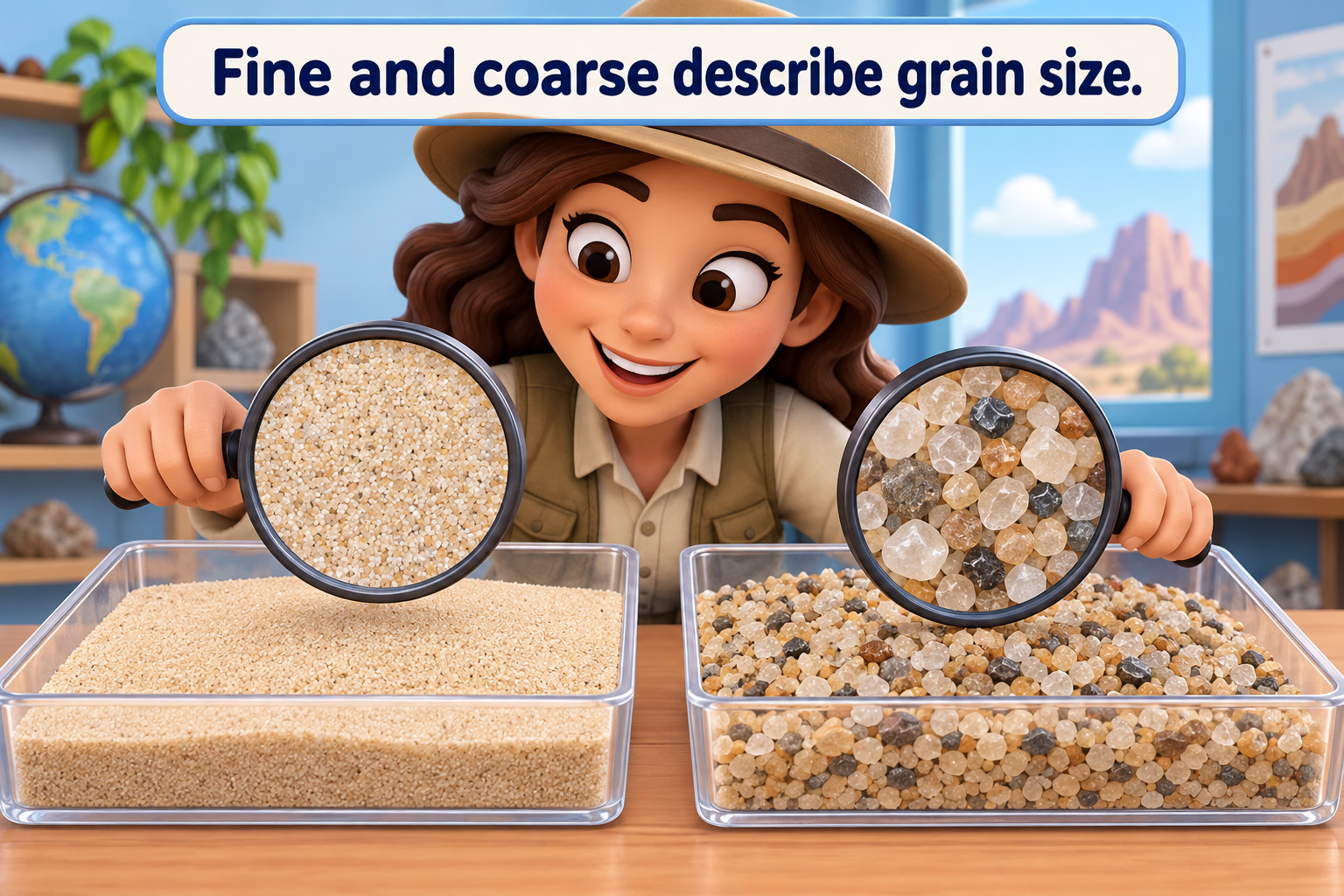
In the Wentworth grain-size scale, sand spans roughly 0.0625 to 2 millimeters, with named subdivisions that make size adjectives more precise. These technical bands are useful for geology; in everyday writing, use them as relative descriptions unless the grains were actually measured.
| Size term | Approximate grain diameter | Plain-language use |
|---|---|---|
| Very fine sand | 0.0625–0.125 mm | Nearly powder-like grains that are hard to distinguish individually. |
| Fine sand | 0.125–0.25 mm | Small grains that feel fine when rubbed between fingers. |
| Medium sand | 0.25–0.5 mm | Clearly visible grains between the fine and coarse ranges. |
| Coarse sand | 0.5–1 mm | Larger grains that are easy to see and feel individually. |
| Very coarse sand | 1–2 mm | The largest sand-sized grains, close to the boundary with granules. |
The National Park Service notes that sand is not a rock type but a size range, and the U.S. Geological Survey uses the Wentworth scale to classify sediment. A beach may mix sizes, so “fine sand” is a useful visual shorthand but not a lab result unless someone measured the sample. NPS explains coastal sediment sizes, while the USGS overview of sediment classification gives the standard ranges.
What do “well-sorted” and “poorly sorted” mean?
Well-sorted sand has grains of similar size; poorly sorted sediment has a wider range. These geology terms describe a sample’s grain-size distribution, not whether it is clean, attractive, or carefully arranged. The National Park Service uses the terms for contrasting beach sediments.
Which words describe sand’s feel and shape?
Use tactile words only for sensations or surface features you can support. Gritty suggests a grainy, abrasive feel; smooth suggests little roughness under the hand; angular and rounded describe grain outlines, which are easier to judge with close observation than from a distant beach view.
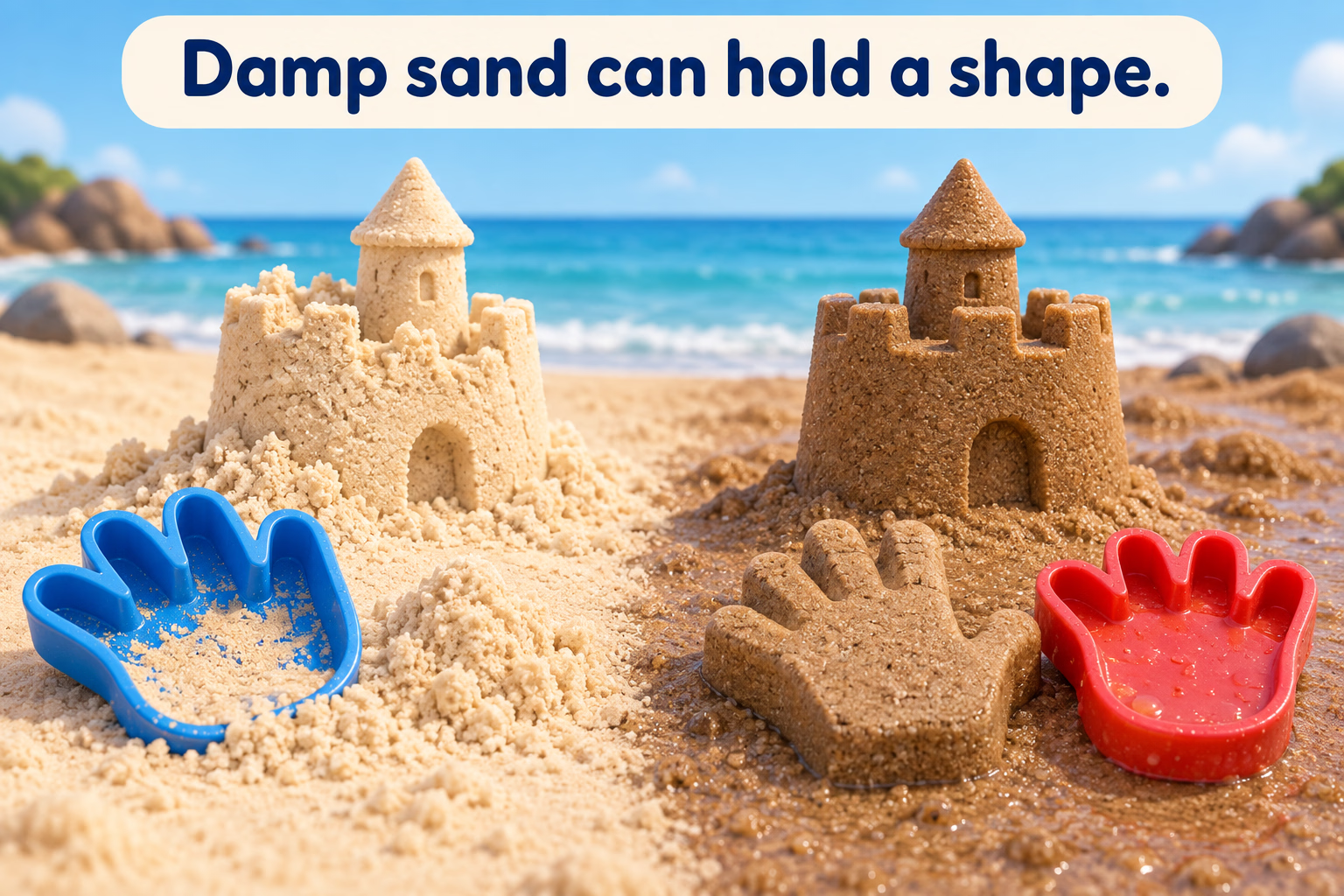
Moisture changes how sand behaves. Dry grains tend to fall apart when handled, while damp sand can hold a mold or footprint; “damp” is more precise than “sticky” when the grains are simply wet enough to cling together. Words like silky and soft are more subjective, so pair them with the setting: “soft, fine play sand” gives a clearer impression than “soft sand.”
What colors can sand be, and what do they tell you?
Sand may look white, cream, tan, golden, brown, red, green, gray, or black, but color alone does not identify its composition or origin. The National Park Service describes quartz-rich white sands, dark volcanic sand, colored minerals such as hematite and olivine, and beaches made largely of shell fragments.
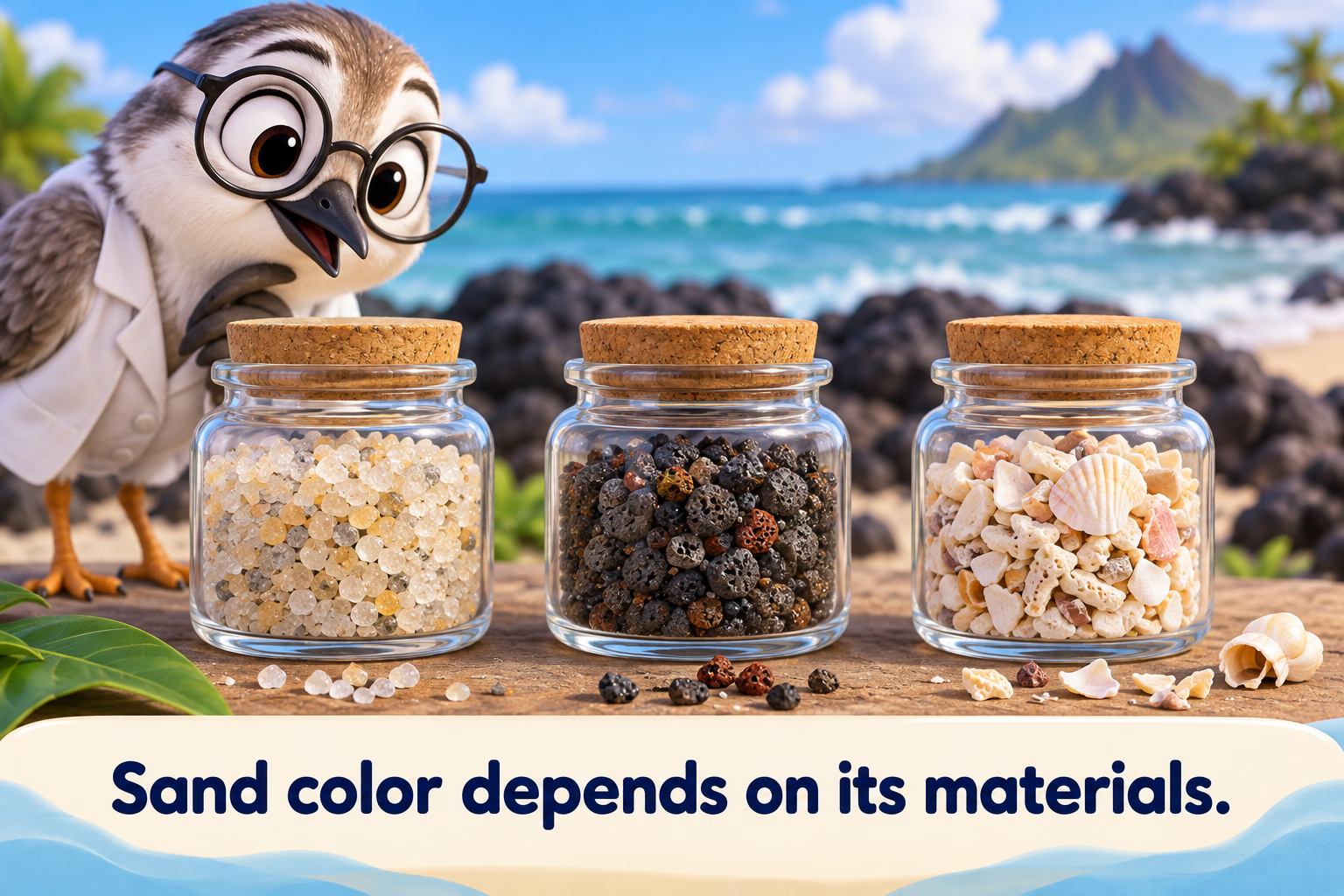
Choose an observation rather than guessing at geology: pale sand, black sand, or sand streaked with dark grains is safe description. Use a material adjective such as quartz-rich or shell-rich only when the material has been identified; color by itself is not proof of mineral content or pollution. See the National Park Service guide to sand colors for examples of how source material affects appearance.
Which adjectives fit different kinds of sand?
- Beach sand: pale, shell-strewn, damp, windblown, well-sorted, or coarse, depending on what is actually present.
- Desert sand: dry, sun-warmed, wind-rippled, fine, or shifting; avoid assuming every desert deposit is the same color or texture.
- River sand: wet, mixed-grain, rounded, or silty when these features are visible or measured.
- Play sand: clean, fine, dry, damp, or moldable; “clean” should describe inspected material, not guarantee safety.
- Construction sand: coarse, graded, washed, or mixed-size when those are supplier specifications rather than guesses.
Do not make a setting word do the work of a grain description. Deserted describes whether a place has visitors; it does not describe sand. Beachy signals a mood, while fine and rounded tell the reader about the sediment.
How can you use adjectives for sand in a sentence?
Pair one or two physical details with a setting or action. A compact phrase usually paints a sharper picture than a chain of loosely related adjectives.
- The fine, pale sand slipped through the hourglass opening.
- Windblown grains formed narrow ripples along the dune.
- Dark mineral streaks crossed the white beach after the waves receded.
- Damp, compact sand held a clear footprint until the next tide.
- Coarse grains and shell fragments crunched beneath the boots.
- The dry desert sand drifted against the stone wall.
- Rounded, golden grains glittered in the low evening light.
- A poorly sorted patch held fine sand beside scattered pebbles.
What are common mistakes when choosing sand adjectives?
- Confusing size with touch: “Coarse” means larger grains; use “rough” only for a rough-feeling surface.
- Calling everything sandy: “Sandy” can mean covered with sand or resembling it; “fine-grained” is more specific for particle size.
- Guessing the source from color: describe visible color unless mineral or shell composition is verified.
- Using nouns as adjectives: beach ball, shovel, and dune are not adjectives describing sand, even if they appear in a legacy word list.
- Treating “clean” as a safety guarantee: appearance cannot establish that sand is free from contaminants.
- Stacking near-synonyms: “gritty, grainy, coarse, rough sand” blurs four different ideas; select the one or two that matter.
Frequently Asked Questions About Adjectives for Sand
What is the best adjective for soft sand?
Use fine if you mean small grains, smooth if the surface feels even, and soft if it compresses or yields underfoot. Those qualities can overlap but are not identical: coarse sand can still feel soft when loose and dry. Add the setting for precision, such as “fine, loose beach sand.”
Is “sandy” an adjective for sand?
Yes, but sandy usually means covered with sand, containing sand, or having a sand-like color or texture. It is broad. “A sandy path” describes the path’s surface; “fine-grained sand” says more about the grains themselves.
What adjectives describe sand color?
Common color words include white, cream, tan, golden, brown, gray, red, green, and black. Select the shade you can see, and do not infer a mineral from color alone. Quartz-rich, shell-rich, or volcanic are composition descriptions and should be used only when supported by observation or a reliable source.
Can sand be described as smooth and gritty?
Yes, if the words refer to different features or samples. A beach may look smooth from a distance while individual grains feel gritty; rounded grains can also feel less sharp than angular grains. Clarify the sense: “The dune surface looked smooth, but the grains felt gritty.”
Should you describe sand as salty, bitter, or edible?
Those words are not useful descriptions of sand’s appearance or texture, and readers should not taste sand to test them. Sand can contain varied natural material and may be contaminated. Describe visible, tactile, or measured properties instead; the legacy source examples below are preserved, but they are not safety guidance.
Original Sand-Adjective Lists and Examples
Source note: The alphabetical index and examples below are preserved exactly as published. They contain mixed categories, including nouns, place names, activities, subjective judgments, and a few questionable definitions; treat them as an unreviewed brainstorming list, not a vetted set of adjectives or a scientific description. The source also mentions tasting sand: do not taste it.
Adjectives are words that modify or describe other words. They can be used to describe the physical appearance of someone or something, or to denote a particular quality. In the English language, there are many different adjectives that can be used to describe sand. Here are some of the most common ones.
sandy – covered in sand or consisting of sand
- Beach – a sandy area near the coast where people sunbathe and paddle in the se
- Dune – a hill of loose sand, often found near beaches or deserts
- Deserted – having no people living in it or visiting it regularly
- Arid – (of land) lacking sufficient water to support plant life; dry
- Parched – dried out by heat or strong sunlight; withered hope this helps! 🙂
Adjectives For Sand
Adjectives are words that describe, identify, and quantify people or things and Adjectives for sand include gritty, hot, rough, and sandy. Adjectives can be used to describe the physical appearance of sand as well as the feeling of sand. The physical appearance of sand can be described using adjectives such as grainy, granular, and particulate. The feeling of sand can be described using adjectives such as itchy, scratchy, and prickly.
Adjectives can also be used to describe the texture of sand. The texture of sand can be described using adjectives such as course, fine, smooth, and soft. Adjectives can also be used to describe the color of sand. The color of sand can be described using adjectives such as brown, black, white, and red. Adjectives can also be used to describe the smell of sand. The smell of sand can be described using adjectives such as musky, earthy, and musty.

Adjectives can also be used to describe the taste of sand. The taste of sand can be described using adjectives such as salty and bitter. Adjectives can also be used to describe the sound of sand. The sound of
A
| Abyssinian | Accessible | Active |
| Aegean | African | Agglutinated |
| Albertan | Alive | Alluvial |
| Angular | Aqua Blue | Arabian |
| Arid | Arm Floaties | Atlantic |
| Awesome |
B
Adjectives are words that describe, identify, and quantify people or things and Adjectives for sand include gritty, hot, rough, and sandy. Adjectives can be used to describe the physical appearance of sand as well as the feeling of sand. The physical appearance of sand can be described using adjectives such as grainy, granular, and particulate. The feeling of sand can be described using adjectives such as itchy, scratchy, and prickly.
Adjectives can also be used to describe the texture of sand. The texture of sand can be described using adjectives such as course, fine, smooth, and soft. Adjectives can also be used to describe the color of sand. The color of sand can be described using adjectives such as brown, black, white, and red. Adjectives can also be used to describe the smell of sand. The smell of sand can be described using adjectives such as musky, earthy, and musty.
Adjectives can also be used to describe the taste of sand. The taste of sand can be described using adjectives such as salty and bitter. Adjectives can also be used to describe the sound of sand. The sound of
| Bach Mat | Baked | Bare |
| Barren | Beach Bag | Beach Ball |
| Beach Chair | Beach Frisbee | Beach Towels |
| Beach Volleyball | Beachy | Beautiful |
| Big Surf | Bitter | Black |
| Black Sand | Blackish | Blazing |
| Bleached | Bleak | Blissful |
| Bloodstained | Bloody | Blue |
| Boardwalk | Boating | Body Surfing |
| Book | Bottomless | Brackish |
| Brave | Breezy | Bright |
| Briny | Broad | Broken |
| Brown | Bucket | Burnous |
C
| Calais | Calcareous | Calm |
| Canadian | Canoe | Canopy |
| Carefree | Careful | Caribbean |
| Casual | Celebrated | Central |
| Certain | Chalky | Choppy |
| Clayey | Clean | Clear |
| Cliff-Top | Clingy | Coarse |
| Coastal | Cold | Cold Beverage |
| Colorless | Coloured | Colourless |
| Commercial | Compact | Concentrated |
| Concrete | Concreted | Conscious |
| Convenient | Coral | Coverup |
| Crabbing | Crowded | Cruel |
| Crumb | Crystal Clear |
D
| Damp | Dangerous | Dark |
| Dated | Dazzling | De-Stressing |
| Dead | Deadly | Deep |
| Den | Deserted | Desolate |
| Developed | Devouring | Dirty |
| Dismal | Distant | Disturbed |
| Dorsetian | Dreadful | Dreary |
| Drifted | Driftwood | Dripping |
| Dry | Dull | Dusty |
E
| Earththy | Eastern | Edible |
| Emerald Green | Endless | Enjoyable |
| Enormous | Entire | Exciting |
| Exhilarating | Extensive |
F
| Faithless | Fiery | Finding Shells |
| Fine | Firm | Fishing |
| Flat | Flinty | Flip Flops |
| Flippers | Fluid | Fluvial |
| Foreign | Foundry | Fresh |
| Freshwater | Friable | Frozen |
| Fun In The Sun |
G
| Gentle | Gleaming | Globigerinoe |
| Glowing | Golden | Grained |
| Grassy | Gray | Great |
| Greedy | Green | Grey |
| Greyish | Gritty |
H
| Hard | Heavy | Hermit Crab |
| Hideous | High Tide | Hot |
| Hourglass | Humid | Hummocky |
| Hungry |
I
| Ice Chest | Idyllic | Immeasurable |
| Impassable | Industrial | Infectious |
| Infernal | Inner Tube | Isolated |
J | K | L
| Jagged | Jet Skiing | Kayak |
| Kite Flying | Lakeside | Lazy |
| Left | Libyan | Light |
| Lighterthe | Like | Liquefied |
| Lone | Lonely | Loose |
| Lovely | Low Tide | Luau |
| Luminous | Lybian |

M
| Manmade | Martian | Meaning |
| Mediterranean | Medium | Mere |
| Micaceous | Milky | Mingled |
| Modern | Moist | Moistened |
| Monazite | Mongolian | Monotonous |
| Moveable | Muddy | Murky |
| Murmurous |
N
| Naked | Narrow Stretch | Nasty |
| Native | Natural | Neap Tide |
| Neglected | Nigh | Novel |
| Numerous |
O
| Oblivious | Oceanfront | Oily |
| Open | Original | Outdoorsy |
| Overlying | Overpraised | Oversized |
P
| Pacific | Pactolian | Paddling |
| Palm Trees | Paradise | Parasailing |
| Peaceful | Pebbled | Pebbly |
| People Watching | Perfect | Pink |
| Plain | Pleasant | Pleasurable |
| Plenteous | Pool Noodles | Poor |
| Populated | Porous | Powdered |
| Powerful | Precious | Prior |
| Private | Public | Pure |
Q | R
| Quartzose | Quick | Quiet |
| Rainless | Real | Red |
| Reddish | Refreshing | Regional |
| Rejuvenating | Relaxing | Remarkable |
| Resort | Restless | Ribbed |
| Rich | Ridged | Rip Current |
| Rocky | Rolling | Rough |
| Running |

S
Adjectives are words that describe or modify other words. Adjectives for sand can include sandy, gritty, rough, smooth, and powdery. Sand is a naturally occurring material that consists of small particles of rock and mineral. It is often used in construction and landscaping. Sand can be found in a variety of colors including white, black, brown, and green.
The size of the particles can also vary, from very fine to coarse. Adjectives that describe the color of sand include white, black, brown, and green. Adjectives that describe the texture of sand include sandy, silver, simple, smooth, and snorkel. Adjectives that describe the size of sand particles include fine and coarse.
| Saltwater | Salty | Sand Dollar |
| Sand Fort | Sandbar | Sandcastle |
| Sandsthe | Sandy | Scarce |
| Scavenger Hunt | Scoriaceous | Scuba Diving |
| Seashells | Seashore | Seaside |
| Shale | Shallow | Sharp |
| Shelly | Shelving | Shifting |
| Shifty | Shoreline | Short |
| Shovel | Shrouding | Siliceous |
| Silicious | Silty | Silver |
| Silvery | Simple | Sixth |
| Sleek | Slippery | Slushy |
| Smooth | Snorkel | Snorkeling |
| Snow-White | Soft | Solitary |
| Sorted | Southern | Sparkling |
| Spiritual | Spittal | Splashing |
| Starfish | Sterile | Sticky |
| Still | Stubborn | Sunbathing |
| Sunglasses | Sunless | Sunlit |
| Sunscreen | Surfing | Sweaty |
| Swim Goggles | Swimming | Swimsuit |
T
| Tar | Tawny | Tenacious |
| Terrible | Thee | Thick |
| Thin | Thirsty | Threatening |
| Throbbing | Tidal Pool | Tide |
| Tis | Titaniferous | Torrid |
| Touristy | Trackless | Tranquil |
| Translucent | Treacherous | Treeless |
| Tropical | Turbulent |
U
| Unblemished | Uneven Shore | Unsaturated |
| Unseeded | Unspoiled | Unstable |
| Untouched | Upper |
V
| Vague | Vast | Vegetable |
| Velvet | Verbal | Virgin |
| Volcanic |
W | Y
| Wading | Wakeboarding | Walking |
| Warm | Washed | Wavy |
| Weighty | Wet | Wettest |
| Wharf | White | White Sand |
| Whitecaps | Wide | Wide Stretch |
| Wild | Wind-Blown | Windblown |
| Windy | Word | Worthless |
| Yellow |
Sand, the tiny granules that cover our beaches and deserts, may seem simple at first glance. However, when we take a closer look, we realize that sand is a world of its own, with a multitude of colors, textures, and compositions. In this article, I’ll be exploring the diverse range of adjectives that can be used to describe sand, along with examples to help paint a vivid picture in your mind.
From powdery white to golden and even black, sand comes in a variety of hues that can evoke different moods and emotions. We’ll delve into adjectives like pristine, sparkling, and velvety, to capture the essence of the sand’s appearance. Moreover, we’ll explore adjectives that describe the texture of sand, such as coarse, fine, and grainy, to give you a sense of how it feels beneath your feet.
But sand isn’t just about its appearance and texture. It also varies in composition, which affects its properties and uses. We’ll discuss adjectives like volcanic, coral, and quartz, to highlight the different types of sand and their origins. So, whether you’re a beach lover, a geology enthusiast, or simply curious about the world around you, join me as we dive into the fascinating world of adjectives for sand.
How to Describe sand? – Different Scenarios
When it comes to describing sand, there are a variety of scenarios to consider. Each scenario presents a unique set of characteristics that can be used to describe sand. Here, I’ll take you through different scenarios and the corresponding adjectives that can be used to describe sand in each case.
- Beach Sand
- Desert Sand
- Construction Sand
- Play Sand
- River Sand
Describing Words for sand in English
When it comes to describing sand, there are many adjectives we can use to paint a vivid picture. Let’s explore some of these words and how they can help us describe different types of sand!
- Soft: Soft sand feels smooth and fine to the touch. It’s great for building sandcastles!
- Fine: Fine sand grains are tiny and almost powdery. It’s perfect for creating intricate sand art.
- Coarse: Coarse sand has larger grains and feels rougher. It’s commonly used in construction projects.
- Pristine: Pristine sand is incredibly clean and free from any impurities. You’ll find this type of sand on untouched beaches.
- Damp: Damp sand is slightly wet and retains its shape when molded. It’s great for making sand sculptures.
- Hot: Hot sand has been heated by the sun and can be quite warm to walk on. Be careful not to burn your feet!
- White: White sand gets its color from the shells and coral that make up its composition. It creates a beautiful contrast against the blue ocean.
- Golden: Golden sand has a warm, yellowish hue. It’s commonly found on tropical beaches.
- Sparkling: Sparkling sand has tiny reflective particles that shimmer in the sunlight. It’s like walking on a glittering carpet!
- Grainy: Grainy sand has noticeable grains that can be felt when touched. It’s commonly used in sandboxes for children to play with.
Read: Adjectives & Linking Verbs: Be, Seem, Taste Explained
Remember, these adjectives are just a starting point. Feel free to mix and match them to create your own unique descriptions of sand. The possibilities are endless!
By using these descriptive words, we can engage young learners and help them build their vocabulary while providing them with a fun and informative experience.
Adjectives for sand
When it comes to describing sand, there are a variety of adjectives that can help paint a vivid picture. Whether it’s beach sand, desert sand, or construction sand, each type has its own unique characteristics. Let’s explore some positive and negative adjectives for sand along with example sentences to help expand your vocabulary.
Positive Adjectives for Sand
Here are twelve positive adjectives that can be used to describe different types of sand:
| Adjective | Definition |
|---|---|
| Soft | Having a smooth texture |
| Fine | Having a small particle size |
| Coarse | Having a large particle size |
| Pristine | Clean and untouched |
| Damp | Slightly wet |
| Hot | Heated by the sun |
| White | Having a light color |
| Golden | Having a yellow or golden color |
| Sparkling | Shimmering or glittering |
| Grainy | Having noticeable grains |
| Powdery | Fine and dry, resembling powder |
| Silky | Smooth and slippery to the touch |
Example Sentences:
- The soft sand at the beach felt delightful between my toes.
- We built a sandcastle using the fine sand we found at the playground.
- The coarse sand was perfect for creating traction on the icy road.
- The beach was so pristine that it looked like nobody had ever set foot on it.
- After a rain shower, the sand on the playground became damp and cool.
… (continue with the other sentences)
Read: Adjectives for Fabric: Examples of Describing Words
Negative Adjectives for Sand
While we often associate positive qualities with sand, there are also a few negative adjectives that can be used to describe it. Here are five negative adjectives for sand:
| Adjective | Definition |
|---|---|
| Rough | Having an uneven texture |
| Dirty | Contaminated or soiled |
| Gritty | Coarse and granular |
| Sticky | Adhering to other surfaces |
| Clumpy | Forming lumps or clumps |
Example Sentences:
- The rough sand scratched my skin as I walked along the beach.
- The construction site was full of dirty sand and debris.
- My sandals were covered in gritty sand after my hike in the desert.
- The sticky sand made it difficult to remove my flip flops.
- The clumpy sand in the sandbox was hard to mold into shapes.
Remember, introducing young learners to new words and helping them build their vocabulary is an important part of their education. Encourage them to explore and describe different types of sand using these colorful adjectives.
Synonyms and Antonyms with Example Sentences
Synonyms for sand
When it comes to describing sand, there are several adjectives that can be used interchangeably to capture its unique qualities. Here are some synonyms that can help young learners expand their vocabulary:
- Soft: The sand at the beach is soft and easy to walk on.
- Fine: The desert sand is made up of fine particles that can easily blow in the wind.
- Coarse: Construction sand has a coarse texture, perfect for building structures.
- Pristine: The untouched beach had pristine white sand that sparkled in the sun.
- Damp: When we dug into the river sand, it felt slightly damp.
- Hot: The sand on a sunny day can get really hot under the feet.
- White: The white sand on the Caribbean beaches is incredibly beautiful.
- Golden: The sun set over the horizon, casting a golden glow on the sandy beach.
- Sparkling: The sand at the beach sparkled in the sunlight, creating a breathtaking scene.
- Grainy: Play sand has a grainy texture, making it perfect for building sandcastles.
Read: Describing Words for Turkey: Synonyms & Examples
Antonyms for sand
To provide a comprehensive understanding of adjectives, it is important to explore not only the synonyms but also the antonyms for sand. Here are some contrasting adjectives to describe sand:
- Hard: Unlike the soft beach sand, the sandstone has a hard surface.
- Rough: The desert sand can be very rough, making it difficult to walk on.
- Smooth: Unlike the coarse construction sand, polished sandstone is smooth to the touch.
- Dirty: The sand in the river appeared dirty due to the presence of sediment.
- Cold: During winter, the sand in some places can be quite cold.
- Colored: Play sand comes in various colors, making it more visually appealing.
By introducing young learners to both synonyms and antonyms for sand, we can help them develop a more nuanced understanding of descriptive language. Encourage children to explore and describe different types of sand, using these adjectives to create vivid and engaging descriptions.
I hope this article has provided you with a comprehensive understanding of the various adjectives that can be used to describe different types of sand. By exploring the characteristics and corresponding adjectives for beach sand, desert sand, construction sand, play sand, and river sand, we have expanded our vocabulary and developed a more nuanced understanding of descriptive language.
Through the list of synonyms and antonyms for sand, along with example sentences, we have gained valuable insights into how these adjectives can be used in context. This knowledge can be particularly helpful for young learners who are in the process of developing their vocabulary and language skills.
As educators, it is important for us to introduce young learners to these adjectives and encourage them to explore and describe different types of sand. By doing so, we not only enhance their language abilities but also foster their curiosity and observation skills.
So, next time you come across sand, take a moment to observe its texture, color, and composition. Use the adjectives we have discussed to describe it accurately and vividly. Let’s continue to expand our descriptive language and appreciate the beauty and diversity of the world around us.
Final verdict
In conclusion, there are many adjectives that can be used to describe sand. Depending on the type of sand, it can be fine or course, light or dark, dry or wet. It can also be smooth or rough, and can vary in size from sand grains to sand dunes. Ultimately, the best adjective to describe sand will depend on its specific properties and how it is being used.


