
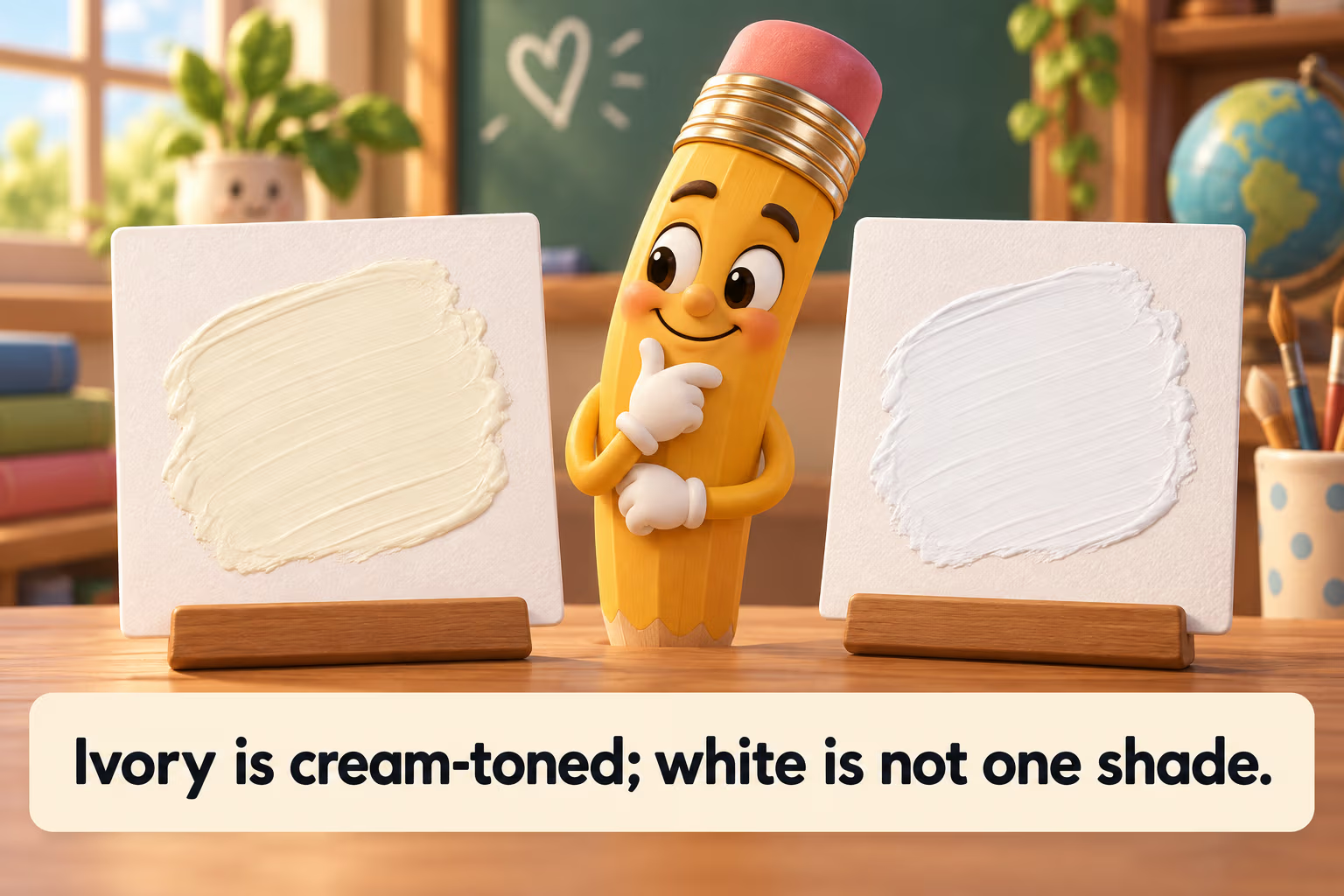
Adjectives for white can describe different things: the shade or undertone, the brightness of light, a surface or material, or a mood the writer wants to suggest. Choose the word that matches what you can observe first. For example, ivory is cream-toned, while blinding describes extreme brightness rather than a paint color.
Quick guide
- For hue, name the shade: ivory, off-white, or creamy.
- For brightness or reflection, choose luminous, gleaming, or blinding glare.
- For a surface or its state, use crisp, pristine, blank, or glistening with a clear noun.
- Words such as pure, serene, and sterile communicate a possible interpretation, not a universal meaning of white.
- Check whether the word describes color, light, texture, state, or mood before using it.
Which Adjectives Describe a Shade of White?
Shade words identify the appearance of the color itself. Ivory points to a pale cream color, and off-white describes white with a little gray or yellow. Creamy suggests warmth; snowy evokes fresh snow; and silvery suggests a cool, reflective look. The exact impression depends on the object and its lighting. See the definitions of ivory and off-white.
Which Words Describe White Light or Reflection?
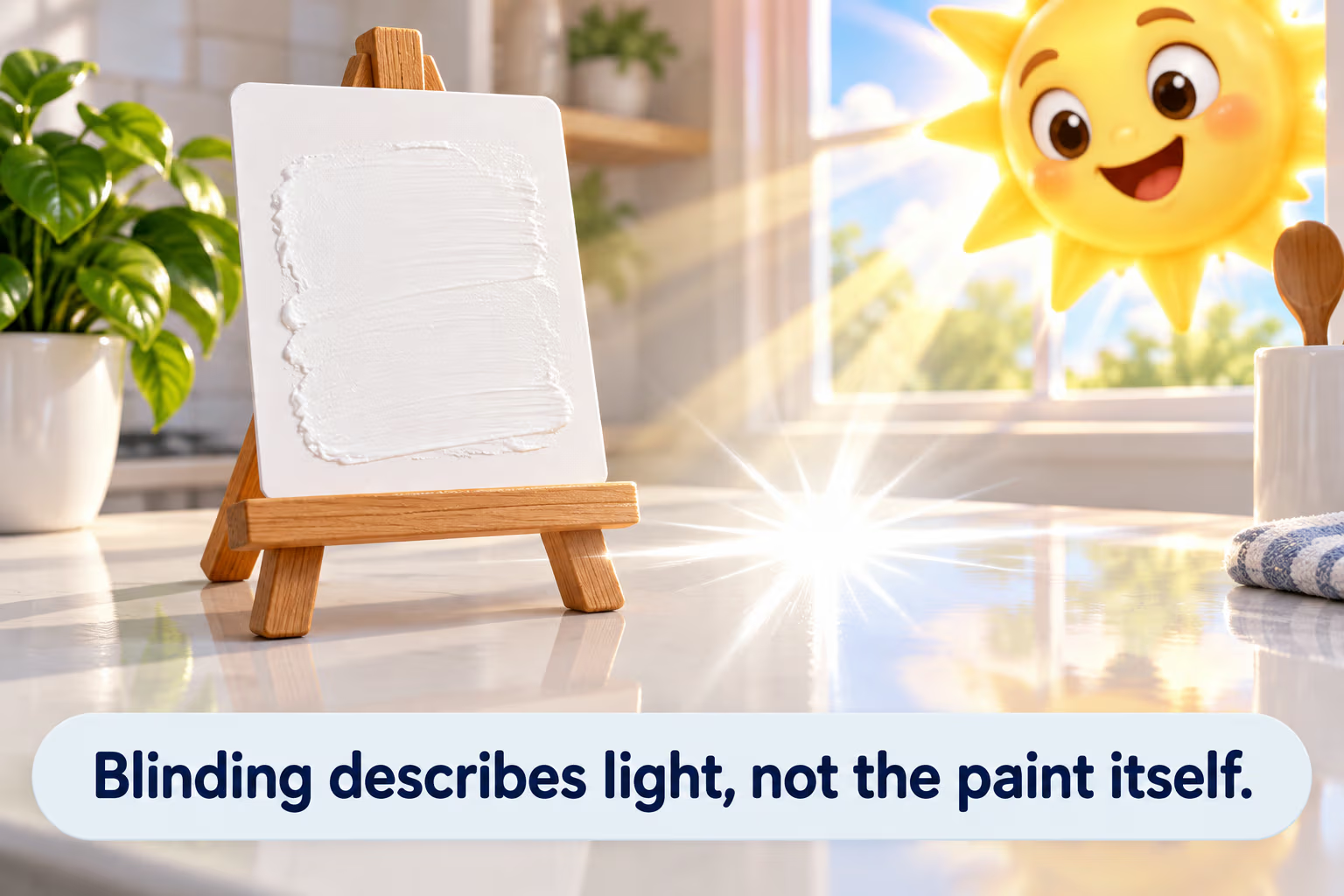
Radiant, gleaming, and luminous focus on brightness or light. Pearlescent suggests a soft, pearly sheen, while dull and washed-out describe reduced shine or intensity. Blinding means extremely bright, so it usually modifies light, glare, or a source of reflection: “Sunlight made the white wall look blindingly bright.” That describes the visual effect, not a fixed paint shade. See Cambridge’s definition of blinding.
When Is a White Adjective a Mood or Metaphor?
Pure, innocent, angelic, serene, peaceful, sterile, and stark may express a writer’s association or the mood of a scene. They are interpretations, not universal properties of white. A useful description starts with visible details—shade, brightness, texture, and setting—then adds a mood word only when that is the intended effect.

The complete original examples and both source tables are preserved below. The added notes after that source block clarify which feature each word describes without changing the original wording.
White is a color that is often associated with purity, innocence, and cleanliness. It is a versatile shade that can be used to describe a wide range of things, from objects to emotions. In this article, I’ll be exploring a variety of adjectives that can be used to describe the color white, along with examples to help you better understand their usage. Whether you’re looking to add depth to your writing or simply expand your vocabulary, these adjectives will help you paint a vivid picture with words.
When it comes to describing white, there are many adjectives that can be used to capture its essence. From “crisp” to “radiant,” these words can help convey the different qualities and characteristics associated with this color. For example, imagine a snowy landscape bathed in the soft glow of the moonlight – you could describe it as “ethereal” or “serene.” Or perhaps you’re trying to convey the pureness of a wedding dress, in which case you might use words like “pristine” or “angelic.” By using these adjectives, you can bring your descriptions to life and engage your readers in a more vivid and captivating way.
In this article, we will explore a plethora of adjectives that can be used to describe the color white. From its association with purity and innocence to its use in describing objects and emotions, there are countless ways to bring this versatile shade to life. By incorporating these adjectives into your writing, you can create a more immersive and engaging experience for your readers. So whether you’re a writer looking to enhance your descriptions or simply someone who wants to expand their vocabulary, this article is for you. Get ready to dive into the world of adjectives for white and discover new ways to paint with words.
How to Describe white? – Different Scenarios
When it comes to describing the color white, there is a myriad of adjectives that can be used to capture its essence in different scenarios. Whether you’re trying to paint a vivid picture, evoke a certain emotion, or simply expand your vocabulary, incorporating descriptive words can enhance your writing and engage your readers. Let’s explore various scenarios where these adjectives can be effectively used:
1. Describing Objects
When describing objects that are white, you can use adjectives like:
- Crisp: Think of freshly laundered sheets or a white, pressed shirt.
- Radiant: This adjective captures the bright and glowing quality of the color white.
- Pristine: Use this word to describe something that is flawlessly clean and untouched.
- Ethereal: Employ this adjective to convey the delicate and airy nature of a white lace dress or the softness of white clouds.
- Gleaming: Use this word when describing a polished white surface that reflects light.
2. Depicting Emotions
Sometimes, we use colors to symbolize emotions. Here are some adjectives to describe emotions associated with the color white:
- Serene: White can convey a sense of calm and tranquility.
- Pure: This word highlights the innocence and goodness often associated with white.
- Peaceful: White can evoke feelings of harmony and peace.
- Delicate: Use this adjective to describe emotions that are gentle and fragile, like a pure white rose.
3. Painting a Visual Landscape
When describing a white landscape, you can use adjectives like:
- Snowy: This word instantly brings to mind a winter wonderland covered in white snow.
- Blank: Use this adjective to depict a white canvas or a pristine sheet of paper, ready to be filled with ideas or art.
- Glistening: Imagine a white sandy beach reflecting the sunlight, creating a glistening effect.
- Silent: This adjective portrays the absence of sound, depicting a calm and quiet white world.
As you can see, the color white lends itself to a wide range of descriptive possibilities. Incorporating these adjectives into your writing can create a more engaging experience for your readers, painting a vivid picture and evoking powerful emotions.
Describing Words for white in English
When it comes to describing the color white, there are a multitude of adjectives that can capture its essence. In this section, I’ll be exploring some of these descriptive words to help enhance your writing and expand your vocabulary. Let’s dive in!
- Pure: White can often evoke a sense of purity, making this the perfect word to describe a clean, untouched surface or object. For example, “The fresh snow was pure and untouched.”
- Radiant: Use this adjective to describe something that emits a glowing, bright white light. For instance, “The bride looked radiant in her white wedding gown.”
- Gleaming: This word signifies a shining, polished white surface that reflects light beautifully. Imagine describing a marble floor that is impeccably clean and gleaming.
- Ivory: If you’re looking for a more elegant and subtle way to describe white, using the word “ivory” can be a great choice. It adds a touch of sophistication and hints at a creamy shade of white. An example could be, “She wore a stunning ivory dress to the gala.”
- Crisp: Use this adjective when you want to convey a fresh and sharp white appearance. It can be applied to clothing, paper, or any object that has a clean and well-defined white color. Think of a new, crisp white shirt or a neatly folded white sheet.
It’s important to note that these examples are just a starting point, and there are countless other words that can be used to describe the color white. Incorporating these adjectives into your writing can help create vivid descriptions and engage your readers in a more immersive experience.
Adjectives for white
When it comes to describing the color white, there are numerous adjectives that can be used to convey different aspects and characteristics. Let’s explore some positive and negative adjectives for white and see how they can enhance our descriptions.
Positive Adjectives for White
White can be associated with purity, lightness, and simplicity. Here are twelve examples of positive adjectives that can be used to describe the color white:
| Adjective | Definition | Example Sentence |
|---|---|---|
| Pure | Not mixed with anything else | The bride’s dress was pure white. |
| Radiant | Shining brightly | The sun cast a radiant white light on the snow. |
| Gleaming | Shiny and bright | The kitchen appliances had a gleaming white finish. |
| Ivory | A creamy white color | The antique piano had beautiful ivory keys. |
| Crisp | Clean and fresh | The bedsheets were crisp white, giving the room a luxurious feel. |
| Silvery | Resembling silver | The moonlight reflected off the snow, giving it a silvery white appearance. |
| Pristine | Perfectly clean and untouched | The snow-covered landscape looked pristine and untouched. |
| Pearlescent | Having a smooth, iridescent shine like a pearl | The car had a pearlescent white paint job that glistened in the sunlight. |
| Glacial | Resembling ice or glaciers | The mountain peaks were covered in a glacial white snow. |
| Ethereal | Delicate and otherworldly | The ballerina’s outfit was ethereal, flowing and white, as if she belonged in a dream. |
| Snowy | Resembling or covered in snow | The cabin sat in a peaceful, snowy white landscape. |
| Luminous | Emitting light or glowing softly | The full moon bathed the night in a luminous white glow. |
Negative Adjectives for White
While white is often associated with positivity, there are also negative adjectives that can be used to describe it in certain contexts. Here are five examples:
| Adjective | Definition | Example Sentence |
|---|---|---|
| Dull | Lacking brightness or interest | The faded curtains were a dull shade of white. |
| Bland | Lacking flavor or excitement | The cake had a bland white frosting that didn’t add much to the taste. |
| Washed-out | Faded or lacking intensity | The old photograph had a washed-out white background. |
| Stark | Harsh and unadorned | The sterile hospital room had stark white walls. |
| Blinding | Extremely bright and dazzling | The sun reflected off the snow, creating a blinding white glare. |
Remember, these are just a few examples of the adjectives that can be used to describe the color white. Feel free to explore further and discover other words that can enrich your descriptions. By incorporating these adjectives, you can create vivid and engaging descriptions that will captivate your readers and immerse them in a more colorful world.
Synonyms and Antonyms with Example Sentences
Synonyms for White
When it comes to finding the right words to describe white, there are plenty of synonyms that can help you convey different nuances and shades. Here are some synonyms for white:
- Pure: The snow was pure white, untouched by any other color.
- Radiant: The bride looked stunning in her radiant white gown.
- Gleaming: The marble floors shone with a gleaming white luster.
- Ivory: The antique clock had a beautiful ivory face.
- Crisp: The clean, crisp white sheets made the bed look inviting.
By using these synonyms, you can add depth and variety to your descriptions of white. Whether it’s the purity of freshly fallen snow or the radiance of a bride on her wedding day, these words can help paint a vivid picture in your readers’ minds.
Antonyms for White
Sometimes, it’s helpful to use antonyms to provide a contrasting description of white. Antonyms can help create a stronger visual impact and highlight the differences between different shades. Here are some antonyms for white:
- Dull: The old, yellowed paper had lost its brightness and become dull.
- Bland: The white walls of the room gave it a bland and sterile appearance.
- Washed-out: The once vibrant colors had faded, leaving a washed-out white.
- Stark: The white room felt stark and devoid of any warmth.
- Blinding: The bright white light from the flashlight was blinding.
These antonyms can be used to describe a lack of vibrancy or to emphasize a stark contrast to a bright white. By incorporating these antonyms into your writing, you can add depth and complexity to your descriptions.
By using synonyms and antonyms, writers can create more evocative and engaging descriptions of white. Whether you want to emphasize purity and radiance or highlight dullness and starkness, these words can help you paint a vivid picture in the minds of your readers. So go ahead, explore further, and discover even more words that can enrich your descriptions. The possibilities are endless.
Conclusion
In this article, I have explored a range of adjectives that can be used to describe the color white. By incorporating these adjectives into your writing, you can create vivid and engaging descriptions that captivate readers and immerse them in a more colorful world.
From positive adjectives like “pure,” “radiant,” and “gleaming” to negative adjectives such as “dull,” “bland,” and “washed-out,” there are countless words to choose from when describing white. These examples are just a starting point, and I encourage you to further explore and discover other words that can enrich your descriptions.
In addition to adjectives, I have also discussed synonyms and antonyms for white, providing examples and explaining how they can be used to add depth and variety to descriptions.
By expanding your vocabulary and incorporating these descriptive words, you can elevate your writing and create more evocative and engaging descriptions of white. So go ahead, experiment with these adjectives, and let your words paint a vivid picture in the minds of your readers.
How Should You Choose an Adjective for White?
Start with the noun and the feature you want readers to picture. A white wall can have an ivory shade, a gleaming finish, or a pristine surface; those phrases describe different qualities. Use the table to choose a word that fits the evidence in the scene.
| Adjective | What it describes | Example |
|---|---|---|
| Ivory | A pale cream shade | “The invitation was printed on ivory paper.” |
| Off-white | White with a slight gray or yellow cast | “They chose an off-white curtain for the room.” |
| Creamy | A warm, cream-like appearance | “A creamy glaze covered the ceramic bowl.” |
| Snowy | A snow-like shade, surface, or covering | “Snowy peaks stood beyond the dark trees.” |
| Silvery | A cool or reflective appearance | “The fabric had a silvery-white sheen.” |
| Radiant | Strong brightness or a glowing effect | “A radiant patch of light fell across the page.” |
| Gleaming | Light reflected from a smooth or polished surface | “The gleaming tiles reflected the window.” |
| Pearlescent | A soft, pearl-like sheen | “Pearlescent paint shimmered when the angle changed.” |
| Blinding | Extremely bright light or glare | “The blinding glare made the snow hard to look at.” |
| Crisp | A fresh, neat look or a sharply defined edge | “The crisp white collar held its shape.” |
| Pristine | A clean-looking or untouched state | “The pristine tablecloth had no visible marks.” |
| Blank | Absence of writing, marks, or content | “She placed a blank white card beside the flowers.” |
| Glistening | A wet or shiny surface catching light | “Glistening frost covered the white rail.” |
| Glacial | Ice-like appearance, coldness, an unfriendly manner, or slowness | “A glacial pace delayed the work.” |
| Pure or serene | A possible symbolic or mood association | “The writer described the quiet, white room as serene.” |
Which Common Examples Need More Context?
Some words listed as adjectives for white do not name a hue. Keep them in the article’s vocabulary, but connect them to the feature they actually describe:
- Silent: this describes sound or the absence of sound. “A silent room with white walls” is clear; “silent white” alone does not name a color quality.
- Blank: this describes a surface without marks or content. Say “a blank sheet of white paper” when both the color and the unmarked state matter.
- Blinding: this describes extreme brightness. Use “blinding white glare” or “light reflecting off the snow” to identify the source of the effect.
- Glacial: this can refer to ice or cold, an unfriendly manner, or a very slow pace. Cambridge lists these senses; it is not a general synonym for white. Use an ice-like comparison only when the appearance supports it.
- Pure, innocent, and angelic: these can signal a literary or personal association. They should not be presented as universal meanings shared by every reader or culture.
Likewise, sterile, stark, bland, delicate, and ethereal convey an impression or mood in context. A white room may look stark to one observer and calm to another. The surrounding nouns and details make the intended meaning clearer.
How Can You Make a White Description More Precise?
- Name the shade or undertone. Is it cream-like, grayish, snowy, or silvery?
- Describe the light. Is the surface dim, softly glowing, reflective, or catching intense glare?
- Identify the material and state. Is the fabric pressed, the page unmarked, or the tile polished?
- Use a mood word as an interpretation. Give readers observable details before calling a scene serene, sterile, or angelic.
- Check the noun. Make sure the adjective describes the thing it modifies, such as “gleaming tiles” or “blinding glare.”
Examples of Adjectives for White in Sentences
- “The off-white curtains looked warmer beside the cool gray wall.”
- “A pearlescent finish gave the white bowl a soft sheen.”
- “The crisp, white shirt had a sharply pressed collar.”
- “Blinding sunlight reflected from the fresh snow.”
- “An unmarked white card sat beside the handwritten note.”
- “The writer called the quiet room serene, then described its pale walls and open windows.”
For a wider vocabulary organized by color, see our guide to color adjectives. The meanings of ivory, off-white, blinding, and glacial are supported by the linked Cambridge entry for ivory, entry for off-white, entry for blinding, and entry for glacial.
Frequently Asked Questions About Adjectives for White
What are good adjectives to describe white?
Useful choices depend on what you want to describe. Ivory, off-white, and creamy name shades; gleaming and luminous describe light; crisp and pristine describe a surface or state. Use mood words such as serene as an interpretation, not a universal color meaning.
Is ivory the same color as white?
Ivory is a pale cream shade, so it is a warmer variation associated with white rather than an exact synonym for every white. Off-white can have a slight gray or yellow cast. These words help readers picture a particular tone when the exact shade matters.
Can you describe an object as blinding white?
You can use blinding white figuratively, but blinding refers to extreme brightness or glare. For precision, say “blinding light reflected from the white wall” or “blinding glare on the snow.” That wording identifies the intense light effect rather than treating it as a separate paint color.
Does white always symbolize purity or innocence?
No single symbolic meaning applies in every situation. A writer may use pure, innocent, or angelic to express an association, but readers’ interpretations can vary by context and culture. Describe the visible shade, light, and setting first, then make the intended symbolism clear.
What does glacial mean when describing something white?
Glacial can refer to ice or cold, an unfriendly manner, or a very slow pace. It does not simply mean “white.” Use it for a white surface only when you mean an ice-like appearance, and make that comparison clear; use ivory or off-white for a shade.


