Ancillary in a Sentence: Meaning and Examples
Ancillary describes something that supports a more important thing, so ancillary in a sentence normally shows what is being helped. The adjective sits before its noun, as in ancillary services, ancillary staff and ancillary costs, and the preposition to links it to whatever it serves, as in “ancillary to the main course.”
Ancillary at a glance
- Ancillary is an adjective meaning supporting or supplementary; the related noun is ancillaries.
- The dominant patterns are ancillary plus a noun and ancillary to plus a noun.
- It belongs to formal business, medical and technical writing rather than casual speech.
- Common collocations are ancillary services, ancillary staff, ancillary equipment and ancillary costs.
- The commonest error is treating ancillary as a synonym for optional, when it means supporting, not disposable.
What does ancillary mean?
Ancillary is an adjective meaning providing support to something more important, or additional and supplementary to it. The Cambridge entry for ancillary records both the supporting and the supplementary senses, and the two overlap, because a support service is usually also an extra one.
As a noun, ancillaries are the people or items that play that supporting role, such as the technicians and stagehands behind a production. Where the emphasis falls on something attached to a larger whole, adjunct is the closer word.
Ancillary is the wrong choice when nothing is being supported: a broken printer is not ancillary, it is simply broken. It also does not mean optional, because an ancillary service can be essential to the main one.
| Sense | Plain meaning | Example sentence |
|---|---|---|
| Supporting (adjective) | Provides secondary help to something larger | The hospital keeps ancillary staff on every ward. |
| Supplementary (adjective) | Added on top of the main item | The flat fee covers meals and ancillary charges. |
| Support item (noun) | A person or thing in a supporting role | The laboratory ancillaries arrived in a separate van. |
Register matters as much as grammar here. In a hospital memo, ancillary staff is neutral and precise; in a message to a friend, the same phrase sounds like a policy document, and extra or backup does the work more naturally.
How do you use ancillary in a sentence?
Ancillary follows two main patterns. It sits in front of the noun it describes, or it follows the verb be with the preposition to naming what it supports.
| Pattern | Example | What it signals |
|---|---|---|
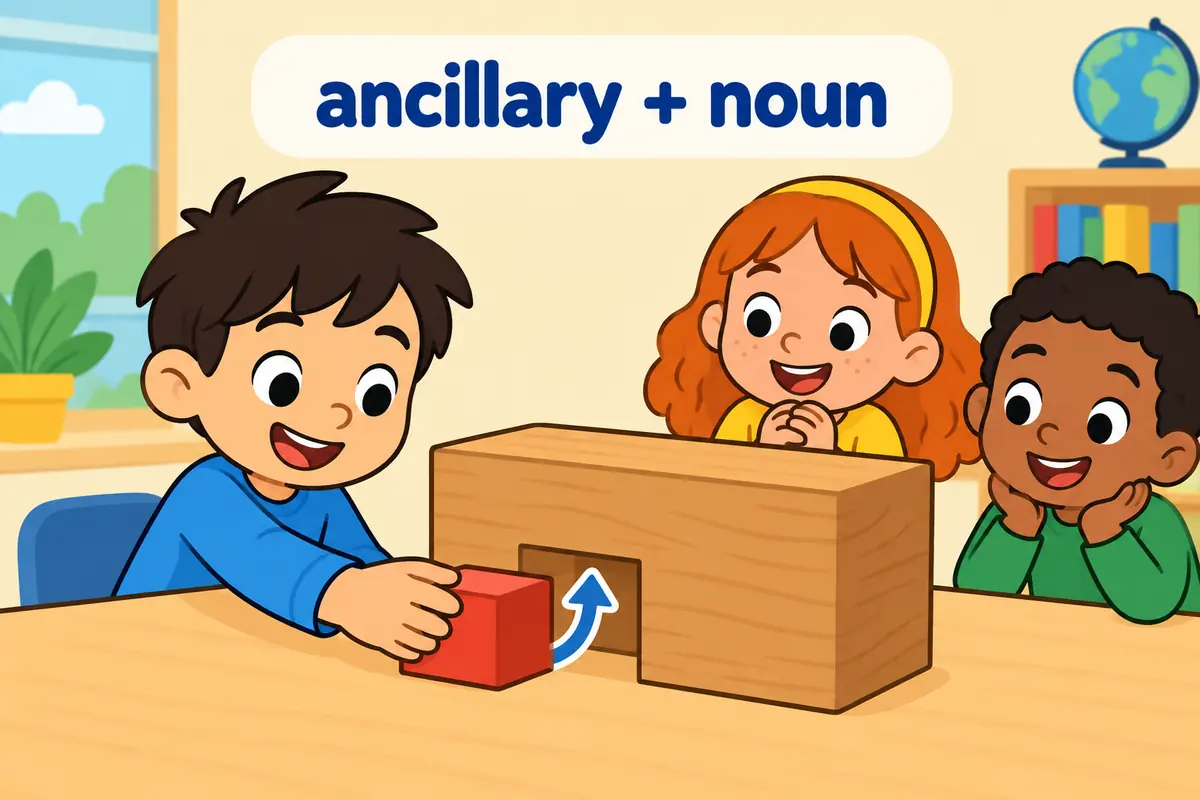
| ancillary + noun | Ancillary staff handle cleaning and transport. | The adjective points forward to the thing that supports. |
| ancillary to + noun | These permits are ancillary to the main application. | States what the smaller item is attached to. |
| be ancillary to | The fee is ancillary to the service, not separate. | Links a cost or duty to its principal. |
| ancillaries (noun, plural) | The ancillaries include meals and insurance. | Names the extras as a group. |
A supplementary form or item belongs to the same family, so supplementary can often replace ancillary without changing the meaning, especially when the item is a form rather than a service.
Ancillary in a sentence: examples across contexts
The adjective keeps the same shape across registers, but the company it keeps changes. Each row below shows why the sentence works, from a classroom note to a legal clause.
| Context | Example sentence | Why this works |
|---|---|---|
| Classroom | The teacher listed the ancillary materials needed for the science fair. | Places the adjective directly before the noun it supports. |
| Workplace email | Please note that travel and ancillary costs are billed separately. | Signals an extra cost attached to a main purchase. |
| News report | Hospital ancillaries such as porters and cleaners also joined the strike. | Uses the noun plural for people in support roles. |
| Medical writing | Ancillary tests were ordered to confirm the scan. | Shows a secondary test supporting a primary finding. |
| Legal writing | The clause is ancillary to the lease and cannot stand alone. | Uses ancillary to attach a provision to its principal. |
| Conversation | We added a few ancillary bits, like tape and spare batteries. | Keeps the adjective informal but still noun-first. |
| Academic writing | Ancillary data supported the main survey findings. | Positions auxiliary evidence beneath a primary dataset. |
| Business report | Ancillary revenue from snacks offset slower ticket sales. | Names a secondary income stream in formal register. |
| Retail | The shop lists its ancillary services, such as gift wrapping. | Uses the adjective for add-on services attached to a main sale. |
| Sports writing | Ancillary coaches support the head coach during matches. | Names support staff in a team setting. |
| Hospitality | Room rates exclude ancillary fees for parking and breakfast. | Signals small charges attached to a main booking. |
| Research funding | The grant covers ancillary expenses such as printing and travel. | Marks secondary costs tied to a main budget. |
An accessory plays the same supporting role for an object rather than a service. A peripheral duty also sits at the edge of the main task, but it still counts as part of it rather than as the centre.
Ancillary vs auxiliary
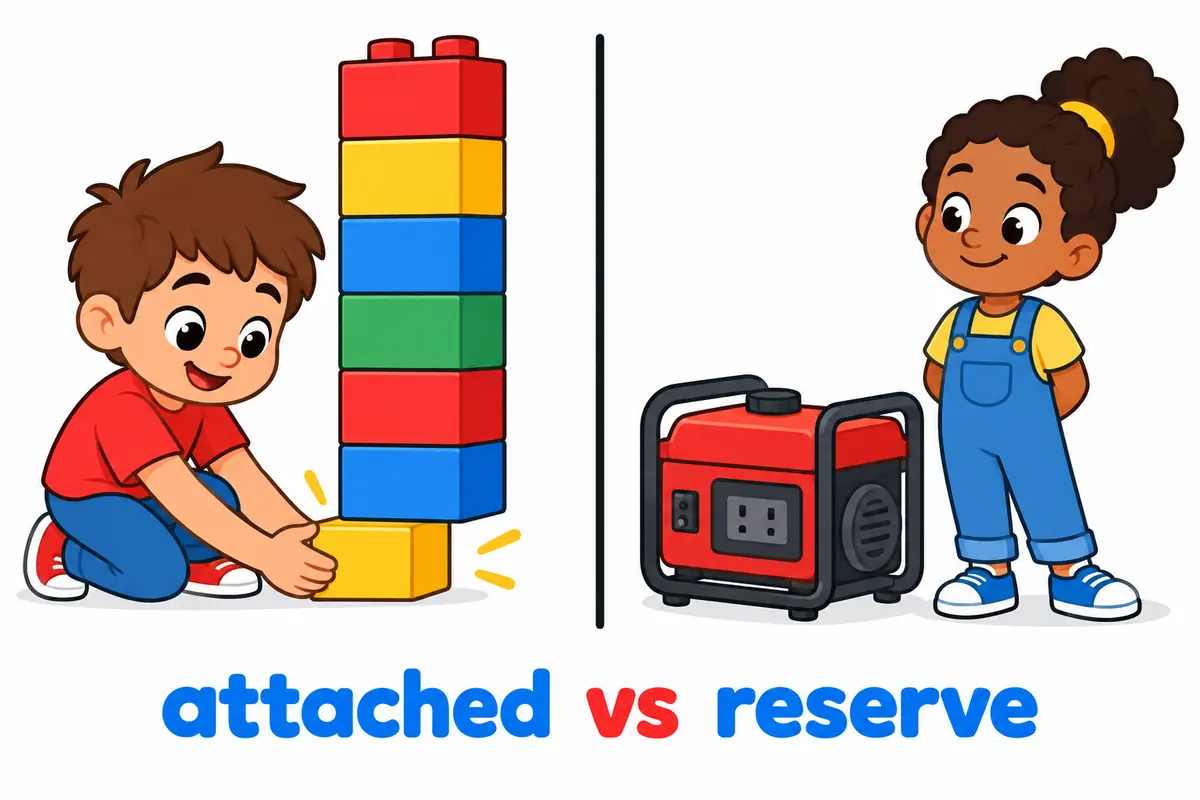
Ancillary and auxiliary both describe support, but they divide the work. Ancillary names support attached to a specific main thing, while auxiliary names a helper or reserve that can act on its own.
| Attribute | Ancillary | Auxiliary |
|---|---|---|
| Core meaning | Supporting something primary | Providing backup or reserve help |
| Typical partner | Services, staff, costs, equipment | Engines, verbs, staff, power, troops |
| Register | Business, legal and medical writing | Technical, grammatical and military writing |
| What it implies | Attached to a named main thing | Available in reserve or as a helper |
| Common slip | Using it for anything extra | Using it for ordinary support staff |
The verdict is simple: choose ancillary when the support hangs on a named main thing, and auxiliary when the helper stands by as a reserve.
Notice where each survives. Auxiliary appears where a system can switch to a spare, as with an auxiliary engine or an auxiliary verb, while ancillary appears where the support is ongoing, as with ancillary staff. The two rarely swap without a shift in meaning.
Word forms and grammar of ancillary
| Form | Part of speech | Example |
|---|---|---|
| ancillary | adjective | Ancillary duties are listed in the contract. |
| ancillaries | noun (plural) | The ancillaries were delivered on Friday. |
| ancillary | noun (rare singular) | Each ancillary reports to the ward manager. |
| ancillarily | adverb (not standard) | Writers avoid ancillarily and use a phrase such as in a supporting role. |
Learners sometimes invent the adverb ancillarily by analogy with formally. It does not exist in standard use, so a phrase like in an ancillary way is the safe rewrite.
The adjective also has no comparative or superlative form in ordinary use, so writers say more ancillary rather than ancillarier, a form that never appears in edited English.
Common mistakes with ancillary
- Incorrect: The meeting was ancillary for the project. Correct: The meeting was ancillary to the project. Rule: the adjective pairs with to, not for.
- Incorrect: Ancillary means optional, so we can drop it. Correct: Ancillary means supporting a main thing, so it may be essential. Rule: optional means removable; ancillary means serving the main thing.
- Incorrect: The ancillary is important to the team. Correct: The ancillaries are important to the team. Rule: as a noun it is normally plural.
- Incorrect: We hired ancillary last month. Correct: We hired ancillary staff last month. Rule: the adjective needs its noun and rarely stands alone.
- Incorrect: She works as ancillary. Correct: She works in an ancillary role. Rule: name the role, not the bare adjective.
- Incorrect: The ancillaries cost was high. Correct: The ancillary cost was high. Rule: use the adjective before a singular noun; reserve ancillaries for the plural noun.
Practice using ancillary
- Fill in the blank: The hospital hired ___ staff to support the nursing team.
- Choose the better word: The generator is (ancillary / auxiliary) because it runs only when the mains fail.
- Correct the error: The insurance was ancillary for the loan.
- Build a sentence: Use ancillary to describe a permit attached to a building project.
- Spot the register: Which sentence belongs in a contract? (a) We threw in some ancillaries. (b) Ancillary costs are payable by the tenant.
- Fill in the blank: Ticket revenue fell, but ___ sales of drinks and snacks held steady.
- Fill in the blank: The school pays for ___ transport on every field trip.
- Choose the better word: The team hired (ancillary / accessory) workers to support the lab.
Answers
- ancillary — it supports the main nursing work.
- auxiliary — the generator is a reserve that activates in an emergency.
- The insurance was ancillary to the loan — ancillary takes the preposition to.
- The parking permit is ancillary to the building project — ancillary to attaches a minor item to its principal.
- (b) — contracts use the formal noun-first pattern, not the casual phrase threw in.
- ancillary — the adjective modifies sales and marks them as secondary income.
- ancillary — the adjective modifies transport as a supporting cost.
- ancillary — people who support a main team are ancillary, not accessory.
The bottom line
Ancillary means supporting something more important, so in a sentence it almost always sits before a noun or after the preposition to. Using ancillary in a sentence correctly means naming what it supports, because the word carries little meaning on its own. Choose auxiliary instead when the helper is a standby rather than an attachment, and never treat ancillary as a synonym for optional. The single rule to keep is that ancillary to marks the link, while a bare ancillary needs a noun.
Frequently asked questions about ancillary
Is ancillary a noun or an adjective?
Ancillary works as an adjective in most sentences, as in ancillary staff, and as a noun when it names the supporting item itself, usually in the plural form ancillaries. The adjective is far more common, so learners can safely default to the noun-first pattern and reserve the noun form for lists of extras.
Does ancillary mean the same as optional?
No. Optional means you can remove the item without harming the main thing, while ancillary means the item supports the main thing. An ancillary service may be essential, so the quick test is to ask whether the main thing still works without it. If it still works, optional; if it serves it, ancillary.
What preposition follows ancillary?
The preposition is to. Something is ancillary to a main activity, a main claim or a main building, as in permits ancillary to a project. Using for after ancillary is the single most common learner error, and swapping in to fixes nearly every instance of it.
Can ancillary describe people?
Yes, but as a plural noun rather than a bare adjective. Nurses, porters and technicians can be called ancillaries, meaning the supporting staff around a main team. In the singular, both British and American usage prefer a fuller phrase such as an ancillary worker or ancillary staff to the bare noun.