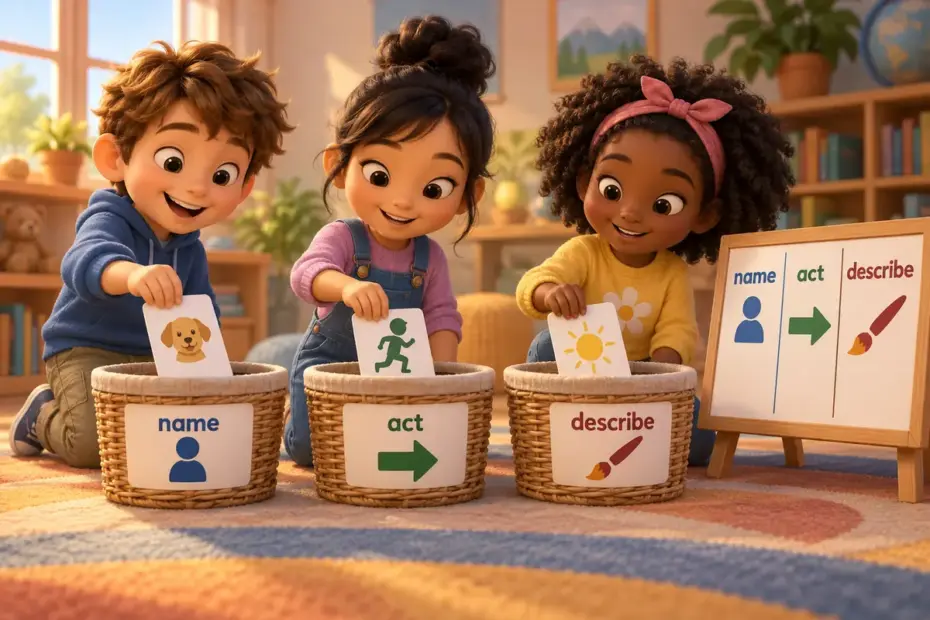
The differences between parts of speech lie in the grammatical job a word performs, not in the word itself. Nouns name, verbs act, adjectives describe nouns and adverbs modify verbs, while prepositions and conjunctions link the parts together, so one word can change role from sentence to sentence.
Differences between parts of speech at a glance
- The main parts of speech are noun, pronoun, verb, adjective, adverb, preposition, conjunction and interjection.
- A word’s part of speech depends on the job it does in a sentence, not on the word itself.
- Nouns name, verbs act, adjectives describe nouns and adverbs modify verbs.
- Function words such as prepositions and conjunctions show relationships rather than content.
- The commonest mistake is labelling a word by its usual role instead of its role in this sentence.
What are the parts of speech?
A part of speech is a category that describes the grammatical job a word performs in a sentence. The same word can move between categories, so the label comes from the sentence rather than a dictionary list.
| Part of speech | Job | Example | Quick test |
|---|---|---|---|
| Noun | Names a person, place, thing or idea | the garden | Can it follow the or a? |
| Pronoun | Replaces a noun | she, they | Does it stand in for a name? |
| Verb | Shows an action or state | runs, seems | Can it change for tense? |
| Adjective | Describes a noun | a quiet street | Does it sit before a noun? |
| Adverb | Modifies a verb, adjective or adverb | she sang softly | Does it tell how, when or where? |
| Preposition | Links a noun to the rest of the sentence | under the bridge | Does it head a phrase of place or time? |
| Conjunction | Joins words or clauses | and, because | Does it connect two units? |
| Interjection | Shows sudden feeling | oh, hooray | Does it stand alone? |
The most confusing pair inside this list is the adjective and the adverb, and these adjectives ending in ed and ing key differences show why a word such as boring and bored changes role so easily.
How do you tell the parts of speech apart?
A reliable answer comes from asking one question about the word’s job, then checking what it pairs with.
| Question to ask | Likely label | Example |
|---|---|---|
| Who or what is it? | Noun | The answer surprised us. |
| What is happening or being? | Verb | The birds sing. |
| What is it like? | Adjective | a heavy bag |
| How, when or where? | Adverb | she left early |
| Where, when or how related? | Preposition | behind the door |
| What is being joined? | Conjunction | tea and cake |
| What replaces a name? | Pronoun | She called them. |
Two habits sharpen the test. First, change the sentence into a question about the word, because a noun answers who or what and a verb answers what happened. Second, move the word to a new slot; a word that still works before a noun is an adjective, while one that works beside a verb is an adverb. Together the two habits settle nearly every ambiguous case.
Parts of speech examples across contexts
Because a word changes category with its job, the clearest proof is a single word used two ways.
| Word | First use | Second use | What changed |
|---|---|---|---|
| light | the light faded | a light bag | Noun became adjective. |
| run | they run daily | a quick run | Verb became noun. |
| fast | a fast car | he ran fast | Adjective became adverb. |
| well | a deep well | she sings well | Noun became adverb. |
| before | before lunch | we met before | Preposition became adverb. |
| book | a heavy book | book a seat | Noun became verb. |
| round | a round table | walk round the park | Adjective became preposition. |
| near | the near bank | sit near the fire | Adjective became preposition. |
| that | that house | I know that it works | Determiner became conjunction. |
Adjectives pile up around a topic, and these adjectives for speech show how one noun can attract a whole set of describing words while the rest of the sentence stays the same.
Content words vs function words
The eight parts split into two groups, and the split explains which words a writer can stretch and which stay fixed.
| Feature | Content words | Function words |
|---|---|---|
| Members | Noun, verb, adjective, adverb | Pronoun, preposition, conjunction, interjection |
| Carries meaning | Yes, on its own | Only in a sentence |
| New members | Added often | Rarely added |
| Stress in speech | Usually stressed | Usually unstressed |
| Example | mountain, climb | the, under |
| Count | Large and open | Small and closed |
| How learned | One at a time | As a fixed set early on |
The split explains a common classroom pattern: a learner can discuss a complex topic once the content words are known, because the small set of function words is already in place. A missing preposition, not a missing noun, is usually what makes a sentence sound unfinished.
Two further categories sit alongside the eight for many teachers. A determiner such as the, a or this introduces a noun, and a modal verb such as can, must or might shows possibility. Both behave like function words, and naming them helps when a sentence resists the eight-way label.
Word forms and grammar of the parts of speech
Many parts of speech are marked by an ending, and a few suffixes signal the category directly.
| Form | Signals | Example |
|---|---|---|
| -ness | Noun | kindness |
| -ly | Adverb | quickly |
| -ful | Adjective | careful |
| -ment | Noun | movement |
| -ise or -ize | Verb | modernise |
| -less | Adjective | harmless |
Some patterns sit between two categories, and these between sentence examples show a preposition that also works as an adverb depending on what follows it.
Common mistakes with the parts of speech
Five slips recur because a word’s usual role is not its role in every sentence.
She sings beautiful. Correct: She sings beautifully. Rule: an adverb modifies the verb, so sing takes beautifully.
The news were surprising. Correct: The news was surprising. Rule: a plural-looking noun can take a singular verb when it names one thing.
Me and Tom went home. Correct: Tom and I went home. Rule: a subject pronoun is used for a subject.
It is a fast run. Correct: It is a quick run. Rule: fast works as an adjective too, but quick reads more naturally before the noun run here.
The reason is because it rained. Correct: The reason is that it rained. Rule: a noun clause after is takes that, not the conjunction because.
Practice with the parts of speech
Answer all six items, then check the reasoning below.
- Label the part of speech of bright in a bright morning.
- Label the part of speech of bright in the lamp shone bright.
- Correct the error: He runs quick.
- Build a sentence using book as a verb.
- Which part of speech is under in under the table?
- Spot the register: turn gave a talk into a sentence using talk as a verb.
Answers
- Adjective. It describes the noun morning.
- Adverb. It tells how the lamp shone, though brightly is the more standard form.
- He runs quickly. An adverb describes the verb run.
- Please book a seat for the concert. Book acts on the noun seat.
- Preposition. It heads a phrase of place that links table to the sentence.
- She talked for ten minutes. The same idea moves from a noun to a verb.

The bottom line
The differences between parts of speech come down to the job a word does, not the word by itself. Nouns and verbs carry the core meaning, adjectives and adverbs add detail, and prepositions and conjunctions hold the parts together. Because one word can serve several roles, the safest habit is to ask what the word is doing in this sentence before labelling it.
Frequently asked questions about parts of speech
How do you identify a part of speech?
Identify a part of speech by asking what job the word does in its sentence and what it pairs with. A word that follows the or a is usually a noun, one that changes for tense is a verb, and one that tells how an action happened is an adverb. The sentence, not the dictionary, supplies the answer.
Can one word be two parts of speech?
Many words belong to more than one category, because the label depends on the job. Light is a noun in the light faded but an adjective in a light bag, and run is a verb in they run daily but a noun in a quick run. The same spelling can serve several parts of speech.
What are the main parts of speech?
The main parts of speech are noun, pronoun, verb, adjective, adverb, preposition, conjunction and interjection. Nouns, verbs, adjectives and adverbs carry meaning on their own, while pronouns, prepositions, conjunctions and interjections mostly show relationships or feeling inside a sentence, which is why the second group is often called function words.
Is there a fixed number of parts of speech?
Most grammar books list eight parts of speech, though some add a category such as determiners. The count varies by how finely a system divides the function words. What stays constant is the idea itself: a part of speech describes a word’s grammatical job, not its spelling.