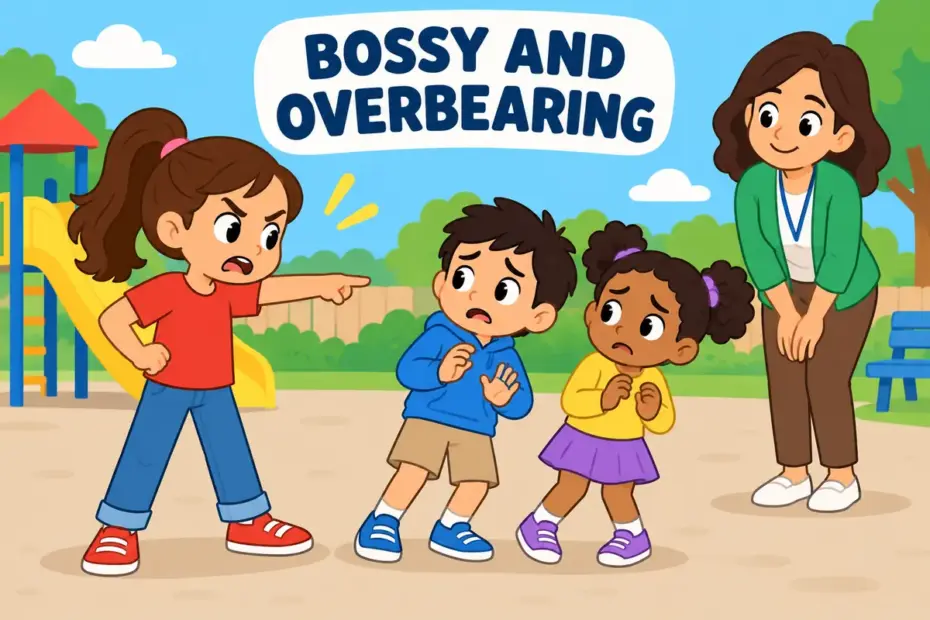
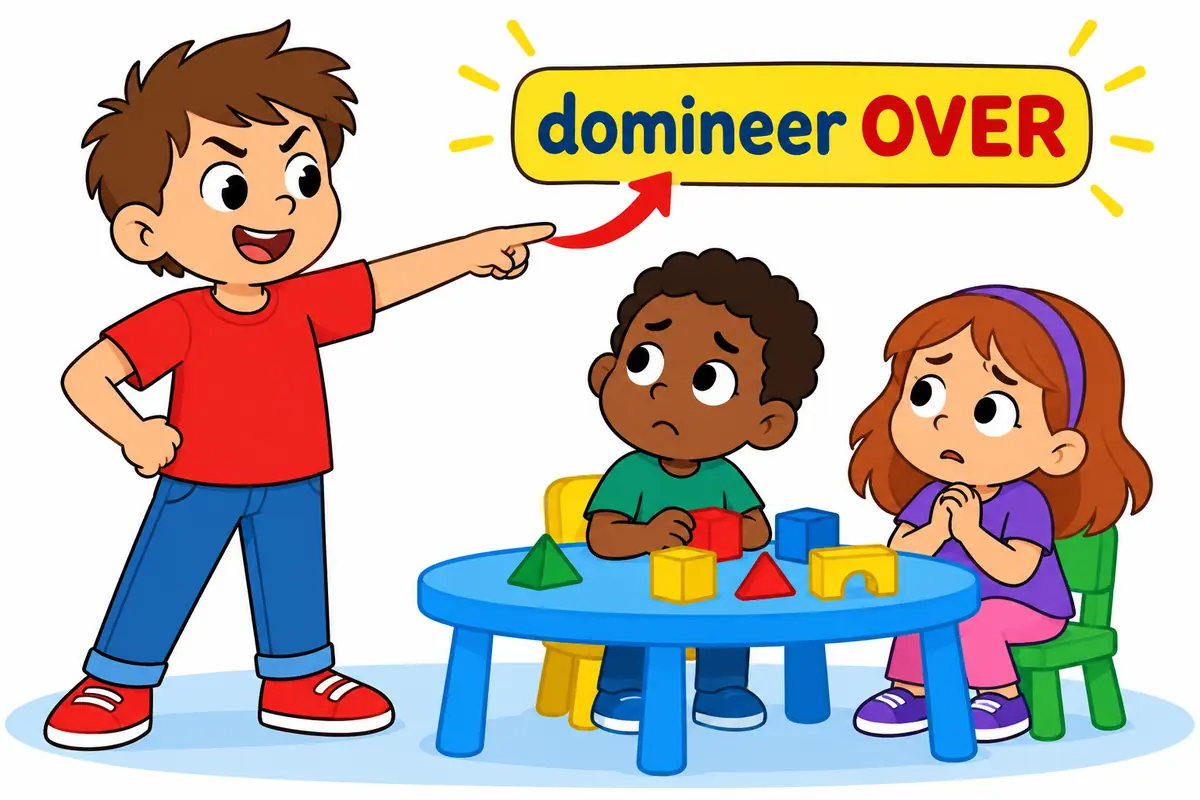
Domineer means to behave in an overbearing, bossy way that forces others to submit. To use domineer in a sentence, give it a subject and usually the preposition over: “The older boy domineered over the whole group.” The verb is intransitive, formal and much rarer than its adjective domineering.
Domineer at a glance
- Domineer is an intransitive verb meaning to behave in a proud, overbearing way.
- Its forms are domineer, domineers, domineered and domineering.
- The usual pattern is domineer over a person or a group.
- It is formal and literary, so everyday speech prefers bossy or overbearing instead.
- The adjective domineering is far more common than the verb itself.
- The commonest error is confusing domineer with the transitive dominate.
What does domineer mean?
Domineer is an intransitive verb meaning to behave in a proud, overbearing way and to assert control over other people. The Cambridge entry for domineer records the overbearing-authority sense, which usually appears with over: one person domineers over others who are expected to submit. Where the action is to frighten someone into compliance, intimidate is the more precise verb, and where the aim is simply to control an outcome, that plainer verb usually reads better.
| Shade of meaning | What it stresses | Example sentence |
|---|---|---|
| Assert overbearing authority | Rule others in an arrogant manner | The manager domineered over the new staff. |
| Behave bossily | Push people around without formal power | He domineered over his younger cousins all summer. |
| Swagger and command | Act as though others must obey | She domineered over the meeting from the first minute. |
One limitation deserves stating plainly. Domineer is a strong, formal word that many readers meet only in its -ing form, and used of a mild, occasional bossiness it overstates the case. It sits close enough to dominate that a careless writer will grab the wrong one, and it describes manner rather than official power, so it is not the word for someone who holds authority fairly. The word also carries a judgement, so it is rarely neutral: calling someone domineering is a criticism, not a statement of rank, and it implies a repeated habit rather than one sharp order.
How do you use domineer in a sentence?
Domineer is intransitive, so it never takes a direct object; the people on the receiving end follow over. The finite verb is rare and the participle does most of the real work in modern English, which the patterns below make clear.
| Pattern | Example | What it signals |
|---|---|---|
| domineer over + person | The foreman domineered over the apprentices. | The standard pattern, with over naming the people controlled. |
| domineer (no object) | He tends to domineer when he is nervous. | Intransitive use with no stated target. |
| domineering + noun | A domineering coach ruined the season. | The participle works as an adjective. |
| be + domineering | She can be domineering without meaning to. | Describes a lasting trait rather than one act. |
| be domineered over | She refused to be domineered over any longer. | Passive use of the verb plus its preposition. |
When the overbearing person also issues orders, dictate adds that specific act of commanding, which domineer leaves unstated. Because the verb is intransitive, it has no ordinary passive; the passive that does exist, be domineered over, keeps the preposition attached to the verb.
Domineer in a sentence: examples across contexts
Domineer keeps one grammar while its setting moves from a classroom to a history essay. The ten sentences below show the bossy and the tyrannical shades at work.
| Context | Example sentence | Why this works |
|---|---|---|
| Classroom | The class monitor domineered over everyone during group work. | Everyday subject showing bossy behaviour. |
| Workplace | The new supervisor domineered over the team from her first week. | Formal but restrained register. |
| Family | He domineered over his younger cousins all summer. | Shows power without formal authority. |
| Sports report | The captain domineered over the squad and ignored the coach. | Leadership turning overbearing. |
| History essay | The baron domineered over the villagers for a decade. | Historical register with over plus a group. |
| Literature | The novel’s aunt domineers over the household. | Fictional characterisation in the present tense. |
| Conversation | Stop domineering over your little brother. | Direct, spoken warning. |
| Advice column | A partner who domineers over you will not change on their own. | Second-person caution about a pattern. |
| News feature | A domineering chairman silenced every dissent. | The participle as a vivid adjective. |
| Memoir | My grandfather never domineered; he simply explained things. | Negation defines the trait by contrast. |
| Community | A domineering committee chair ran every meeting his own way. | The participle as an adjective in local news. |
| Parenting | One sibling domineered over the others until the parents stepped in. | Family dynamics with a clear resolution. |
Two plainer words carry the same idea with less formality: a person who relies on fear will bully others, while those on the receiving end may obey out of habit rather than respect. Notice that the finite verb appears mostly in past narration, while the participle appears in description; that split is the clearest sign of the word’s range.
Domineer vs dominate
Domineer and dominate differ by two letters and are constantly mixed up. The governing sense of tyrannize is closer to domineer, while the weaker outcome of yield describes what the other people do.
| Attribute | domineer | dominate |
|---|---|---|
| Core idea | Behave in an overbearing way | Hold power or control over something |
| Grammar | Intransitive; usually domineer over | Transitive; takes a direct object |
| What it describes | Manner and personality | Position, influence or share |
| Scope | People and relationships | Objects, markets, games and conversations too |
| Frequency | Rare and formal | Common and neutral |
Verdict: use domineer for a bossy, overbearing manner, and dominate whenever you mean holding power, a leading position or a majority. A team can dominate a match, but only a person domineers over other people. A useful test is the question each verb answers: dominate answers what holds power, while domineer answers how a person treats other people. The grammar usually decides the choice before meaning does, because only dominate can take the thing being controlled as its object.
Word forms and grammar of domineer
Domineer inflects regularly, and the participle has taken on a life of its own as an adjective. The table lists the forms a writer is most likely to reach for.
| Form | Part of speech | Example |
|---|---|---|
| domineer | verb, base form | They domineer over anyone who disagrees. |
| domineers | verb, third person singular | He domineers over the whole office. |
| domineered | verb, past and past participle | The landlord domineered over his tenants. |
| domineering | participle and adjective | A domineering tone ended the discussion. |
| domineering | noun, rare | Her domineering tired the whole family. |
| domineer over | verb plus preposition | She domineered over the committee. |
The adjective domineering is by far the commonest form, which is why learners meet it first and the finite verb second. There is no noun as common as the adjective, so writers usually reach for domineering rather than inventing a noun form.
Common mistakes with domineer
The five errors below come from the two traits that trip writers up: the missing preposition and the pull of the more common word dominate. Each correction also shows the transitive verb that would fit if the meaning were different.
- Incorrect:
He domineered the new staff.Correct: He domineered over the new staff. Rule: Domineer is intransitive, so it needs over rather than a direct object. - Incorrect:
She domineered the meeting.Correct: She dominated the meeting. Rule: Domineer describes bossy manner; dominate takes a direct object and covers meetings too. - Incorrect:
He was very domineer with his friends.Correct: He was very domineering with his friends. Rule: The adjective is domineering, not domineer. - Incorrect:
The team domineered the match.Correct: The team dominated the match. Rule: Domineer applies to people, not to contests. - Incorrect:
They domineered to us.Correct: They domineered over us. Rule: The preposition is over, not to.
Practice using domineer
Work through the six items, then check the reasoning rather than only the answer.
- Fill the gap: The older pupils ______ over the younger ones at break.
- Choose the better verb: The team (domineered / dominated) the match from start to finish.
- Correct the error: She domineered the whole department.
- Build a sentence: use domineering about a fictional character.
- Spot the register: which fits a formal essay — the baron domineered over the villagers, or the baron was a big bossy-pants?
- Rewrite with a plainer verb: The coach domineered over the players. Use bully.
Answers
- domineered — the past tense keeps the intransitive pattern with over.
- dominated — a match is a thing, so the transitive dominate is required.
- She domineered over the whole department — domineer needs the preposition over.
- Model answer: The domineering uncle in the novel controls every family dinner — the participle describes his manner.
- The baron domineered over the villagers — a formal essay keeps the literary verb and avoids slang.
- The coach bullied the players — bully names the same behaviour in plainer, everyday language.
The bottom line
Use domineer in a sentence for a person who behaves in an overbearing way and pushes others to submit, and give it the preposition over. Two facts decide most uses: the verb is intransitive, so the people it affects never become a direct object, and it describes manner rather than official power. When the meaning is to hold power or a leading position, dominate is the right verb instead. A single act of rudeness is not domineering; the word describes a settled way of treating people.
Frequently asked questions about domineer
Is domineer a common word?
No. Domineer is rare and formal, so it appears mainly in literary writing and older prose. Most people describe the same behaviour with bossy, overbearing or controlling. The adjective domineering is common enough to be recognised, but the finite verb usually sounds bookish.
Does domineer take an object?
No. Domineer is intransitive, so it cannot take a direct object. The people it affects follow the preposition over, as in she domineered over the committee. A sentence such as she domineered the committee is wrong because that pattern belongs to dominate.
What is the difference between domineer and domineering?
Domineer is the verb, while domineering is its present participle and the far more common adjective. You domineer over a person, but you describe the person or the manner as domineering. The adjective can also stand alone after be, as in the manager can be domineering.
Is domineer the same as bully?
They overlap but are not identical. Bully names repeated, often cruel behaviour aimed at someone weaker, and it is everyday language. Domineer is formal and describes an overbearing manner and a habit of commanding others. A domineering person may bully, but the words are not interchangeable.