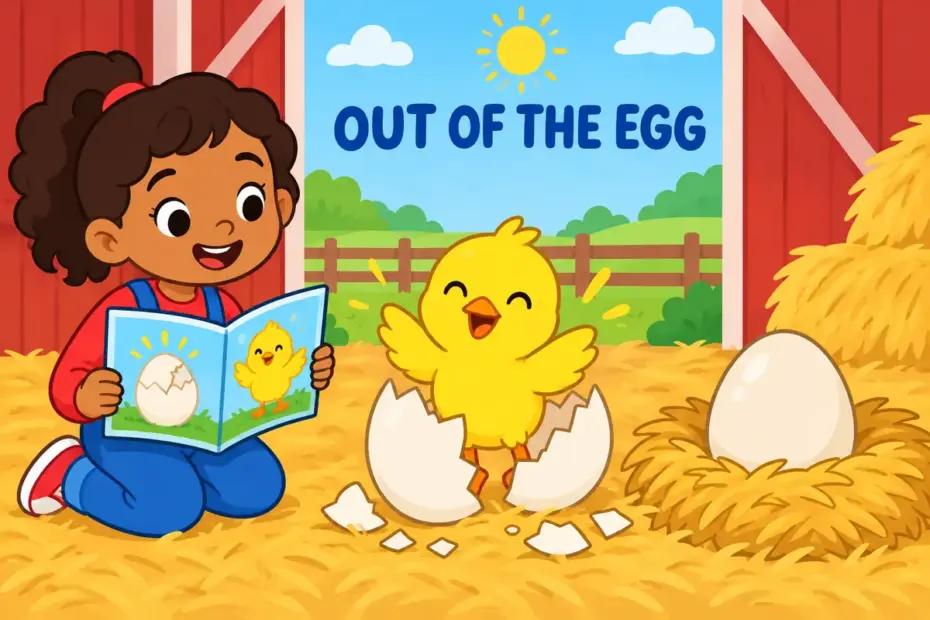
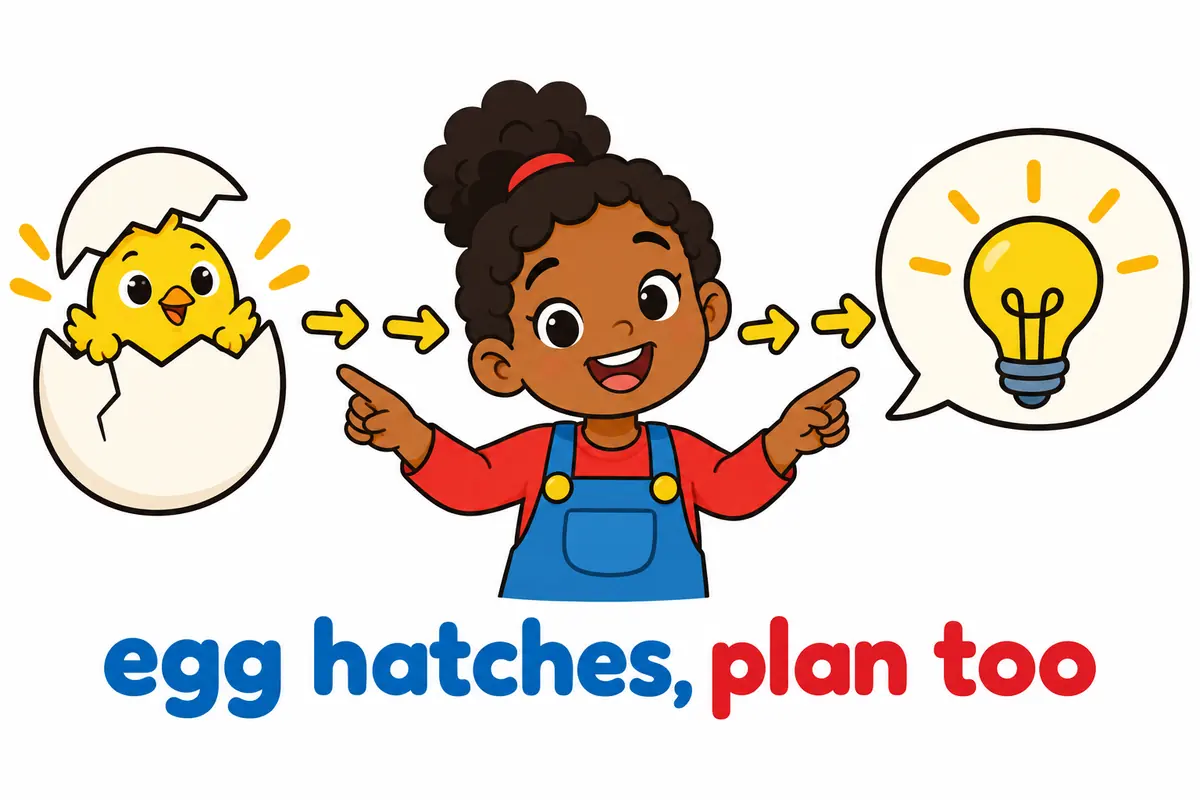
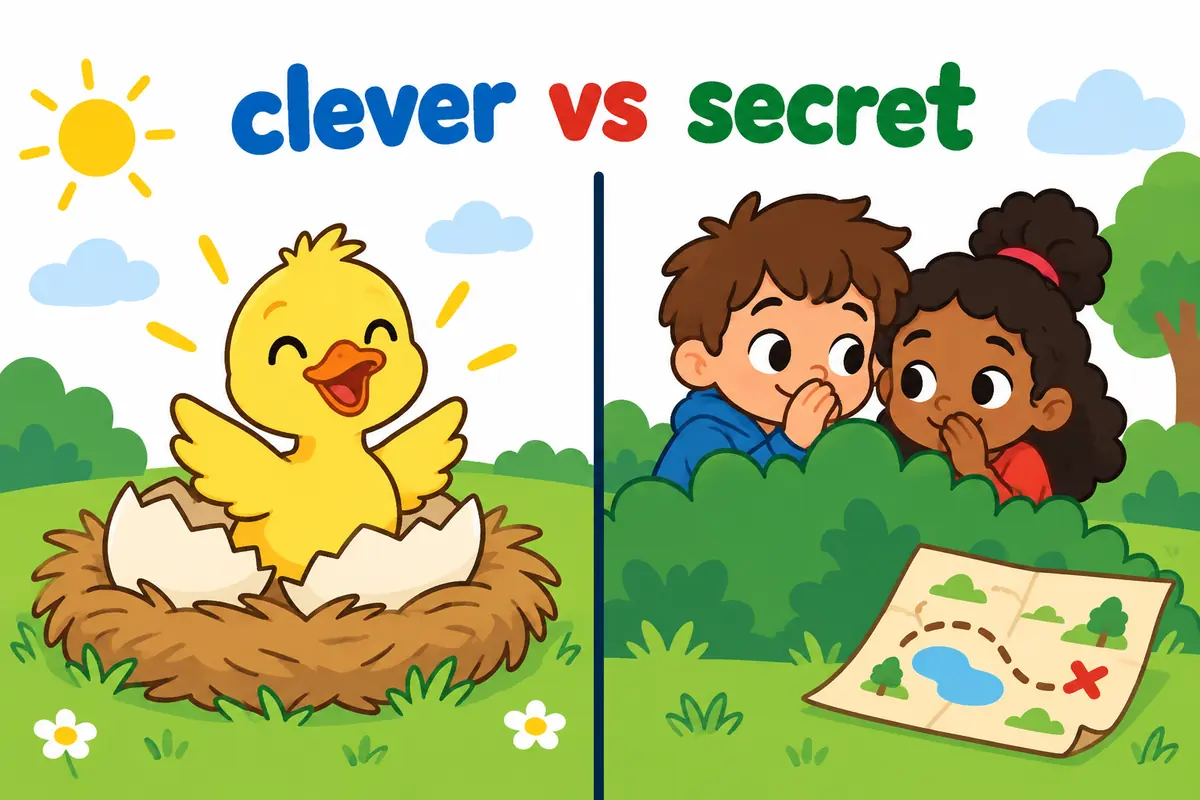
Hatch is a verb meaning to break out of an egg or to devise a plan in secret, and it is also a noun for an opening with a cover. When it means emerge, the subject is the young animal: “The chicks hatched overnight.” When it means devise, the object is the plan itself: “They hatched a scheme.”
Hatch at a glance
- Hatch is a verb with two lives, one about eggs and one about plans, plus a separate noun sense.
- Its forms are hatches, hatched and hatching; a young animal is a hatchling.
- In the egg sense the subject hatches intransitively; in the plan sense hatch takes an object.
- Common collocations include hatch a plan, hatch a scheme and hatch out.
- The commonest error is confusing hatch with hatchet or reaching for it when plot is meant.
What does hatch mean?
Hatch is a verb meaning to emerge from an egg, or to think up a plan in secret, and a noun meaning a covered opening in a floor, deck or wall. The Cambridge entry for hatch records the egg sense, the plan sense and the noun sense, and the object or subject usually makes clear which is in play.
| Sense | Plain meaning | Example sentence |
|---|---|---|
| Emerge from an egg | A young animal breaks out of its shell | Three ducklings hatched before dawn. |
| Produce young from eggs | Incubate eggs until they open | The turtle hatched forty eggs on the same beach. |
| Devise in secret | Invent a plan quietly | Two clerks hatched a scheme to alter the records. |
| Covered opening | A small door or lid in a surface | She lifted the hatch and climbed into the loft. |
Hatch does not only mean eggs. When the subject is a plan, the word implies secrecy, which is why a writer who means invent openly reaches for devise instead. The noun hatch never means a bird; it is the opening, so a sentence about a ship or a loft uses the same spelling in a different sense.
How do you use hatch in a sentence?
Hatch switches between intransitive and transitive use depending on the sense. In the egg sense the subject does the hatching; in the plan sense hatch needs an object, and the phrasal form hatch out marks the moment of emergence.
| Pattern | Example | What it signals |
|---|---|---|
| subject + hatch (intransitive) | The chicks hatched at sunrise. | The young animal emerges on its own. |
| hatch + object (eggs) | The hen hatched six eggs. | An animal or machine incubates and opens eggs. |
| hatch + object (plan) | They hatched an escape plan. | Secret devising, often with an air of plotting. |
| hatch out | The tadpoles hatched out in the warm water. | Marks the completion of emergence. |
| hatch from + source | The butterfly hatched from its chrysalis. | Names the casing the animal leaves. |
Hatch in a sentence: examples across contexts
The two main senses rarely overlap, because the subject is either an animal or a person. The rows below show both in their natural settings, with the reason each sentence works.
| Context | Example sentence | Why this works |
|---|---|---|
| Classroom science | The class watched a butterfly hatch from its chrysalis. | The intransitive egg sense with a clear source. |
| Farm report | More than a hundred chicks hatched in the incubator overnight. | Transitive machine subject incubating eggs. |
| News report | Two officials hatched a plan to hide the missing funds. | The secret-deviser sense in factual prose. |
| Workplace email | We hatched a backup plan in case the venue cancels. | Informal but clear use of the plan sense. |
| Storytelling | The friends hatched a daring scheme behind the shed. | Plan sense with a playful, secretive tone. |
| Technical note | Larvae hatch from eggs laid on the underside of leaves. | Precise biological use with from. |
| Historical writing | Rebels had hatched the uprising months before it began. | Formal plan sense describing concealed preparation. |
| Everyday conversation | The ducklings emerge from their shells in spring. | Shows the plainer verb chosen in casual talk. |
| Travel writing | Turtles hatch on this beach every August. | Intransitive sense with a repeated event. |
Hatch vs plot
Hatch and plot both mean to devise something, and the difference is one of tone as much as meaning. Hatch suits a clever or surprising plan; plot suggests a secret and often harmful one. The table sets the two apart, and contrive is the third option when the plan feels forced.
| Attribute | Hatch | Plot |
|---|---|---|
| Core meaning | Devise a plan, or emerge from an egg | Plan something secretly |
| Typical object | a plan, a scheme, an escape | a rebellion, a murder, revenge |
| Connotation | Clever, sometimes playful | Sinister, always secretive |
| Tone | Neutral or light | Serious, often criminal |
| What it implies | A plan is being formed | A wrong is being arranged |
Choose hatch for a plan that is inventive or mischievous, and plot when hidden wrongdoing is involved. Neither is a synonym for invent in an honest, open sense, where devise is the safer word.
Word forms and grammar of hatch
| Form | Part of speech | Example |
|---|---|---|
| hatch | verb, base form | They hatch new plans each term. |
| hatches | verb, third person | The egg hatches after about three weeks. |
| hatched | past and past participle | The plan was hatched in secret. |
| hatching | present participle | The chicks are hatching right now. |
| hatchling | noun | A hatchling needs warmth and food. |
| hatchery | noun | The salmon hatchery released thousands of fry. |
There is no verb hatchen, and the past tense is hatched, not hatchened. A related word that is often confused is hatchet, which is a small axe and never a verb here, so writing hatchet a plan is a mistake rather than a variation.
Common mistakes with hatch
- Confusing it with hatchet.
The rivals hatcheted a plan to merge.Correct: The rivals hatched a plan to merge. Rule: hatch forms its own past tense; hatchet is a separate noun. - Adding an object to the egg sense.
The egg hatched itself at noon.Correct: The egg hatched at noon. Rule: in the emergence sense hatch is intransitive. - Using hatch for open invention.
The committee hatched a public statement.Correct: The committee devised a public statement. Rule: hatch implies secrecy and does not fit open, formal drafting. - Writing the wrong past form.
The ducklings hatchen yesterday.Correct: The ducklings hatched yesterday. Rule: the past tense is hatched. - Mixing up the noun senses.
The crew opened the bird to find the hatch.Correct: The crew opened the hatch to find a bird’s nest. Rule: as a noun hatch is a covered opening, not an animal.
A last trap concerns the phrasal verb. Hatch out is fine for a batch of eggs, but writers sometimes stretch it to plans, as in hatch out a scheme, where plain conceive a scheme reads more naturally.
Practice using hatch
- Fill in the blank: The chicks ______ during the night and were dry by morning.
- Choose the better word: The rebels (hatched / devised) a secret plot to seize the radio station.
- Correct the error: The egg hatched itself inside the warm box.
- Build a sentence: describe a class project, using hatch a plan.
- Spot the register: which sentence belongs in a biology report? (A) The eggs hatched after nine days. (B) The eggs popped open after nine days.
- Fill in the blank: Larvae ______ from eggs laid on the leaves.
Answers
- hatched. The past tense of hatch is hatched.
- hatched. A secret plan suits the connotation of hatch, though both verbs are grammatical.
- The egg hatched inside the warm box. The emergence sense is intransitive, so no reflexive object is needed.
- Sample: The team hatched a plan to build a model volcano for the science fair.
- Sentence A. Hatched is the neutral term expected in a scientific report.
- hatch. The present-tense plural agrees with larvae and names their emergence.
The bottom line
Hatch means to break out of an egg or to devise a plan quietly, and it also names a covered opening. Keep the egg sense intransitive and the plan sense transitive, spell the past tense hatched, and reserve hatch for clever or secret schemes. Where a plan is honest and open, devise is the plainer and safer choice.
Frequently asked questions about hatch
Is hatch a verb or a noun?
Hatch is both. As a verb it means to emerge from an egg or to devise a plan, as in the eggs hatched or they hatched a scheme. As a noun it means a covered opening in a floor, deck or wall, as in lift the hatch. Context and word order make the two uses easy to tell apart.
What does hatch a plan mean?
To hatch a plan means to think it up, usually in secret and often with a hint of mischief. The phrase suggests quiet, clever preparation rather than open discussion, which is why it suits escape plans and schemes. For honest, public planning, devised a plan is the more neutral choice. The verb needs a direct object here.
What is the past tense of hatch?
The past tense and past participle are both hatched, so you write the chicks hatched and the plan was hatched. There is no form hatchen or hatchened. The present participle is hatching, used in sentences such as the eggs are hatching now, and the third-person form is hatches. The related noun for a newborn animal is hatchling.
Do eggs hatch or are they hatched?
Both are correct, depending on focus. An intransitive sentence says the eggs hatched, meaning the young animals emerged on their own. A transitive sentence says the hen hatched the eggs, or the incubator hatched them, naming what kept them warm until they opened. The emergence sense is the commoner and needs no object.
Have you ever wondered how to properly use the word “hatch” in a sentence? When we talk about hatching, we are referring to the act of bringing forth young from an egg.
In a sentence, “hatch” can be used to describe the process by which an egg opens and a chick emerges, but it can also be metaphorically applied to the hatching of a plan or a scheme.
7 Examples Of Hatch Used In a Sentence For Kids
- The little bird waited for the egg to hatch.
- A butterfly emerges when the cocoon hatches.
- Can you help the baby duck hatch from its shell?
- The lizard’s eggs will soon hatch.
- The mother hen keeps her eggs warm until they hatch.
- What do you think will hatch from this egg?
- The baby chicks like to play after they hatch.
14 Sentences with Hatch Examples
- After the long wait, the eggs finally began to hatch in the biology lab.
- The students eagerly observed the chick hatch from its egg during the agricultural science class.
- The engineering students watched as the robot they had built successfully managed to hatch the egg placed inside it.
- The computer science students worked together to hatch a plan for their upcoming hackathon project.
- The business students were eager for their startup idea to hatch and take off in the competitive market.
- The architecture students studied different designs to hatch a unique and innovative building plan.
- The medical students observed the tadpoles hatch from the frogspawn in their lab experiment.
- The sports science students monitored the effects of different training methods on the athletes’ ability to hatch new personal records.
- The environmental science students were excited to witness the endangered turtle eggs hatch and make their way to the ocean.
- The art students worked tirelessly to hatch a creative concept for their final exhibition project.
- The law students meticulously analyzed the evidence in order to hatch a strong case for their mock trial.
- The psychology students researched various theories to hatch a deeper understanding of human behavior.
- The literature students brainstormed ideas to hatch a compelling narrative for their short story assignment.
- The fashion design students collaborated to hatch a unique collection for the college runway show.
How To Use Hatch in Sentences?
To use the word “Hatch” in a sentence, you can follow these simple steps:
-
Identify the context: Determine the meaning of “Hatch” you want to use in your sentence. It can mean to emerge from an egg, a small opening or panel in a floor, wall, or ceiling, or a plan or scheme.
-
Select the appropriate meaning: Choose the definition of “Hatch” that best fits the message you want to convey in your sentence.
-
Construct your sentence: Form a sentence that includes the word “Hatch” in the context you have chosen. For example:
- “The baby birds will hatch from their eggs in the next few days.”
- “The spy crawled through the small hatch in the ceiling to access the secret room.”
- “We need to come up with a new business hatch to increase our sales.”
-
Check for clarity: Make sure that the sentence makes sense and effectively conveys the meaning of the word “Hatch” in the context you have selected.
-
Practice: Try using the word “Hatch” in different sentences to become more comfortable incorporating it into your writing or conversations.
Remember, the key is to ensure that the word “Hatch” is used correctly within the sentence to enhance your communication skills and vocabulary.
Conclusion
In summary, hatch is a versatile word that can be used in various contexts to describe the act of emerging or coming into existence. From eggs hatching, to new plans or ideas “hatching” in someone’s mind, the word conveys a sense of new beginnings and growth. It can also refer to a small door or opening, as in a hatch on a boat or an escape hatch in a building.
Overall, hatch serves as a dynamic word that symbolizes birth, creation, and opportunity. Whether it’s a literal or figurative usage, the word hatch captures the essence of something new and exciting taking form or being revealed.