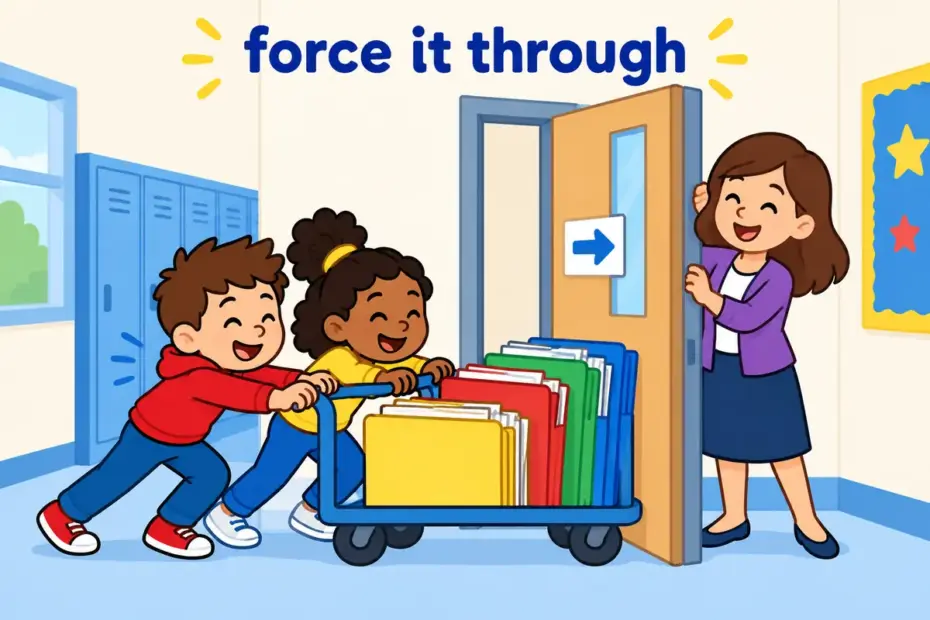
Push through means to force something such as a plan or a bill to completion despite opposition, or to keep going until a hard task is finished. Decide whether a thing is forced or a person perseveres: “The mayor pushed the budget through.” With an object, the particle may follow it or stay before it.
Push Through at a glance
- Push through is a phrasal verb with both transitive and intransitive uses.
- Transitive sense: to force a plan, bill or application to acceptance.
- Intransitive sense: to keep going and finish despite difficulty, pain or opposition.
- The particle can move, so push the bill through and push through the bill are both correct.
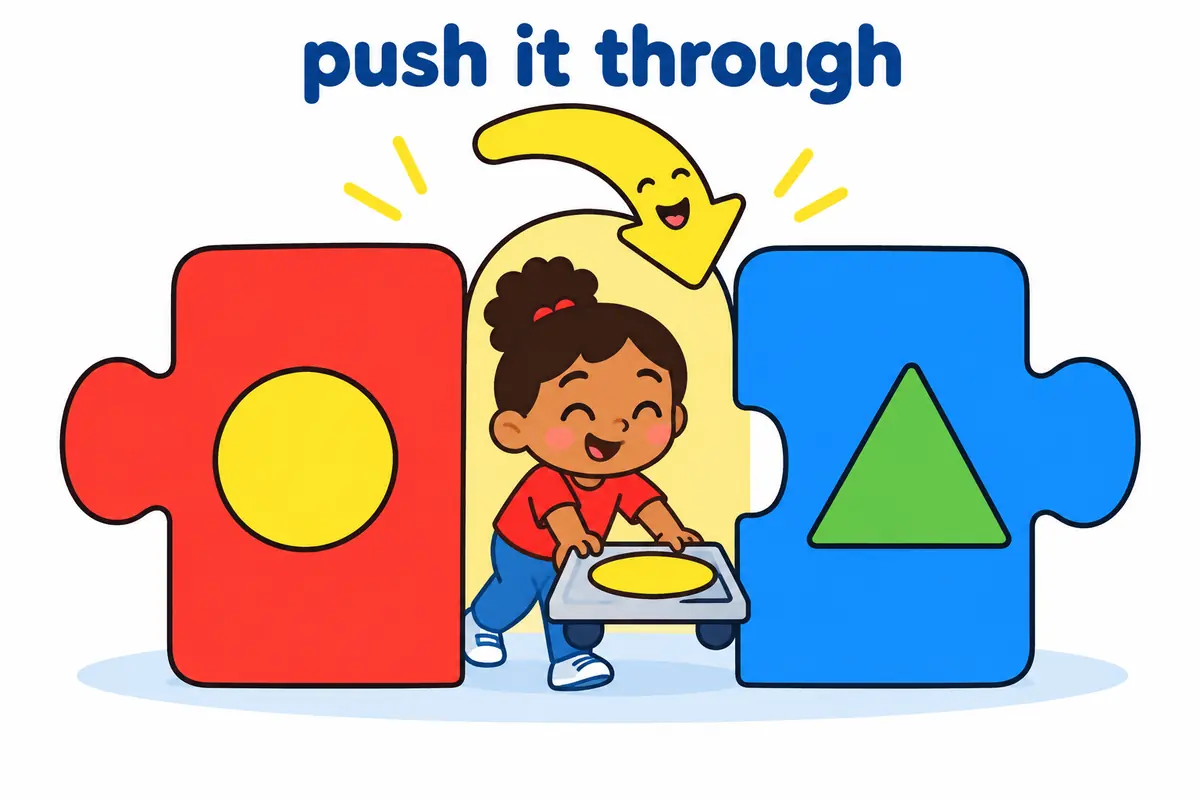
- A pronoun object must sit between the two words: push it through.
- The commonest error is confusing push through with follow through.
What does push through mean?
Push through has two linked senses that share the idea of overcoming resistance. The Cambridge entry for push through records both the transitive sense of forcing something past an obstacle and the intransitive sense of continuing until a goal is reached, and the same image of steady pressure explains each.
| Sense | Plain meaning | Example sentence |
|---|---|---|
| Force something | Get a plan, bill or application accepted | The committee pushed the motion through. |
| Persevere | Keep going until a task is done | She pushed through the last chapter before dawn. |
| Make a way | Move forcibly through a crowd or barrier | Rescuers pushed through the packed hall. |
| Help finish | Push a person through a course or test | A tutor pushed him through the exam. |
One limitation matters. Push through is not a synonym for go through with, which simply means carrying out a plan you had already made; push through always implies resistance that had to be overcome.
How do you use push through in a sentence?
Push through is separable when it takes a noun object and inseparable when it does not. The five patterns below show where the object sits and what each arrangement signals.
| Pattern | Example | What it signals |
|---|---|---|
| push + object + through | The minister pushed the reform through. | Object sits between verb and particle, the usual order for a short object. |
| push through + object | They pushed through a new safety policy. | The whole verb precedes a longer or heavier object. |
| push through, no object | The team pushed through to the final. | Intransitive use meaning persevere to a goal. |
| push + person + through | Her mentor pushed her through the course. | One person helps another finish something hard. |
| push through + difficulty | He pushed through the pain to finish the race. | Perseveres despite a physical barrier. |
Separability is the point learners miss. A pronoun object must go between the two words, so push it through is correct and push through it is wrong. With a full noun phrase both orders are possible, though the split order is commoner when the object is short.
The base verb keeps its sense of force in other combinations as well: push around means to bully someone with repeated pressure, and the feeling of weight still belongs to push.
Push through in a sentence: examples across contexts
Push through appears wherever effort meets resistance. The twelve sentences below move from a boardroom to a sports track, and each one makes clear what had to be overcome.
| Context | Example sentence | Why this works |
|---|---|---|
| Workplace | The manager pushed the request through before the budget freeze. | A deadline supplies the resistance. |
| Politics | Parliament pushed the housing bill through in a single sitting. | The transitive sense, with a law as the object. |
| School | Mia pushed through her revision despite a heavy cold. | The intransitive sense of persevering. |
| Sports | The runner pushed through the final hill to win. | A physical barrier makes the effort visible. |
| Health routine | Nurses pushed through a long night shift together. | The subject is a team sharing endurance. |
| Business email | We will push the contract through by Friday. | Names both object and deadline in one line. |
| News report | Campaigners pushed the scheme through against strong opposition. | The named opposition explains the effort. |
| Charity work | Volunteers pushed the funding bid through at the last minute. | Time pressure drives the phrase. |
| Personal narrative | She pushed through her sadness and finished the speech. | Emotional endurance is treated like any barrier. |
| Technical writing | Engineers pushed the cable through the narrow duct. | The literal sense, with a channel as the obstacle. |
| Committee meeting | The chair pushed through the amendment after a brief debate. | Speed of decision is the point. |
| Everyday speech | I pushed through the pile of dishes before bed. | A small chore shows the informal use. |
Where the work is reading or reviewing rather than forcing, a phrase such as run through fits better, because it names a quick review rather than a struggle.
Push through vs follow through
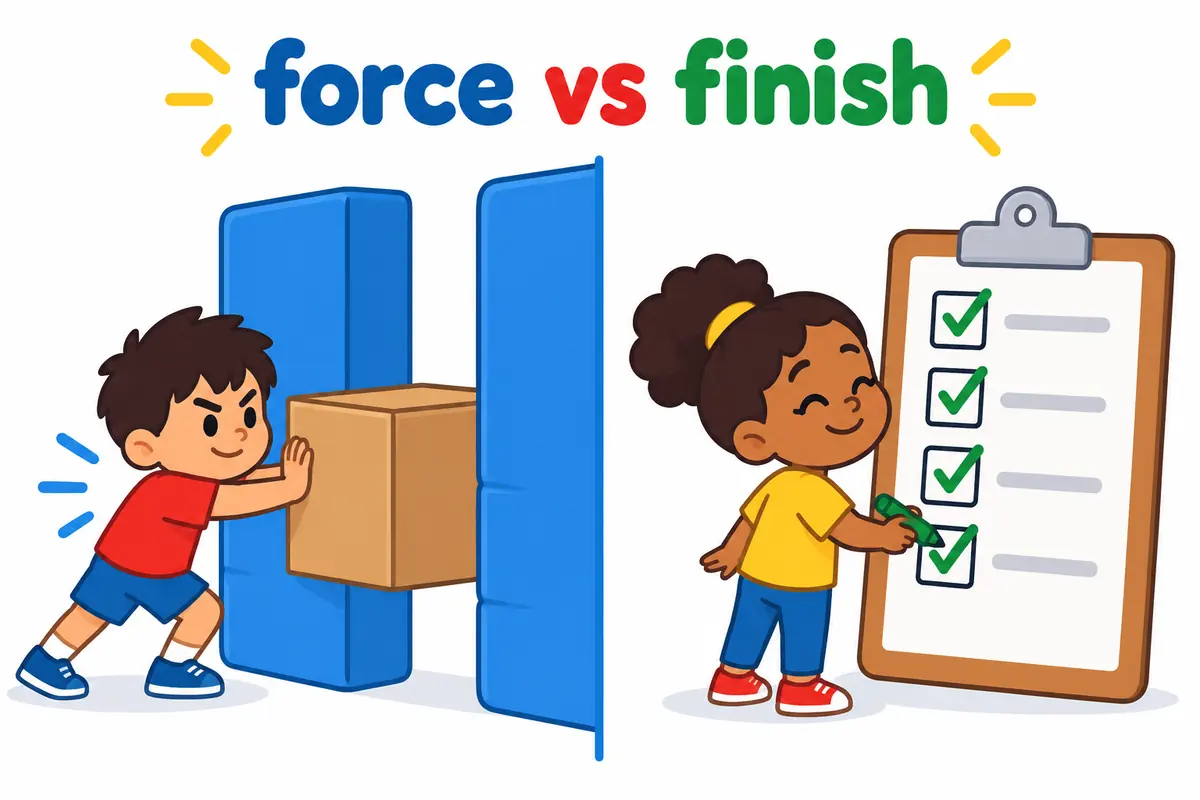
Push through and follow through both describe finishing, but they start from different problems. Push through is about obstacles; follow through is about commitment.
| Attribute | push through | follow through |
|---|---|---|
| Core meaning | Force past resistance to finish | Complete what you promised or started |
| Focus | The barrier being overcome | The promise being kept |
| Typical subject | A person or team under pressure | A person or group with a commitment |
| Common object | a bill, plan, task, race | a promise, plan, threat, swing |
| What it implies | effort against opposition | reliability and follow-up |
| Register | neutral to journalistic | neutral, common in coaching and business |
A third verb, pull through, means to survive a crisis or an illness rather than to force a project along, so keep it for recoveries.
Verdict: choose push through when a barrier is the problem, follow through when a promise is the issue, and pull through when someone survives a serious setback.
Word forms and grammar of push through
Push through is a phrasal verb, so its parts stay recognisable while the verb inflects. The table gives the forms you are most likely to need, plus one that is not a real word.
| Form | Part of speech | Example |
|---|---|---|
| push through | phrasal verb, base | We must push through the backlog today. |
| pushed through | past tense | The council pushed the plan through last night. |
| pushed through | past participle | The bill was pushed through in an hour. |
| pushing through | present participle | She is pushing through her final exams. |
| push it through | pronoun pattern | If the form is ready, push it through. |
| push-through | non-standard | Avoid it; there is no noun push-through. |
The particle shares its spelling with throughout, a single word meaning all the way through a place or period; the two are unrelated in use.
Common mistakes with push through
- Incorrect:
The manager pushed through it the request.Correct: The manager pushed it through. Rule: A pronoun object sits between the verb and the particle. - Incorrect:
She pushed through with her promise to call.Correct: She followed through on her promise to call. Rule: Follow through means keep a commitment; push through means force past an obstacle. - Incorrect:
They pushed through with the deal.Correct: They pushed the deal through. Rule: Push through takes its object directly, while go through with is the phrase that takes with. - Incorrect:
He push through the crowd.Correct: He pushed through the crowd. Rule: The past tense needs -ed.
Practice using push through
Work through the six items, then check the reasoning rather than only the answer.
- Fill the gap: The director ______ the new policy ______ before the holiday.
- Choose the better word: He finally (pushed through / followed through) on his promise to coach the team.
- Correct the error: We pushed through it the application on Friday.
- Build a sentence: use push through with no object about a student finishing a tough term.
- Spot the register: which belongs in a committee report — the board pushed the plan through, or we totally forced it through?
- Rewrite with a pronoun: The staff pushed the invoice through. Replace the invoice with it.
Answers
- pushed the new policy through — the object sits between the verb and the particle.
- followed through — a promise is a commitment, so follow through fits; push through suits obstacles.
- We pushed it through on Friday — a pronoun object goes between the two words.
- Model answer: Ana pushed through to finish her exams on time.
- The board pushed the plan through — a report keeps a neutral tone and avoids totally.
- The staff pushed it through — the pronoun must sit between push and through.
The bottom line
Use push through in a sentence when something has to be forced past resistance or a task has to be finished under pressure. Two details decide most sentences: the particle can move with a noun object but never with a pronoun, so push it through is the fixed order, and the verb is not the same as follow through, which is about keeping a promise rather than overriding an obstacle.
Frequently asked questions about push through
Is push through ever written as one word?
No. Push through is always two words when it works as a verb, and there is no standard noun written push-through. Some writers invent one for headlines, but in ordinary prose the phrase stays open and the verb carries the tense.
Can push through take a pronoun?
Yes, but the pronoun must sit between the verb and the particle. Push it through is correct, while push through it is not. Short noun objects allow both orders, so push the bill through and push through the bill are equally acceptable.
What is the difference between push through and follow through?
Push through focuses on overcoming resistance such as a deadline or an opponent, while follow through focuses on keeping a promise or completing what you started. A team pushes a bill through parliament but follows through on a commitment to train.
Does push through mean the same as go through with?
No. Go through with means to carry out a plan you had already decided on, with no obstacle implied. Push through always suggests that something blocked the way and had to be forced, which is why the two phrases suit different sentences.