Snake in a Sentence: Meaning and Examples
Snake in a sentence can name a legless reptile or describe a route that winds through bends. The noun appears in “A snake rested beneath the log”; the verb appears in “The path snakes along the ridge.” Choose the meaning that matches the subject and sentence structure.
Key facts at a glance
- Snake is a count noun for a long-bodied reptile with no legs.
- As a verb, snake means to move along a winding route.
- The verb often takes a direction phrase such as through the woods.
- Snaked is the regular past-tense form; snaking is the present participle.
- A snake in the grass is a figurative insult for an untrustworthy person.
What does snake mean in a sentence?
Snake has a literal noun meaning and a movement verb meaning. Cambridge Dictionary defines the noun as a reptile with a long body and no legs; its verb entry describes moving along a route with many twists or bends.
| Use | Pattern | Example |
|---|---|---|
| Noun: animal | article + snake | A snake slid beneath the log. |
| Verb: winding movement | route + snakes + direction phrase | The trail snakes through the forest. |
| Figurative idiom | a snake in the grass | She called the dishonest character a snake in the grass. |
The subject resolves the meaning. In “The snake crossed the path,” an animal acts. In “The path snakes toward the lake,” a route follows a curved course. The idiom is figurative and expresses distrust rather than describing an animal.

How do you use snake as a verb?
Use snake when a river, path, queue, or similar subject follows a winding course. The verb often takes a direction phrase: a stream snakes through a meadow, a queue snakes around a building, or a road snakes up a hillside.
- Choose a subject that follows a curved route.
- Use snakes in the present, snaked in the past, or snaking after a form of be.
- Add a place phrase to show where the route bends.
- Check that the subject is the route, not an animal.
Examples: “The road snakes around the mountain,” “A narrow stream snaked between the fields,” and “A line was snaking past the ticket booth.” The direction phrase makes the movement easy to picture.
What are clear example sentences with snake?
- The snake rested under a flat stone until the path was quiet.
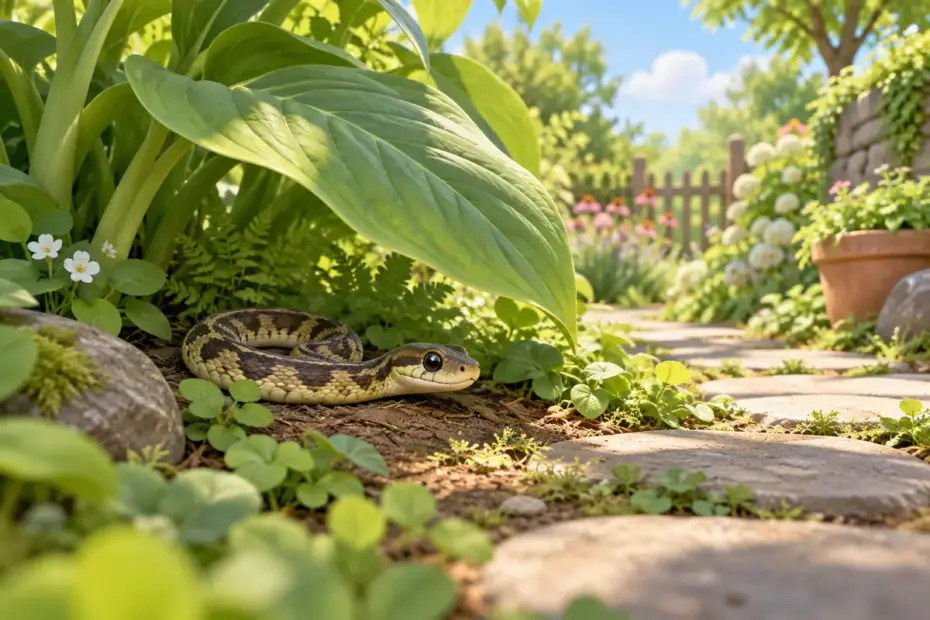
- A garter snake crossed the sunny garden bed.
- The river snakes through the valley before reaching the coast.
- Our queue snaked around the museum lobby on a rainy morning.
- He described the betrayer as a snake in the grass.
- The nature guide explained why visitors should observe reptiles from behind the marked barrier.
Keep context clear when a sentence includes an animal and a route. “The snake followed the river” describes an animal following water; “the river snakes through the forest” uses the verb. The subject and grammar tell readers which sense is intended.

When should you avoid the figurative insult?
Snake can insult a person by suggesting betrayal or dishonesty. Use snake in the grass only when that judgment is intended; it is strongly negative. In neutral writing, name the specific behavior, such as lying or breaking a promise, instead of labeling someone.
For real wildlife, do not encourage touching or approaching a snake. Give an unfamiliar animal space and follow local wildlife guidance. A vocabulary example can teach the noun without implying that every species behaves the same way or is safe to handle.
Frequently asked questions about snake in a sentence
Is snake a noun or a verb?
Snake can be both. As a noun, it names a legless reptile or appears in an idiom about an untrustworthy person. As a verb, it describes a route that bends as it moves. Check the subject and nearby direction phrase to identify the intended use.
What does snake mean as a verb?
As a verb, snake means to travel along a route with many bends. A road can snake through a mountain pass, and a queue can snake around a hall. The regular past tense is snaked; the present participle is snaking.
What is a sentence using snake for the animal?
“A small snake rested beneath a flat rock beside the garden path” uses snake as an animal noun. The article a and adjective small signal a singular count noun, while rested tells what it did. This is literal, not figurative.
Is “snake in the grass” literal?
Usually it is figurative. The idiom describes someone viewed as secretly untrustworthy or treacherous, not a reptile hiding in vegetation. Because the phrase criticizes a person, use it only when that meaning fits the tone and evidence in the sentence.
Choosing the right meaning of snake
Use snake as a noun for the reptile and as a verb for a winding path, river, road, or line. A clear subject, direction phrase, and specific example usually make the meaning obvious; reserve the idiom for deliberate criticism.
Original article
Imagine walking through the dense jungle when suddenly you spot a sleek and slithering creature moving gracefully through the underbrush. That’s right, you’ve just encountered a snake – a limbless reptile known for its intriguing patterned skin and venomous fangs.
An example sentence featuring the word “snake” could be: “Careful where you step in the garden, you never know when a snake might be hiding nearby.”
7 Examples Of Snake Used In a Sentence For Kids
- Snake slithers on the ground.
- Be careful, snake might be hiding in the bushes.
- Some snakes have beautiful colors.
- Snake flicks its tongue to smell.
- Never disturb a snake in the wild.
- Don’t touch a snake, it could be dangerous.
- Remember to stay away from snakes in the forest.

14 Sentences with Snake Examples
- Snake sightings are quite common in the outskirts of college campuses in India.
- It is important to be cautious while walking through grassy areas where a snake could be hiding.
- The biology department offers a workshop on identifying different species of snakes in India.
- Remember to report any snake sightings near the hostel buildings to the campus security.
- Planning a trek in the Western Ghats? Make sure to be aware of the potential snake habitats.
- The environmental club organizes awareness programs on the conservation of snakes in India.
- If you encounter a snake on campus, keep a safe distance and call for help immediately.
- During monsoon season, snakes may seek shelter in buildings, so be cautious when entering dark areas.
- The veterinary department studies the venom of various snake species found in India.
- Local folklore often includes stories about mystical powers associated with certain types of snakes.
- The zoology professor specializes in researching the behavior and habitats of snakes native to India.
- As part of the wildlife photography club, students have the opportunity to capture stunning images of snakes in their natural environment.
- During field trips to national parks, students might have the chance to observe a snake in the wild.
- Learning about first aid for snake bites is an essential skill for students exploring nature reserves in India.

How To Use Snake in Sentences?
To use the word Snake in a sentence means to incorporate it into a sentence in a way that clearly conveys its meaning. When using “Snake,” it refers to a long, legless reptile that moves by slithering on the ground.
To correctly use snake in a sentence, you can start by identifying the context in which you are referring to a snake – for example, its appearance, behavior, or habitat. Here’s an example sentence: “The green snake slithered silently through the grass in search of its next meal.”
When incorporating snake into a sentence, it is essential to make sure it fits grammatically and makes sense within the context of the sentence. It’s also helpful to provide enough detail for the reader to visualize the snake in question.

To practice using Snake in sentences, try writing a few examples where you describe different types of snakes, their actions, or their surroundings. For instance, “I was startled to see a massive snake hanging from the tree branch above me.”
By gaining experience in using snake in sentences, you will become more comfortable incorporating it into your writing and communication. Remember to stay mindful of the context and clarity of your sentences to effectively convey your message to others.
Conclusion
In conclusion, the use of sentences with “snake” as the keyword has demonstrated the versatility of this word in the English language. Whether describing a physical reptile slithering through the grass, or metaphorically referencing someone’s deceitful or cunning behavior, “snake” plays a prominent role in vivid and impactful storytelling.
With its ability to evoke a range of emotions and imagery, sentences with “snake” serve as a powerful linguistic tool for writers and speakers alike. From creating suspenseful narratives to conveying cautionary tales, the word “snake” adds depth and complexity to diverse forms of communication, showcasing its enduring relevance in the realm of language.


