Treatise in a Sentence: Meaning, Examples & Practice
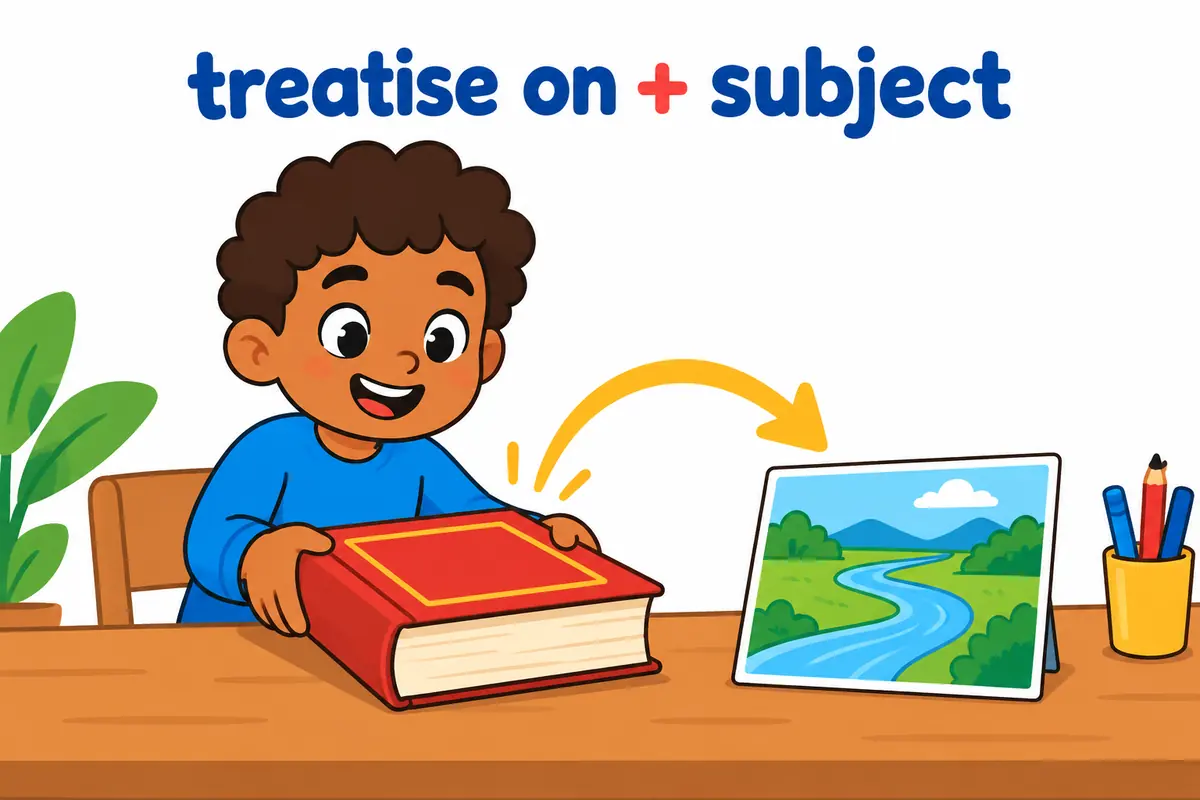
Treatise means a long, formal written work that examines one subject in an ordered, systematic way. To use treatise in a sentence, name the subject after on: “She published a treatise on Roman law.” The noun is countable, so it needs a or an, and its plural is treatises.
Treatise at a glance
- Treatise is a countable noun for a long, systematic work on one subject.
- The standard pattern is treatise on plus the subject.
- The plural is treatises, with a final syllable.
- The word belongs to academic, legal and historical writing.
- The commonest error is writing treatise about where treatise on is meant.
What does treatise mean?
Treatise is a noun meaning a long, formal piece of writing that treats one subject thoroughly and in order. The Cambridge entry for treatise stresses length and system, and two related senses appear: a scholarly study and, historically, a book of instruction. The word carries the idea of a subject taken apart and argued through step by step rather than reported or summarised. That is why a treatise is judged by how completely it covers its single field, and why a reader usually meets the word in a bibliography, a reading list or a review of scholarship. Because the word names a whole genre rather than a single book, it is often qualified by its subject or its author, as in a treatise on grammar or the treatises of Aristotle.
| Sense | Plain meaning | Example sentence |
|---|---|---|
| Scholarly work | A detailed, formal study of one subject | Her treatise on river ecology ran to six hundred pages. |
| Instructional book | A manual teaching a skill or subject (historical) | The treatise taught young nobles how to manage an estate. |
| Extended argument | A written work defending a position | The pamphlet grew into a treatise on free speech. |
| Systematic survey | A work that covers a whole field in order | His treatise on the law of evidence is still cited. |
Treatise is not a label for any long document. A report, a manual or a long email is not a treatise, because the word implies a subject argued through rather than recorded or taught. Where you only mean a written work, article or paper is the plainer choice, and where you mean a short piece, essay is safer still. The word also sounds dated when it is applied to a modern technical report that no one would call a treatise.
How do you use treatise in a sentence?
Treatise sits in a small set of dependable patterns, and the preposition after it is the one readers notice. Five patterns cover almost every real sentence, from a library catalogue entry to a sentence of literary criticism. Notice that the noun is countable in all of them, so it always arrives with a, the or a possessive.
| Pattern | Example | What it signals |
|---|---|---|
| treatise on + subject | He wrote a treatise on the ethics of war. | On names the single subject the work covers. |
| a or the + treatise | The treatise opens with a short history. | The noun is countable and needs a determiner. |
| write, publish or read + a treatise | She published a treatise on trade routes. | Verbs of authorship are the usual partners. |
| treatise in + field | His treatise in economics is still cited. | In names the discipline rather than the topic. |
| the treatises of + author | The treatises of the period argue for reform. | The plural covers a body of work. |
Treatise in a sentence: examples across contexts
Treatise keeps its formal character wherever it appears, and the sentences below show how that character survives a change of setting. Each one names the work and its subject, which is the habit the noun rewards. The contexts run from a school essay to a publisher catalogue, and the reason column explains what each sentence gains from keeping the formal word rather than reaching for book or study. The examples span a dozen settings, from a lecture hall to a footnote, because the noun is at home in any formal written context.
| Context | Example sentence | Why this works |
|---|---|---|
| School essay | The philosopher wrote a treatise on justice that filled four volumes. | The formal noun signals a serious, ordered work. |
| University reading list | Students read a treatise on constitutional law in the first term. | A reading list favours the precise academic term. |
| Publisher catalogue | The press reissued a nineteenth-century treatise on navigation. | The label fits a historical, systematic work. |
| Legal writing | The judge cited a treatise on the law of evidence. | Courts treat a treatise as an authority. |
| History lecture | The treatise taught young nobles how to run an estate. | Shows the older, instructional sense of the word. |
| Book review | The treatise argues its case across nine careful chapters. | Names the shape of the work, not just its length. |
| Library catalogue | Two treatises on the subject survive from that century. | The plural covers a small body of scholarship. |
| Academic email | I am still working through the treatise on trade routes. | Keeps the register appropriate to scholarship. |
| Biography | His treatise on free speech grew from a short pamphlet. | Shows how a work can grow into a treatise. |
| Philosophy seminar | The seminar compared the treatise with a modern textbook. | The contrast throws the older form into relief. |
| Footnote | See the treatise on river ecology for a full account. | Treats the work as the standard reference. |
| Conversation | It is less a report than a treatise on the whole project. | The word can borrow weight in speech too. |
Treatise vs essay
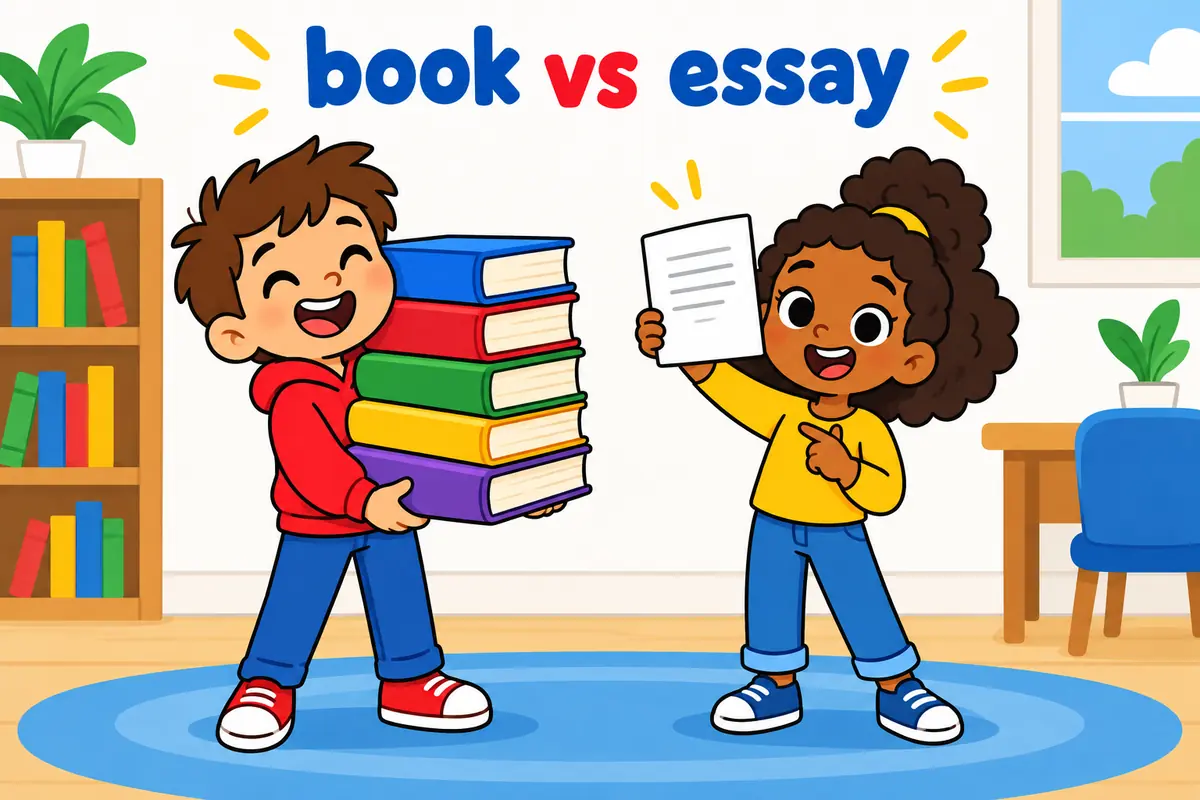
Treatise and essay both name written works and sit at opposite ends of a scale, so they are rarely interchangeable. An dissertation adds a third point: it is a treatise written for a degree. The difference between a treatise and an essay is length, scope and how tightly the argument is organised.
| Attribute | treatise | essay |
|---|---|---|
| Length | Book length or a long formal work | Short, usually under a few thousand words |
| Scope | One subject examined thoroughly | One idea or argument explored |
| Tone | Formal and systematic | Personal or reflective to formal |
| Structure | Ordered chapters or sections | Loose or free-standing paragraphs |
| Typical setting | Academic, legal and historical writing | School, magazine and blog |
| Purpose | To treat a subject completely | To try out or share an idea |
Verdict: choose treatise for a long, systematic treatment of a single subject, an essay for a short piece that explores an idea, and a dissertation when the work is submitted for a degree.
Word forms and grammar of treatise
Treatise has a simple set of forms, and learners often build the wrong adjective from it. The table lists what exists and what to avoid, and it flags the rarer synonym disquisition, which means much the same thing but appears far less often. The verb treat is related in origin but not in meaning here, and the noun treating belongs to a different sense altogether. In a sentence, the noun behaves like other countable nouns, taking a or the and forming its plural with -s.
| Form | Part of speech | Example |
|---|---|---|
| treatise | noun, singular | The treatise defends a single argument. |
| treatises | noun, plural | Two treatises on the subject survive. |
| treatise’s | noun, possessive | The treatise’s first chapter is the clearest. |
| treat | verb, different meaning | The essay treats its subject lightly. |
| treatise-like | adjective, non-standard | Use like a treatise instead in formal prose. |
| disquisition | noun, rare synonym | The lecture became a disquisition on grammar. |
Common mistakes with treatise
- Incorrect:
She wrote a treatise about the history of tea.Correct: She wrote a treatise on the history of tea. Rule: On is the standard preposition before the subject. - Incorrect:
He published treatise on trade.Correct: He published a treatise on trade. Rule: A countable noun needs a determiner such as a or the. - Incorrect:
The two treatise were bound together.Correct: The two treatises were bound together. Rule: The plural is treatises, with an extra syllable. - Incorrect:
The manager sent a treatise explaining the new policy.Correct: The manager sent a lengthy memo explaining the new policy. Rule: A practical memo is not a treatise; the word implies a formal, systematic study.
Practice using treatise
Work through the six items, then check the reason rather than only the answer.
- Fill the gap: The philosopher ______ on justice runs to four volumes.
- Choose the better word: The two-page assignment is an (essay / treatise), not a book.
- Correct the error: She wrote a treatise about the history of medicine.
- Build a sentence: use treatise on about a long legal study.
- Spot the register: which belongs in a university reading list, a treatise on constitutional law, or a big write-up about the constitution?
- Rewrite in the plural: The library holds one treatise by that author. Make it more than one.
Answers
- treatise — on justice names the single subject the work covers.
- essay — a two-page piece is a short work, the opposite of a treatise.
- She wrote a treatise on the history of medicine — the subject follows on, not about.
- Model answer: The judge published a treatise on the law of evidence.
- A treatise on constitutional law — a reading list keeps the formal term and the preposition on.
- The library holds several treatises by that author — the plural adds a syllable.
The bottom line
Use treatise in a sentence for a long, formal work that examines one subject from end to end, and introduce the subject with on. Two nuances decide most sentences: the noun is countable, so it needs a determiner before it, and its plural is treatises. For a short written piece, essay or article is the honest word, and for a work submitted for a degree, dissertation is more exact.
Frequently asked questions about treatise
Is treatise a common word?
Treatise is uncommon in speech and regular in academic, legal and historical writing. Most people meet it on a reading list or in a citation rather than in conversation. A plain alternative such as book or study does the same work in everyday sentences.
What is the plural of treatise?
The plural is treatises, pronounced with an extra middle syllable. Possessives follow the same pattern, as in the treatise’s argument or the treatises’ margins. The singular and plural both keep the same final s sound, so the spelling is the only change.
What is the difference between a treatise and a dissertation?
A dissertation is a formal piece of research submitted for a degree, so it has a set academic purpose. A treatise is any long, systematic work on one subject, and it can be written outside a degree. Every dissertation is long, but not every treatise is a dissertation.
Does treatise take on or about?
Treatise takes on before its subject: a treatise on ethics, a treatise on government. The preposition about is not wrong in speech but reads as informal next to this formal noun. Keeping on marks the register and matches the pattern in most published writing.