Waken vs Awaken: Meaning and How to Choose
Waken vs awaken is settled by register more than meaning: choose waken for plain, literal waking and awaken for formal or figurative waking. Both verbs mean to stop sleeping or to cause someone to stop sleeping, but awaken also means to stir a feeling, and it survives in written English while waken retreats into speech.
Waken vs awaken at a glance
- Waken and awaken are both verbs meaning to stop sleeping or to rouse someone from sleep.
- Waken leans literal and transitive, as in a noise wakens the baby.
- Awaken leans formal and figurative, as in the film awakened old memories.
- Everyday speech prefers wake or wake up; the two longer verbs belong to writing.
- Awaken carries an extra sense, to stir a feeling or make someone aware of something.
Waken vs awaken: the master comparison
The table weighs the two verbs on the criteria that actually change a writer’s choice, and every cell names a real difference rather than a preference. Where the aim is simply to get someone out of bed, rouse is the blunter verb, which is why neither waken nor awaken belongs in a shouted instruction.
| Criterion | waken | awaken |
|---|---|---|
| Core meaning | To stop sleeping or to rouse someone | To stop sleeping or to rouse someone |
| Extra meaning | Rarely figurative | To stir a feeling or awareness |
| Typical transitivity | Usually transitive | Both transitive and intransitive |
| Everyday partner | noise, alarm, birds, baby | memories, interest, conscience, fear |
| Register | Plain and slightly literary | Formal and literary |
| Adjective from it | wakened | awakened |
| Frequency in speech | Uncommon | Rare |
| Best chosen for | A literal wake-up in narration | A figurative or dignified waking |
Read the table as a set of tendencies rather than laws. Waken can appear in the passive, and awaken can describe a literal waking, so the two verbs overlap in the middle. The reliable split sits at the edges: an abstract object such as hope or memory takes awaken almost without exception, while a plain narrated alarm or bird call takes waken. That is why an editor rarely changes one to the other once the object of the sentence is clear.
Which should you use?
Match the situation to the verb and the choice becomes easy, because the two differ less in meaning than in the company they keep.
| Situation | Choose | Example |
|---|---|---|
| Waking a child in a story | waken | The birds wakened the children before dawn. |
| Everyday instruction or speech | wake up | Wake up, we are late. |
| Stirring an emotion on the page | awaken | The letters awakened an old grief. |
| A formal report or ceremony | awaken | The delegates were awakened by the bells. |
| A line of poetry about morning | awaken | The city awakened slowly beneath the rain. |
When the two seem interchangeable, favour the shorter verb for a physical scene and the longer one for a mental or emotional one. A sentence such as the storm wakened the village stays concrete; the storm awakened old fears turns inward. Readers feel the shift even when they cannot name the rule, so the object of the sentence is the best guide a writer has.
What do waken and awaken mean?
Waken and awaken share a core meaning: both name the end of sleep, whether it happens by itself or is caused by something else. The Cambridge entry for waken and the Cambridge entry for awaken treat them as near synonyms, and the difference is in range rather than definition. Awaken reaches further into metaphor, which is why it keeps appearing in writing about ideas while waken stays with sleep.
| Verb | Sense | Example sentence |
|---|---|---|
| waken | Stop sleeping, no object | He wakened at first light. |
| waken | Rouse someone from sleep | The storm wakened the whole village. |
| awaken | Stop sleeping, no object | She awakened early and listened. |
| awaken | Stir a feeling or awareness | The documentary awakened public anger. |
One limitation deserves stating plainly. Neither verb is the everyday choice, and forcing one into casual talk sounds stilted. In speech people say wake or wake up, as in wake up, the bus leaves in ten minutes. Save waken and awaken for writing that wants a slightly raised register, and keep them apart from the adjective awake, which describes a state rather than an action. Each verb also has its own fuller pattern on the pages for waken and awaken if you want to compare single sentences.
A useful test is substitution. If you can replace the verb with wake up and the meaning survives, then waken or wake will do just as well. If the sentence needs the idea of stirring something up or making someone aware, awaken is the only member of the family that fits, because waken has no figurative gear at all.
How do you use waken and awaken in a sentence?
Both verbs fit before a person or an abstract noun, and the passive with by appears constantly in narration. The table shows the patterns that matter most.
| Pattern | Example | What it signals |
|---|---|---|
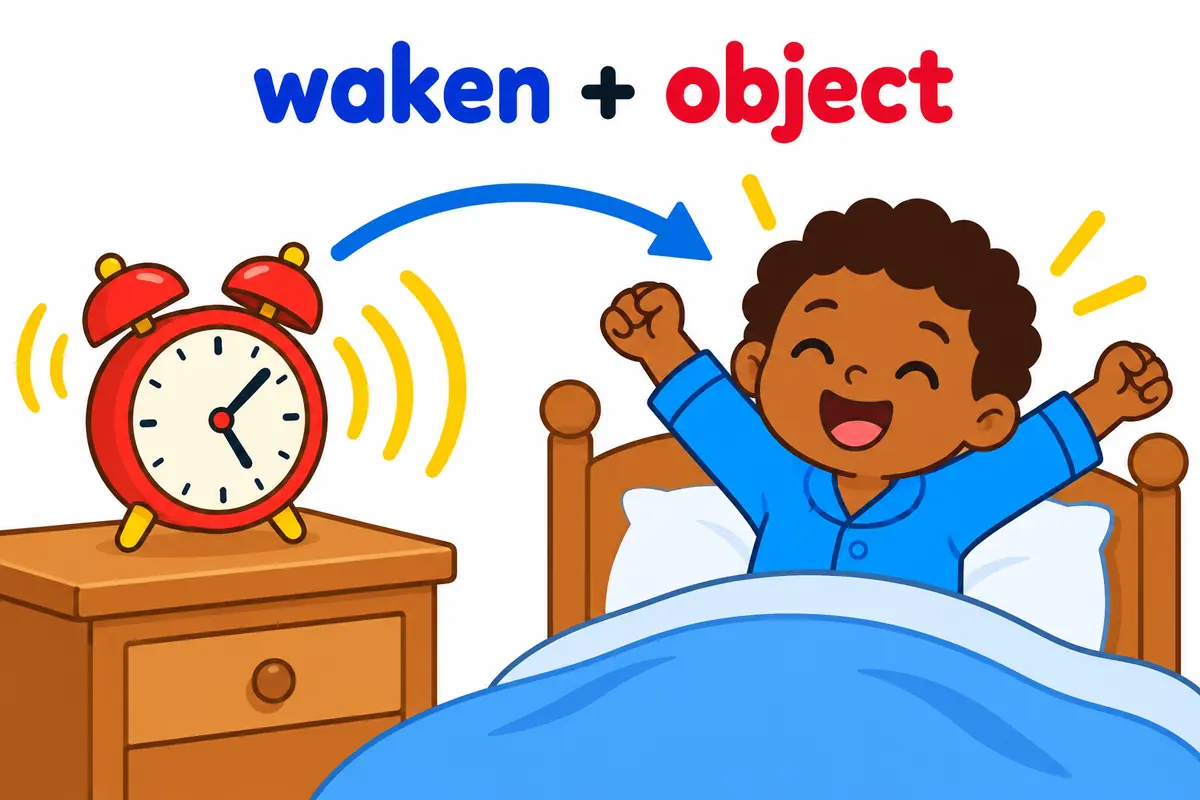
| waken + object | The alarm wakened the sleeper. | Transitive, literal, names the rousing force. |
| waken with no object | He wakened at dawn. | Intransitive and dated, but grammatical. |
| awaken + person | A knock awakened her. | Formal version of a literal waking. |
| awaken + feeling | The speech awakened hope. | Figurative, the special strength of awaken. |
| be awakened by | They were awakened by thunder. | Passive, common in narration and reports. |
| wake up | Wake up, it is late. | Everyday speech, the plainest option. |
Waken and awaken in a sentence: examples across contexts
Each sentence below keeps one of the two verbs while the setting changes, and every one shows what was doing the waking and what was woken.
| Context | Example sentence | Why this works |
|---|---|---|
| Children’s story | The birds wakened the children with their singing. | Literal transitive waken in gentle narration. |
| Diary | I wakened before the alarm and watched the light. | Intransitive waken in a quiet first-person line. |
| Novel | She awakened to a house full of silence. | Formal intransitive awaken sets a mood. |
| News report | Residents were awakened by the smell of smoke. | Passive awaken in factual reporting. |
| Speech | The speech awakened a sense of duty in the room. | Figurative awaken with an abstract object. |
| History essay | The reform awakened hopes that the war ended. | Figurative, linking a change to a feeling. |
| Poetry | The city awakened slowly beneath the rain. | Personification, a natural home for awaken. |
| Medical note | The patient was awakened every hour for checks. | Clinical passive, neutral in tone. |
| Memoir | Old songs awaken memories I cannot place. | Present-tense figurative awaken. |
| Conversation | I wake up at six, whatever the season. | The everyday verb, for contrast. |
Word forms and grammar of waken and awaken
Waken and awaken are regular, but the shorter verb wake is irregular, which is where most learner errors begin. The table sets the three families side by side and includes the noun awakening.
| Form | Part of speech | Example |
|---|---|---|
| wake, woke, woken | verb, irregular | I woke at six, and the dog had woken me. |
| waken, wakened, wakened | verb, regular | The bells wakened the town. |
| wakened | adjective | a wakened sleeper |
| awaken, awakened, awakened | verb, regular | The news awakened her. |
| awakened | adjective | an awakened conscience |
| awakening | noun | a rude awakening about the budget |
| wakening | noun, rare | the wakening of the house |
| awake | verb and adjective | She was awake, and the baby awoke at midnight. |
Common mistakes with waken and awaken
- Incorrect:
The noise awakened up the baby.Correct: The noise woke the baby up. Rule: Up belongs to the phrasal verb wake up, not to waken or awaken. - Incorrect:
The film wakened my interest in space.Correct: The film awakened my interest in space. Rule: An emotion or idea needs awaken; waken stays literal. - Incorrect:
He was awoken by the storm.Correct: He was awakened by the storm. Rule: Awaken forms its participle as awakened; awoken belongs with awake. - Incorrect:
The campaign awakened people about the danger.Correct: The campaign awakened people to the danger. Rule: Awaken takes the preposition to for a danger or a fact. - Incorrect:
I awaken at seven every day.Correct: I wake up at seven every day. Rule: Everyday speech prefers wake up to the longer verbs. - Incorrect:
an awaken childCorrect: an awakened child. Rule: Use awakened as the adjective, or the adjective awake.
Practice using waken and awaken
Work through the six items, then compare your reasoning with the answers rather than only the keys.
- Fill the gap: The documentary ______ public anger across the country. (wakened or awakened)
- Choose the better word: In a news report, the residents were (wakened / awakened) by the smell of smoke.
- Correct the error: The children were awoken by the birds.
- Build a sentence: use awaken to describe a song stirring a memory.
- Spot the register: which belongs in a bedtime story, the birds wakened the children or the birds awakened the children?
- Rewrite with wake up: The alarm awakened me at five.
Answers
- awakened — an abstract emotion needs the figurative verb awaken.
- awakened — a formal report prefers the raised register of awaken.
- The children were awakened by the birds — awaken forms its participle as awakened.
- Model answer: The old song awakened a memory of her first summer by the sea.
- The birds wakened the children — a story prefers the plainer literal verb.
- The alarm woke me up at five — everyday speech uses wake up.

The bottom line
Waken vs awaken comes down to register and range: use waken for plain, literal waking and awaken for formal or figurative waking, especially when a feeling or awareness is stirred. Two nuances decide most sentences: waken rarely carries the figurative sense, and everyday speech prefers wake up to both. When a sentence needs the plainest verb, choose wake and let waken and awaken do the literary work.
Frequently asked questions about waken and awaken
Is awaken more formal than waken?
Yes. Awaken belongs to careful written English, where it can also mean to stir a feeling, while waken stays closer to plain narration. In conversation both are rare, and wake up is the natural choice. Choosing awaken signals a raised register, while choosing waken signals a simple, literal wake-up in a story.
Can waken be used figuratively?
Only weakly. Waken occasionally appears in figurative writing, but awaken owns that territory, as in the speech awakened hope. If the object is an emotion, an idea or a memory, awaken is the safer and more idiomatic verb. Save waken for physical sleep and for the noise or light that ends it.
What is the past tense of awaken?
The past tense and past participle of awaken are both awakened, as in the news awakened her and she had awakened early. Awoken belongs to the verb awake instead, so a careful writer keeps the two families apart. Waken is regular too, using wakened for both forms, while wake keeps woke and woken.
Does waken need an object?
No, though it often takes one. Waken is transitive in the alarm wakened the sleeper, and intransitive in he wakened at dawn. The intransitive use is grammatical but old-fashioned, so modern writers usually reserve waken for the transitive literal pattern and leave the rest to wake or wake up.