Year vs Calendar Year: Which One Should You Use?
Year vs calendar year comes down to this: use calendar year for the fixed period from January 1 to December 31, and use year for any twelve-month stretch, an age or a school or fiscal term. Choose calendar year whenever a report, tax figure or comparison depends on that exact period.
Year vs calendar year at a glance
- Year is a noun for any twelve-month span or a named period such as the school year.
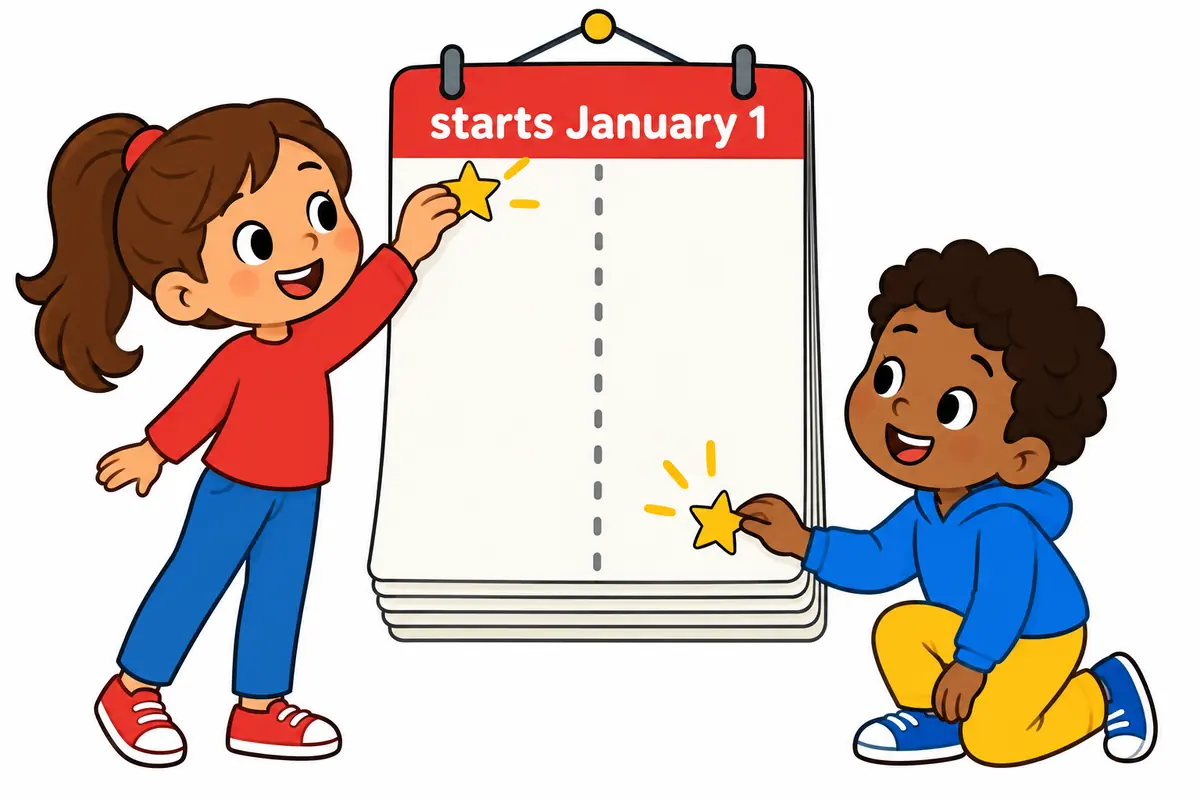
- Calendar year is narrower: the fixed period from January 1 to December 31.
- Reports, taxes and statistics usually need calendar year because the boundaries are fixed.
- Age, duration and academic periods usually need year, school year or fiscal year instead.
- The commonest error is writing year in a document that depends on a fixed January start.
What is a year and what is a calendar year?
Year is a noun for a period of twelve months, for the time the Earth takes to travel around the Sun, or for a named period such as the school year. The Cambridge entry for year covers all three uses, which is why the word is so flexible and, in a formal document, sometimes so vague. A calendar year removes that vagueness: the Cambridge entry for calendar year defines it as the period from January 1 to December 31 within one numbering system.
| Term | Core meaning | Example sentence |
|---|---|---|
| year | Any twelve-month span or a named period | She has worked here for a year. |
| calendar year | The fixed period from January 1 to December 31 | The company files accounts for each calendar year. |
| school year | A teaching period that starts in autumn | The school year begins in September. |
| fiscal year | An accounting period that may start in any month | Their fiscal year ends in March. |
| year, meaning age | How old a person or thing is | He is twelve years old. |
One limitation is worth stating plainly. Year alone is ambiguous, so it can mean the calendar period, an age or a school term all in the same paragraph. Calendar year is precise but rigid, and it is the wrong term for an academic or fiscal period that deliberately avoids a January start.
Year vs calendar year: the decision table
The table below weighs the two terms against the criteria that decide most real sentences. Read down the middle for the general word and the right-hand column for the fixed period.
| Criterion | year | calendar year |
|---|---|---|
| What it names | Any twelve-month span or a named period | The fixed January 1 to December 31 period |
| Start date | Flexible; depends on context | Always January 1 |
| Typical use | Age, duration, school or fiscal periods | Reports, taxes, statistics, comparisons |
| Ambiguity | High; the reader must infer the span | Low; one fixed meaning per system |
| Can it be shortened | Yes: this year, last year | Rarely; usually written in full |
| Register | Everyday and formal | Formal, financial and legal |
| Best replaced by the other when | The period really is January to December | A named or moving period is meant |
The comparison is not about which word is stronger but about how much the sentence needs to pin down. The moment a figure depends on a fixed boundary, the general word becomes a liability.
How do you use year vs calendar year in a sentence?
Both terms are nouns, so the grammar turns on the preposition and the determiner. Five patterns cover almost every sentence, and the fixed-period patterns are the ones that appear in annual reports.
| Pattern | Example | What it signals |
|---|---|---|
| for + year | She trained for a year before the race. | A duration measured in twelve-month units. |
| in + the + calendar year | Profits fell in the last calendar year. | A fixed reporting period. |
| per + calendar year | The cap is ten thousand units per calendar year. | A quota reset on January 1. |
| calendar year + number | Calendar year 2024 closed in profit. | Names one numbered fixed period. |
| year-on-year | Sales rose on a year-on-year basis. | Compares the same position in successive years. |
Only calendar year can follow per without ambiguity, because per promises a fixed period, and only year can express an age or a duration.
Year vs calendar year in a sentence: examples across contexts
The two terms rarely swap places without changing the meaning. The twelve sentences below pair them with the contexts that call for each, from a tax form to a history essay.
| Context | Example sentence | Why this works |
|---|---|---|
| Everyday conversation | I have known her for a year. | year measures a plain duration. |
| Personal finance | She reviews her spending each calendar year. | The fixed January start matches a yearly budget. |
| Business report | Revenue grew eight percent in the last calendar year. | Investors expect a fixed reporting period. |
| Tax filing | The allowance applies per calendar year. | A quota that resets on January 1. |
| Academic writing | The study covered three calendar years of readings. | A countable, fixed span of data. |
| School office | The school year runs from September to July. | A named period that deliberately avoids a January start. |
| Workplace email | Our fiscal year ends in March, not December. | Separates the accounting period from the calendar period. |
| News report | The anniversary marks a year since the flood. | anniversary counts elapsed twelve-month spans. |
| Contract clause | The lease runs for a term of five years. | A stated contractual period, not a fixed calendar one. |
| History essay | That decade reshaped the whole town. | decade groups ten years without fixing a start month. |
| Legal writing | Interest accrues per per annum. | The formal phrase for each year. |
| Sports report | The team stayed unbeaten for a calendar year. | A vivid streak still defined by fixed dates. |
Set side by side, the examples show the pattern: general periods take year, and fixed or numbered periods take calendar year.
Which should you use?
Match the situation to the term rather than guessing, because each reader expectation below is fixed by convention.
- Writing a tax, accounts or statistics report for a fixed period: use calendar year, because the figures must line up with January 1.
- Describing an age, a duration or a general span: use year, since no fixed boundary is involved.
- Referring to a teaching period: use school year, which follows the academic calendar rather than the calendar year.
- Referring to an accounting period that ends in March: use fiscal year, and never calendar year.
- Writing a contract where year alone could be read two ways: define the term, and if it means January to December, write calendar year.
When in doubt, ask whether the sentence would change if the period began in July. If it would, calendar year is the safe term; if it would not, year is probably enough.
Word forms and grammar of year and calendar year
Year inflects and forms compounds freely, while calendar year is a fixed two-word noun whose plural falls on the second word. The table sets the two side by side.
| Form | Part of speech | Example |
|---|---|---|
| year | noun, singular | It took a year to finish. |
| years | noun, plural | She lived there for three years. |
| yearly | adjective or adverb | The yearly audit is due. |
| calendar year | noun, singular | The 2024 calendar year closed in profit. |
| calendar years | noun, plural | Three calendar years of data were released. |
| year-end | compound noun | The year-end accounts are ready. |
Keep the plural on the noun: calendar years is correct, and calendars year is not. The adjective yearly covers the same ground as per year without naming a fixed period.
Common mistakes with year and calendar year
- Incorrect:
The audit covers the year from January to December.Correct: The audit covers the calendar year. Rule: When the period is fixed, the precise term saves a phrase. - Incorrect:
Our fiscal calendar year ends in March.Correct: Our fiscal year ends in March. Rule: A fiscal year is not a calendar year, so the two labels cannot combine. - Incorrect:
He is twelve calendar years old.Correct: He is twelve years old. Rule: Age takes year, never the fixed-period term. - Incorrect:
The school calendar year starts in September.Correct: The school year starts in September. Rule: Academic periods run on their own dates, not on January 1. - Incorrect:
The cap is ten thousand units for calendar years.Correct: The cap is ten thousand units per calendar year. Rule: A recurring quota takes per followed by the singular.
Practice using year and calendar year
Work through the six items, then check the reasoning rather than only the answer.
- Fill the gap: The tax office counts income by ______ , from January to December.
- Choose the better word: The school (year / calendar year) begins in September.
- Correct the error: The report compares two fiscal calendar years.
- Build a sentence: use per calendar year about a limit on free repairs.
- Spot the register: which belongs in an annual report — revenue rose in the calendar year, or business was up loads this year?
- Rewrite for a fixed period: The firm tracks its spending over a year. Use calendar year instead.
Answers
- calendar year — the January-to-December boundary makes the fixed term necessary.
- year — an academic period starts in September, so it is not a calendar year.
- The report compares two fiscal years — fiscal and calendar cannot both apply.
- Model answer: Each household is allowed two free repairs per calendar year.
- Revenue rose in the calendar year — a report keeps the formal, fixed term.
- The firm tracks its spending over a calendar year — the fixed period names the exact span.
The bottom line
Use calendar year when a sentence depends on the fixed January 1 to December 31 period, and use year for a duration, an age or a named period. The two facts that decide most sentences are these: calendar year is precise but rigid, and year is flexible but ambiguous. For an academic or accounting period that does not follow January, the accurate terms are school year and fiscal year, not calendar year.
Frequently asked questions about year vs calendar year
Is a calendar year always twelve months?
Yes. A calendar year is twelve months, but so is an ordinary year. The difference is the boundary: a calendar year begins on January 1 and ends on December 31, while any other twelve-month span counts as a year without being a calendar year.
What is the difference between a fiscal year and a calendar year?
A calendar year always ends on December 31, while a fiscal year can end in any month the organisation chooses. A company whose fiscal year ends in March still reports on a twelve-month period, but that period straddles two calendar years.
Can you write years instead of calendar years?
Often you can, but the meaning shifts. Years simply counts twelve-month spans, while calendar years counts fixed January-to-December periods. In a statistical or financial sentence the difference matters, because the totals are tied to those exact dates, and a reader who assumes the wrong period may misread every figure that follows.
How do you shorten calendar year?
It is usually written in full, because the abbreviation CY is understood mainly inside finance and government. Writing this year or last calendar year is clearer in ordinary prose. Shortening it to year alone is the one change that can undo the precision the phrase exists to provide.