Quick Answer: Vegetables That Start With H
Common H names include habanero, Hakurei turnip, Hamburg parsley, haricot bean, heart of palm, heirloom tomato, Hispi cabbage, Hokkaido squash, horseradish, Hubbard squash, Hungarian wax pepper, husk tomato, and hyacinth bean. The list also includes less familiar edible plants such as hops shoots and himbabao. “Vegetable” is a culinary label here: some entries are fruits botanically, some are bean crops, and some are particular cultivars or regional foods.
For a quick kitchen shortlist, try heart of palm in a salad, horseradish grated into a sauce, Hakurei turnips raw or roasted, or Hubbard and Hokkaido squash baked until tender. Hot peppers such as habaneros and Hungarian wax peppers bring very different levels of heat, so start with a small amount.

H Vegetables Grouped by the Part You Eat
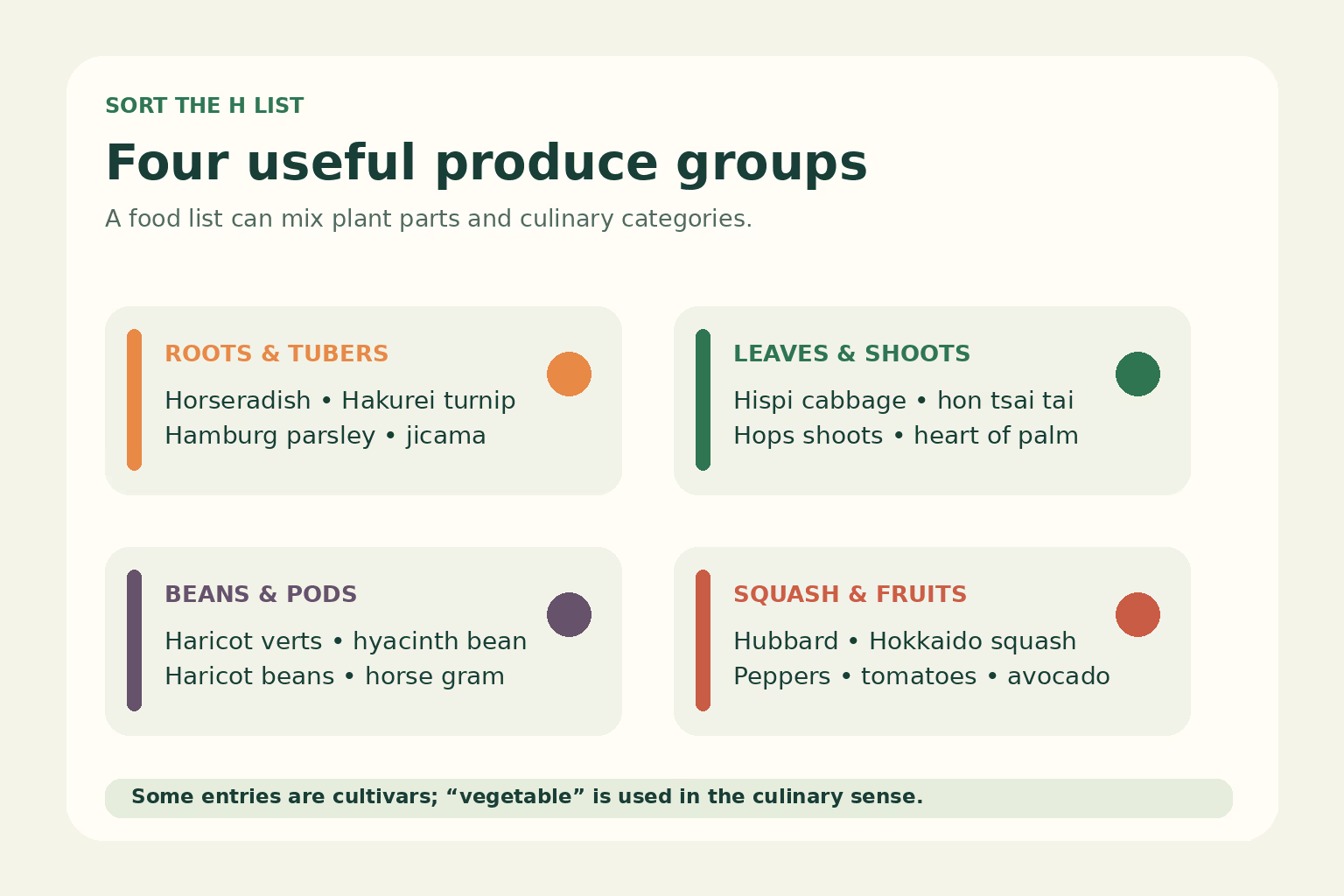
Grouping the names by edible part makes this alphabet list easier to use. The table describes ordinary culinary use; it does not imply that every plant belongs to the same botanical family.
| Group | H examples | Typical use |
|---|---|---|
| Roots and tubers | Horseradish, Hakurei turnip, Hamburg parsley root, jicama (often misspelled “hicama”) | Grate horseradish; slice turnips and jicama; roast parsley root. |
| Leaves, shoots, and stems | Hispi cabbage, hon tsai tai, hops shoots, heart of palm | Quick-cook leafy greens and shoots; use tender hearts of palm in salads or warm dishes. |
| Pods, seeds, and beans | Haricot verts, haricot beans, hyacinth beans, horse gram | Cook fresh pods or fully cooked dried legumes; preparations vary by species. |
| Squash and other fruits eaten as vegetables | Hubbard squash, Hokkaido squash, habanero, Hungarian wax pepper, husk tomato, heirloom tomato, Hass avocado | Roast winter squash; season with peppers; use tomatoes and avocado in salads, sauces, and cooked dishes. |
For example, Hakurei is a turnip cultivar with smooth white roots; the University of Delaware Extension lists it as an early-maturing variety. Hubbard is a winter squash in the Cucurbita maxima group, and “Hokkaido” is commonly used for red kuri-type winter squash. A cultivar name can therefore count in a word list even though it is not a separate species.
How to Choose and Prepare H Produce
For a sharp, spicy flavor
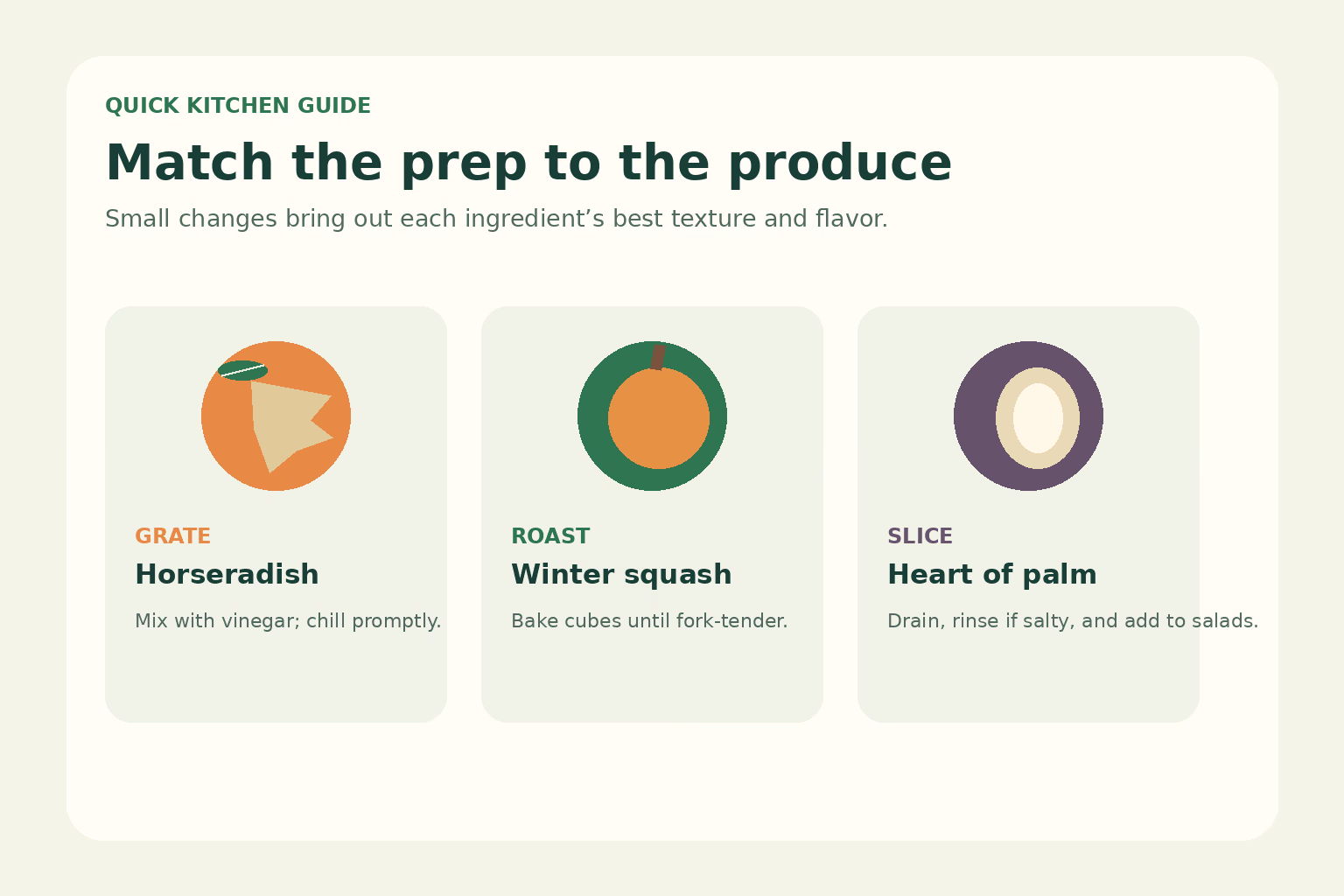
Fresh horseradish root is grated and mixed with vinegar to make a pungent condiment. Add it gradually to sauces, dressings, or cooked vegetables; its aroma fades after preparation, so refrigerate it. Habanero and Hungarian wax peppers are edible pepper fruits with distinct heat and flavor. Remove seeds and membranes for a milder result, wear gloves if handling very hot peppers, and wash hands and tools before touching your eyes.
For a mild, sweet side dish
Hakurei turnips are small, smooth, and mild enough to serve raw in thin slices; their greens can also be cooked. Winter squash such as Hubbard and Hokkaido have firm flesh suited to roasting, soups, and purées. Cut squash on a stable board with a sharp knife, remove the seeds, and cook until a fork slides easily into the flesh.
For salads and quick meals
Heart of palm is the tender inner core of certain palms. Canned pieces are ready to slice into salads, grain bowls, or sandwiches; drain and rinse them if the packing liquid tastes salty. Haricot verts are slender green beans that cook quickly by steaming, sautéing, or blanching. Husk tomatoes (also called ground cherries in some markets) are wrapped in papery husks; remove the husks and use ripe fruit in sauces, salsas, or salads.
Names That Need a Little Clarification
- Hicama: The usual spelling is jicama. It is a crisp edible root, despite the alternate spelling appearing in the original list.
- Hass avocado, heirloom tomatoes, and peppers: These are botanically fruits, though commonly prepared as vegetables. They fit a culinary list, not a strict botanical list of vegetable species.
- Haricot beans: “Haricot” refers broadly to common beans or particular white beans depending on regional usage; it is not a synonym for every kidney bean. Use the specific bean name on a recipe or packet.
- Hamburg parsley: The familiar garden crop is grown for its edible parsley-like root as well as its leaves; it is not simply a flat-leaf parsley variety.
- Himbabao: This Philippine food name refers to edible flower clusters and young tops from a tree, not a plump eggplant. Philippine agriculture sources document the flower spikes as food.
- Hispi cabbage: This name usually refers to a compact, pointed cabbage. It should not be confused with Savoy cabbage, which has crinkled leaves.
These distinctions matter when a reader is identifying a seed packet, checking a recipe, or building a strict botanical list. They also explain why alphabetized food lists can include roots, leaves, legumes, fruits used as vegetables, and regional edible plants together.
Frequently Asked Questions
What is the most familiar vegetable that starts with H?
Horseradish, Hubbard squash, hot peppers, and haricot verts are among the most recognizable H entries in many English-language kitchens. Which one seems most familiar depends on local cooking and grocery availability.
Is a tomato or pepper a vegetable?
In everyday cooking, both are commonly treated as vegetables because of how they are used in savory dishes. Botanically, they are fruits because they develop from a flower and contain seeds.
Which H vegetables can be eaten raw?
Hakurei turnips, jicama, ripe tomatoes, and avocado are commonly eaten raw. Heart of palm is also sold ready to eat. Follow package directions for preserved or prepared foods, and do not eat unfamiliar wild plants based only on a name or photograph.
Are all beans and squash on this list different species?
No. Some names refer to a species or crop group; others are varieties, cultivars, or market names. For instance, Hubbard is a type of winter squash, Hakurei is a turnip cultivar, and “hot pepper” is a broad group rather than one species.
Research and Further Reading
- University of Delaware Cooperative Extension: Turnips and Hakurei cultivar
- University of Minnesota Extension: Growing horseradish
- University of Minnesota Extension: Winter squash types and handling
- University of Florida IFAS Extension: Heart of palm and edible plant parts
- Mariano Marcos State University Extension: Alukon or himbabao as an indigenous vegetable
- Philippine Council for Agriculture, Aquatic and Natural Resources Research and Development: Himbabao food use
Venturing into the abundant world of vegetables, every letter of the alphabet unfolds a unique bouquet of flavors, colors, and health benefits. When it comes to the letter ‘H’, we are led into a delightful alcove of the vegetable kingdom, showcasing a curated selection with its own tales of taste and nourishment.
This article is dedicated to shining a spotlight on those vegetables that are adorned with the ‘H’ insignia. From the hearty horseradish with its robust punch to the humble heart of palm, we’ll journey through the varied profiles, culinary applications, and nutritional merits of these vegetables. Whether you’re a culinary maestro, a passionate gardener, or simply someone with an appetite for knowledge, step into the verdant world of vegetables that harmonize with the letter “H”.
Awesome Vegetables That Start With The Letter H
As we traverse the intriguing world of vegetables, each letter of the alphabet unfurls a set of delicious and nutritionally rich options. Moving into the realm of the letter ‘H’, we find a mix of classic favorites and lesser-known gems. This article delves into 10 vegetables that begin with the letter ‘H’, exploring their culinary uses and health benefits.
1. Horseradish
This robust root vegetable is known for its pungent and spicy flavor. Native to Southeast Europe and Western Asia, horseradish has long been utilized as a condiment to accompany dishes like roast beef. Moreover, it’s packed with compounds called glucosinolates which have potential antioxidant properties.

2. Hubbard Squash
The Hubbard squash, with its warty exterior and rich, sweet flesh, is one of the many winter squashes loved around the world. Available in colors ranging from blue-gray to bright orange, it’s a favored choice for purees, pies, and soups. It’s a good source of vitamin A, C, and dietary fiber.
3. Haricot Verts
A fancy name for the slender and tender French green beans. Haricot verts are typically shorter than the common green bean and boast a delicate flavor. Perfect for a quick sauté or blanching, these beans offer a mix of vitamins A, C, and K.

4. Hakurei Turnips
Also known as Tokyo turnips or salad turnips, Hakurei turnips are small, sweet, and crispy. Unlike the stronger-flavored, purple-skinned turnip varieties, these can be eaten raw, making them perfect for salads. However, they are equally delightful when roasted or stir-fried. They are rich in vitamin C, fiber, and phosphorus.
5. Heart of Palm
Derived from the inner core of specific types of palm trees, hearts of palm resemble white asparagus in appearance. They offer a slightly nutty and tender taste and are a delightful addition to salads. Notably, they are a good source of protein, fiber, and vitamins C and B6.

6. Hops Shoots
While hops are famously known for their role in beer production, their young spring shoots are a rare and delectable vegetable. With a flavor akin to a cross between asparagus and spinach, they can be steamed, sautéed, or used in salads. They contain essential vitamins and minerals and also have calming properties.
7. Hot Peppers
Encompassing a wide variety of chili peppers like jalapeños, habaneros, and cayennes, hot peppers add zest to dishes. Capsaicin, the compound responsible for their heat, has been linked to various health benefits, including boosting metabolism. Additionally, they are rich in vitamins A and C.

8. Hyacinth Bean
Also known as Lablab, this bean is native to Africa but is widely cultivated in Asia and other tropical regions. The pods, seeds, flowers, and leaves are all edible, though they must be cooked properly to neutralize toxins. They’re a good source of protein, dietary fiber, vitamins, and minerals.
9. Hicama (Jicama)

A crunchy and mildly sweet tuber, jicama hails from Mexico. Often described as a cross between an apple and a potato in texture, it’s mostly eaten raw in salads or with a sprinkle of chili powder and lime. It’s low in calories but rich in vitamin C and fiber.
10. Hon Tsai Tai

An Asian green, Hon Tsai Tai is characterized by its purple stems and yellow flowers. It has a mildly mustard-like flavor and can be eaten raw or lightly cooked. It’s a source of vitamins A and C, calcium, and iron.
11. Habanero

Habaneros aren’t just your average chili pepper. These fiery fruits, native to the Caribbean and Central America, pack a punch that can reach up to 325,000 Scoville Heat Units (SHU)! That’s over 200 times hotter than a jalapeño! ️
Despite their intimidating heat, habaneros offer a unique flavor profile. Their fruity aroma blends with a citrusy taste, making them a popular ingredient in hot sauces, salsas, and Caribbean jerk marinades. Just be careful when handling them – their oils can easily irritate your skin and eyes.
Fun fact: The world’s hottest pepper, the Carolina Reaper, is a hybrid of a habanero and a ghost pepper!
12. Hamburg Parsley

Hamburg parsley, also known as German parsley, is a hardy herb prized for its strong, peppery flavor. Unlike its curly Italian cousin, Hamburg parsley has flat, broad leaves that add a vibrant green pop to dishes.
This versatile herb is a staple in European cuisine, often used in soups, stews, salads, and sauces. Its robust flavor pairs well with meats, potatoes, and root vegetables. Hamburg parsley is also a rich source of vitamins A and C, making it a healthy addition to any meal.
Tip: Hamburg parsley is best used fresh, as its flavor can fade quickly when dried. Chop it just before using for the most intense taste.
13. Haricot Beans

Haricot beans, also known as kidney beans, are a diverse group of legumes native to the Americas. These colorful beans come in a variety of shapes and sizes, ranging from the small, dark red kidney bean to the large, creamy white lima bean.
Haricot beans are a nutritional powerhouse, packed with protein, fiber, and essential vitamins and minerals. They’re a great addition to vegetarian and vegan diets, and they can be used in countless dishes, from hearty stews and soups to salads and side dishes.
Did you know? The black bean, a type of haricot bean, is the national bean of Brazil!
14. Heirloom Tomatoes

Heirloom tomatoes aren’t just delicious – they’re living pieces of history! These vibrant, flavorful fruits have been passed down through generations, often originating before the era of mass-produced hybrid varieties. Unlike their uniform supermarket counterparts, heirloom tomatoes come in a dazzling array of shapes, sizes, and colors, from plump, heart-shaped Brandywines to striped Green Zebras.
Beyond their visual appeal, heirloom tomatoes offer a taste explosion. Each variety boasts a unique flavor profile, ranging from sweet and juicy to tangy and earthy. They’re perfect for enjoying raw in salads or sandwiches, or savoring cooked in sauces, stews, and even desserts. Their diverse genetics also make them more resistant to diseases and pests, often thriving in home gardens.
Did you know? The Cherokee Purple tomato is an heirloom variety with a rich history, grown by Native American tribes for centuries. Its deep purple color and complex flavor make it a treasured heirloom.
15. Himbabao

The himbabao, also known as Filipino eggplant, is a culinary powerhouse. Unlike the long, slender eggplants familiar in many cuisines, himbabao are plump and round, with smooth, glossy skin ranging from deep purple to white. But their true magic lies inside. Unlike their sometimes bitter counterparts, himbabao boasts a sweet, delicate flesh that’s perfect for absorbing the flavors of sauces and spices.
This versatile vegetable is a staple in Filipino cooking, starring in dishes like adobo, pinakbet, and kare-kare. Its mild flavor and sponge-like texture make it ideal for frying, grilling, stewing, or even stuffing. Himbabao is also packed with nutrients, including vitamins A and C, fiber, and antioxidants.
Fun fact: The word “himbabao” comes from the Tagalog word for “egg,” reflecting its resemblance to the familiar protein.
16. Hispi Cabbage

Hispi cabbage, also known as Savoy cabbage, is a winter wonder. Its crinkled, emerald green leaves are a testament to its cold-weather resilience, making it a perfect addition to winter gardens and farmers’ markets. Unlike its smooth-headed cousins, hispi cabbage offers a unique texture, with loose, ruffled leaves that hold onto sauces and seasonings with ease.
But hispi cabbage isn’t just about looks. Its mild, slightly sweet flavor makes it a versatile ingredient in soups, stews, stir-fries, and even coleslaws. Its loose structure also allows for creative stuffing and braising, making it a culinary chameleon. Plus, hispi cabbage is a nutritional powerhouse, rich in vitamins K and C, and dietary fiber.
Tip: Don’t overcook hispi cabbage! Its delicate leaves retain their crispness and flavor best with quick cooking methods like stir-frying or grilling.
List of Vegetables Starting with H

| Habanero | Hakurei Turnip | Hamburg Parsley |
| Haricot Beans | Hass Avocado | Heart Of Palm |
| Heirloom Tomatoes | Himbabao | Hispi Cabbage |
| Hokkaido Squash | Horse Gram | Horseradish |
| Hot Peppers | Hubbard Squash | Hungarian Wax Pepper |
| Husk Cherry | Husk Tomato | Hyacinth Bean |
| Haricot Verts | Habanero Pepper |
Conclusion
The ‘H’ category of vegetables brings forth a harmonious blend of flavors and textures, from the fiery kick of hot peppers to the sweet crunch of hicama. These selections, besides their culinary virtues, are packed with beneficial nutrients, ensuring our dishes not only tantalize the taste buds but also nourish the body. By incorporating these ‘H’ vegetables into our meals, we open doors to new culinary adventures and a hoard of health benefits. Whether it’s the spicy hint of horseradish in a sauce or the tender bites of Haricot Verts in a salad, let these vegetables elevate your culinary repertoire.
Vegetables That Start With
A | B | C | D | E | F | G | H | I | J | K | L | M | N | O | P | R | S | T | U | V | W | Y | Z