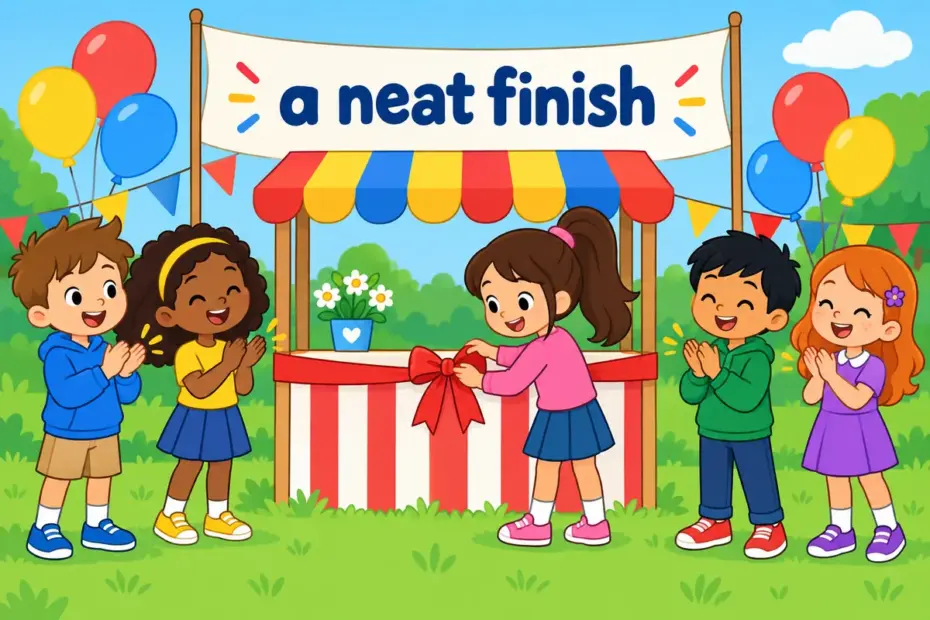
Round off means to finish something neatly or to make a number simpler, and as a phrasal verb it needs an object in a sentence. To use round off correctly, name what is completed or simplified: “We rounded off the meal with coffee.” The verb is transitive and separable, so round the evening off is also correct.
Round off at a glance
- Round off is a transitive phrasal verb; its forms are rounds off, rounded off and rounding off.
- It is separable: round the evening off and round off the evening are both standard.
- The finishing sense partners with an event, a day or a performance.
- The number sense partners with a figure, a total or a price.
- The commonest error is confusing round off with round up, which changes a number upward.
What does round off mean?
Round off is a phrasal verb with three related senses: to finish something in a pleasing way, to make a number simpler, and to make an edge smooth and round. The Cambridge entry for round off records the first two. The completion sense names an event, the number sense names a figure, and the shaping sense names a physical edge.
| Sense | Plain meaning | Example sentence |
|---|---|---|
| Finish neatly | Complete an event or period well | They rounded off the tour with a win. |
| Simplify a number | Replace a figure with a near, simpler one | Round off the total to the nearest ten. |
| Smooth an edge | Make a corner or rim curved | Round off the corners of the board. |
One limitation is worth stating. Round off suggests a light, pleasing finish, so it suits a meal, a season or a list rather than a formal conclusion. For a legal or academic ending, conclude is the more appropriate verb.
The three senses share the idea of a boundary being settled. Finishing sets a pleasant end to an event, simplifying settles a figure near a round value, and smoothing sets a curve on a hard edge. The object tells you which boundary is in play.
How do you use round off in a sentence?
Round off is transitive and separable: the object may follow the whole verb, as in round off the evening, or sit between the parts, as in round the evening off. The particle off cannot be stranded after the object when the object is a pronoun, so we say round it off, never round off it. Five patterns cover most sentences.
| Pattern | Example | What it signals |
|---|---|---|
| round off + event or period | They rounded off the season in style. | The completion sense, with an occasion as object. |
| round + object + off | She rounded the speech off with a joke. | Separable form; the object splits the verb. |
| round off + a number | Round off the figure to two decimals. | The number sense, often in instructions. |
| be rounded off | The day was rounded off with music. | Passive; the occasion stays in focus. |
| round it off | We finished the evening and rounded it off well. | A pronoun must sit between the two parts. |
The pronoun rule is the one to memorise: with it or them, the object always goes in the middle, so round it off is right and round off it is wrong.
Separability is a matter of rhythm as much as grammar. Short objects, especially pronouns, prefer the middle position, as in round it off, while longer noun phrases usually follow the whole verb, as in round off the whole evening with a song. Both orders are correct, and neither is more formal than the other.
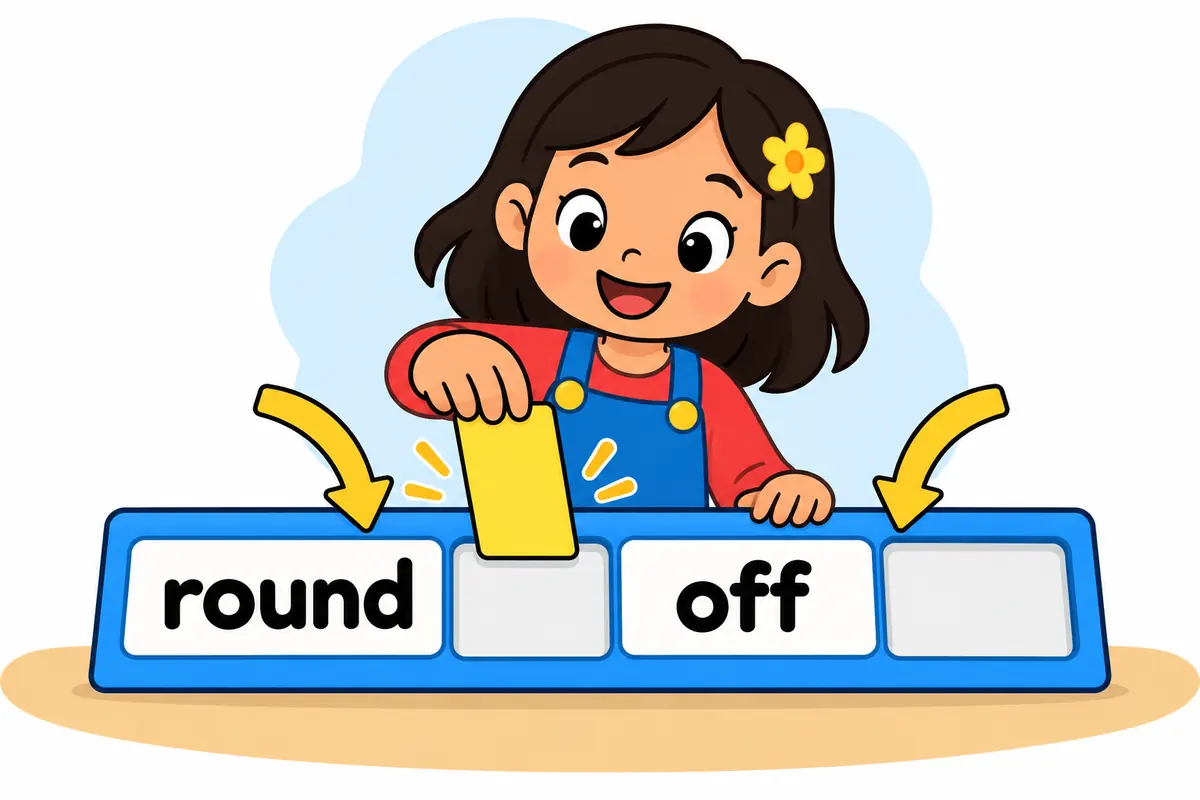
Round off in a sentence: examples across contexts
Round off moves easily between celebrations and arithmetic. Each sentence below shows which sense is active and whether the verb is split.
| Context | Example sentence | Why this works |
|---|---|---|
| School event | The choir rounded off the concert with a quiet song. | The completion sense ends an occasion. |
| Workplace email | We rounded off the quarter with a short review. | A period is the object of the verb. |
| Maths lesson | Round off each amount to the nearest pound. | The number sense appears in an instruction. |
| News report | The festival was rounded off by a fireworks display. | Passive keeps the event in focus. |
| Conversation | We rounded the trip off with a swim. | The object sits between round and off. |
| Sports report | A late goal rounded off a fine performance. | The performance is the thing completed. |
| Craft class | Round off the corners of the card before folding. | The shaping sense names a physical edge. |
| Academic writing | The paper rounds off with a short summary. | A document is the object of the finishing sense. |
| Accounting note | Round off the figures before you publish them. | The number sense with a pronoun-like object. |
| Birthday party | A slice of cake rounded off the celebration. | A small final pleasure completes the occasion. |
| Maths homework | She rounded off the answer to the nearest ten. | The number sense replaces a figure with a simpler one. |
| Book review | A quiet final chapter rounds off the story. | A document is the object of the finishing sense. |
Only the conversational and accounting rows split the verb with a pronoun; the rest keep round and off together for a smoother rhythm.
Round off vs round up
Round off and round up look alike and both touch numbers, but they do different jobs. Round off simplifies toward a near figure, while round up always moves the number higher.
| Attribute | round off | round up |
|---|---|---|
| Core job | Finish an event or simplify a figure | Raise a figure to the next whole unit |
| Direction | Nearest value, up or down | Upward only |
| Typical object | An occasion, a day, a total, a price | A number, a price, a count |
| Usual context | Events as well as arithmetic | Arithmetic and pricing |
| Example | Round off the total to the nearest ten. | Round up the total to the next ten. |
Verdict: choose round off to finish something or simplify a figure, and round up only when the number must rise.
The direction is the giveaway. If the result may go down as well as up, the verb is round off; if it must increase, the verb is round up. A total rounded off can fall, but a total rounded up never does.
Word forms and grammar of round off
Round is a regular verb, so the phrasal verb adds -s, -ed and -ing to round. The hyphenated noun round-off names the act itself. Related verbs in the same family mark the direction of a finish.
| Form | Part of speech | Example |
|---|---|---|
| round off | phrasal verb, base form | We will round off the meeting with tea. |
| rounds off | verb, third person singular | A dessert rounds off the meal. |
| rounded off | verb, past and past participle | The show was rounded off with a duet. |
| rounding off | verb, present participle | He is rounding off the figures now. |
| round-off | hyphenated noun | A smooth round-off gave the routine its polish. |
| round up | related phrasal verb | They rounded up the total to be safe. |
Use the verb forms for actions and the hyphenated round-off for the act as a thing, as in a neat round-off.
Other verbs finish in the same area: to finish and to complete are neutral, to cap suggests a final peak, and the base verb round underlies them all. For a different sense with the same particle, back off means to withdraw.
The hyphenated noun appears most in sports and dance, where a round-off is a specific tumbling move that finishes a run. That specialised sense is one reason careful writers keep the noun and the verb apart.
Common mistakes with round off
- Incorrect:
We round off it with a song.Correct: We rounded it off with a song. Rule: A pronoun object must sit between round and off. - Incorrect:
Round off up the total.Correct: Round off the total or round up the total. Rule: Off and up are different particles and cannot both follow round. - Incorrect:
They rounded off.Correct: They rounded off the evening. Rule: The phrasal verb is transitive and needs an object. - Incorrect:
She rounded off to finish the report.Correct: She rounded off the report with a summary. Rule: Name the object rather than using an infinitive of purpose. - Incorrect:
Round off the numbers to be bigger.Correct: Round up the numbers to be bigger. Rule: Round off moves to the nearest value, not upward.
Practice using round off
Work through the six items, then check the reasoning rather than only the answer.
- Fill the gap: A short speech ______ the ceremony nicely.
- Choose the better word: To make the figure higher, (round off / round up) the amount.
- Correct the error: We rounded off it with a walk.
- Build a sentence: use round off with a pronoun object about a long day.
- Spot the register: which belongs in a maths worksheet — Round off to two decimals, or Let’s round off with cake?
- Rewrite with the hyphenated noun: The skater finished the routine smoothly. Use round-off instead.
Answers
- rounded off — the ceremony is the object of the completion sense.
- round up — the number must move higher, which is round up, not round off.
- We rounded it off with a walk — the pronoun sits between round and off.
- Model answer: We rounded it off with a quiet cup of tea.
- Round off to two decimals — a worksheet uses the number sense in an instruction.
- The skater gave the routine a smooth round-off — the hyphenated noun names the act.
The bottom line
Use round off in a sentence to finish an event neatly or to simplify a number, always with an object after the verb or between its two parts. Two details decide the wording: the phrasal verb is transitive and separable, and a pronoun object must sit in the middle, as in round it off. When a figure has to rise rather than settle, round up is the correct verb.
Frequently asked questions about round off
Is round off separable?
Yes. Round off is a separable phrasal verb, so the object may follow the whole verb or sit between the parts: round off the evening or round the evening off. With a pronoun the object must go in the middle, giving round it off rather than round off it.
Does round off mean the same as round up?
No. Round off replaces a figure with the nearest simpler value, which may be higher or lower, as when 43 becomes 40. Round up always moves the number higher, so 43 becomes 50. Outside arithmetic, round off also means to finish an event well.
Can round off be used for people?
The object is usually an event, a period, a document or a number rather than a person. You round off a season or a speech, not a colleague. A person can be rounded off only in the rare sense of having an edge or outline made smooth.
What is the noun form of round off?
The noun is the hyphenated round-off, meaning the act of finishing or smoothing something, as in the gymnast landed a clean round-off. It is countable, so it takes a or the. The unhyphenated round-off is never used as a verb form.