Negative words that start with M include adjectives for mood or behavior, nouns for hardship, and verbs for harmful actions. Choose a word by what it describes and how strong it sounds: morose describes a withdrawn mood, while malicious claims an intent to cause harm.
At a glance
- Not every unpleasant-sounding M-word is negative in every context; mundane can simply mean ordinary.
- Match part of speech to the sentence: malice is a noun, malicious an adjective, and mangle a verb.
- Words such as malevolent and malicious suggest harmful intent and are stronger than mean.
- Use emotional words such as morose to describe a temporary mood, not a whole person’s identity.
- A precise example helps readers understand the word without relying on a synonym list alone.
Which negative words beginning with M are most useful?
The most useful word is the one that names the specific problem rather than simply adding criticism. A misleading chart gives a false impression, a miserly host refuses reasonable spending, and a monotonous routine feels dull because it repeats.
| Word | Part of speech | Meaning and example |
|---|---|---|
| Malicious | Adjective | Intended to harm: “The malicious rumor damaged a colleague’s reputation.” |
| Malevolent | Adjective | Wishing or showing ill will: “The story’s malevolent ruler threatened the village.” |
| Manipulative | Adjective | Unfairly influencing others: “The manipulative pitch hid the true cost.” |
| Morose | Adjective | Unhappy and withdrawn: “He grew morose after the team canceled its trip.” |
| Miserly | Adjective | Unreasonably unwilling to spend: “The miserly owner would not repair the broken heater.” |
| Misleading | Adjective | Giving a false impression: “The headline was misleading because it omitted the date.” |
| Monotonous | Adjective | Dull through repetition: “The monotonous alarm sounded every ten minutes.” |
| Mediocre | Adjective | Only average or not very good: “The review called the sequel mediocre.” |
| Malaise | Noun | A general feeling of discomfort or lack of energy: “A sense of malaise settled over the office.” |
| Malice | Noun | A desire to harm: “The editor found no evidence of malice in the mistake.” |
| Mangle | Verb | To damage or spoil severely: “The rushed copy edit mangled the quotation.” |
| Mislead | Verb | To cause someone to believe something untrue: “The graph could mislead readers about the scale.” |
The Cambridge Dictionary defines malicious by the intention to harm or upset. By contrast, morose describes a particular unhappy, withdrawn mood; the difference matters when choosing a word about behavior rather than character.
Are all M-words negative in every sentence?
No. Meaning depends on context and the speaker’s evaluation. Mundane may neutrally describe routine tasks, while “a mundane lecture” judges the talk as uninteresting; mean can refer to unkindness, an average in mathematics, or what someone intends.
Before using an unfamiliar word, check its part of speech and an example in a current dictionary. A word’s emotional tone may also vary by audience: miserly is strongly disapproving, whereas modest is usually positive or neutral despite sometimes implying limited size or ambition.
How can you use a negative M-word precisely?
Describe the action, evidence, or feeling that supports the word. “The manager is malicious” makes a serious claim about intent; “the manager sent a message that falsely accused a colleague” reports an observable action and lets the reader assess it.
- Identify whether the word names a feeling, a quality, an event, or an action.
- Check the intensity: annoying is milder than malevolent.
- Ask whether the evidence shows intent, effect, or only the writer’s reaction.
- Use an example or replace the label with a concrete description when the claim is important.
The Cambridge entry for mundane includes the sense of ordinary or not interesting. That is why a vocabulary list should label tone rather than treating every word as an absolute insult.
Frequently asked questions about negative M-words
What is a strong negative adjective that starts with M?
Malicious is strong because it suggests an intention to harm or upset someone. Use it when evidence supports intent; for a gloomy mood, morose is more precise and makes a different claim.
Is mundane a negative word?
Mundane often carries a negative judgment when it means dull or uninteresting, but it can also mean ordinary or everyday. The surrounding noun and sentence determine whether it sounds critical or neutral.
What negative M-word describes someone unwilling to spend?
Miserly describes someone judged to be excessively unwilling to spend money. It is more disapproving than frugal, which can describe careful and sensible use of money.
How do I avoid sounding too harsh?
Describe the specific action or outcome before choosing a personal label. “The comment embarrassed her” gives observable context; “he is malicious” assigns intent and should be reserved for stronger evidence.
Navigating the vastness of the English lexicon, one realizes the intriguing patterns that emerge in language. With each letter of the alphabet, we can find a spectrum of words — some positive, some neutral, and some decidedly negative. When it comes to the letter “M”, the language doesn’t disappoint. Beneath the many magnanimous and merry terms that “M” has to offer, there’s a darker side that unveils words that describe the unpleasant facets of life and human nature.
This article delves into a selection of negative words that commence with the letter “M”, revealing their meanings, origins, and the nuances that make English such a rich and complex language. Whether you’re a wordsmith, a writer, or just someone intrigued by the darker side of vocabulary, read on to explore the murky depths of “M”.
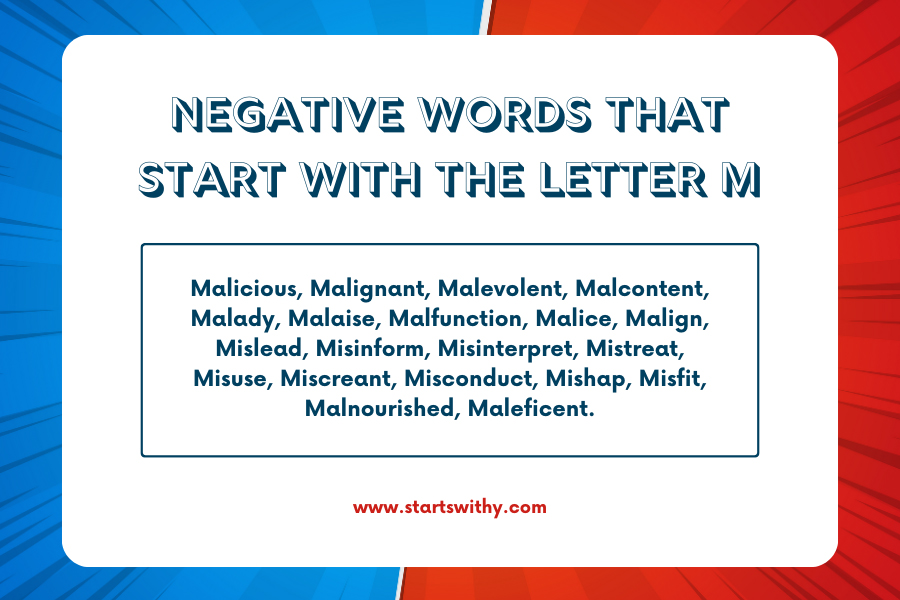
Negative Words That Start With The Letter M
The English language is vast and varied, showcasing an array of words that evoke all manner of feelings, memories, and associations. Among these, the letter ‘M’ stands out, not only for its middle position in the alphabet but also for its rich lexicon. Despite its many positive and neutral terms, ‘M’ is also a starting point for numerous words with more negative connotations. In this article, we’ll delve into some of these negative words that commence with the letter ‘M’.
1. Malice
A desire to harm others or to see others suffer; extreme ill will. Malice speaks to a deep-seated and often unjustified animosity.
2. Malign
To speak about someone in a spitefully critical manner. It can also be an adjective describing something harmful or evil in nature.
3. Mope
To spend one’s time passively or without purpose, often in a state of melancholy or boredom.
4. Malevolent
Showing or having a wish to do evil to others. A malevolent individual derives pleasure from the pain or misfortune of others.
5. Mundane
Lacking interest or excitement; dull. Mundane tasks or routines can often be repetitive and uninspiring.
6. Misanthropic
Having or showing a dislike of other people; unsociable. Misanthropes harbor a general distrust or disdain for humanity.
7. Miscreant
A person who behaves badly or in a way that breaks the law. Miscreants can be sources of trouble or disruption.
8. Mislead
To cause someone to have a wrong idea or impression. Misleading can result in confusion, wrong decisions, or even harm.
9. Malady
A disease or ailment. While it primarily refers to physical illnesses, it can also be used metaphorically for social or moral ills.
10. Maleficent
Producing harm or evil; harmful in effect. Not to be confused with the fictional character, this word is less common but profoundly negative.
11. Morose
Sullen and ill-tempered; gloomily irritable. Morose individuals often have a pessimistic view of the world.
12. Mangle
To severely mutilate, disfigure, or damage by cutting, tearing, or crushing. Mangled items often lose their original shape or function.
13. Mock
To tease or laugh at in a scornful or contemptuous manner. Mocking can hurt feelings and damage self-esteem.
14. Malaise
A general feeling of discomfort, illness, or unease whose exact cause is difficult to identify. It can refer to both physical and societal feelings of unease.
15. Malpractice
Improper, illegal, or negligent professional behavior. Malpractice can lead to harm or injustice, especially in medical or legal fields.
List of Negative Words Starting with M
| Macabre | Machiavellian | Mad |
| Madden | Maddening | Maddeningly |
| Madder | Madly | Madman |
| Madness | Maladjusted | Maladjustment |
| Maladroit | Malady | Malaise |
| Malarkey | Malcontent | Malcontented |
| Maledict | Malevolence | Malevolent |
| Malevolently | Malice | Malicious |
| Maliciously | Maliciousness | Malign |
| Malignant | Malodorous | Maltreatment |
| Mangle | Mangled | Mangles |
| Mangling | Mania | Maniac |
| Maniacal | Manic | Manipulate |
| Manipulation | Manipulative | Manipulators |
| Mar | Marginal | Marginally |
| Martyrdom | Martyrdom-Seeking | Mashed |
| Massacre | Massacres | Materialistic |
| Matte | Mawkish | Mawkishly |
| Mawkishness | Meager | Mean |
| Meaningless | Meanness | Measly |
| Meddle | Meddlesome | Mediocre |
| Mediocrity | Melancholy | Melodramatic |
| Melodramatically | Meltdown | Menace |
| Menacing | Menacingly | Mendacious |
| Mendacity | Menial | Merciless |
| Mercilessly | Mess | Messed |
| Messes | Messing | Messy |
| Midget | Miff | Militancy |
| Mindless | Mindlessly | Mirage |
| Mire | Misalign | Misaligned |
| Misaligns | Misanthropic | Misapprehend |
| Misbecome | Misbecoming | Misbegotten |
| Misbehave | Misbehavior | Miscalculate |
| Miscalculation | Miscellaneous | Mischief |
| Mischievous | Mischievously | Misconception |
| Misconceptions | Miscreant | Miscreants |
| Misdirection | Miser | Miserable |
| Miserableness | Miserably | Miseries |
| Miserly | Misery | Misfit |
| Misfortune | Misgiving | Misgivings |
| Misguidance | Misguide | Misguided |
| Mishandle | Mishap | Misinform |
| Misinformed | Misinterpret | Misjudge |
| Misjudgment | Mislead | Misleading |
| Misleadingly | Mismanage | Mispronounce |
| Mispronounced | Mispronounces | Misread |
| Misreading | Misrepresent | Misrepresentation |
| Miss | Missed | Misses |
| Misshapen | Missing | Misstatement |
| Mist | Mistake | Mistaken |
| Mistakenly | Mistress | Mistrust |
| Mistrustful | Mistrustfully | Mists |
| Misunderstand | Misunderstanding | Misunderstandings |
| Misunderstood | Misuse | Moan |
| Mobster | Mock | Mocked |
| Mockeries | Mockery | Mocking |
| Mockingly | Mocks | Moldy |
| Molest | Molestation | Monotonous |
| Monotony | Monster | Monstrosities |
| Monstrosity | Monstrous | Monstrously |
| Moody | Moot | Mope |
| Morbid | Morbidly | Mordant |
| Mordantly | Moribund | Moronic |
| Morons | Morose | Mortification |
| Mortified | Mortify | Mortifying |
| Motionless | Motley | Mourn |
| Mourner | Mournful | Mournfully |
| Muddle | Muddled | Muddy |
| Mudslinger | Mudslinging | Mulish |
| Multi-Polarization | Mundane | Murder |
| Murderer | Murderous | Murderously |
| Murky | Muscle-Flexing | Mushy |
| Musty | Myopic | Mysterious |
| Mysteriously | Mystery | Mystify |
| Myth |
Conclusion
The letter ‘M’, in all its majesty, also melds into words that echo negativity or disapproval. These words are but a fraction of the ‘M’ lexicon, serving as a reminder of the language’s complexity and range. By understanding and appropriately using such terms, we can better navigate the myriad moods and messages that our words convey, ensuring that our communication remains effective and nuanced.
Negative Words That Start With
A | B | C | D | E | F | G | H | I | J | K | L | M | N | O | P | Q | R | S | T | U | V | W | X | Y | Z