Negative Words That Start With A: Meanings & Examples
Negative words that start with A can describe poor quality, unfriendly behavior, blame, or lack of interest. Words such as abysmal, abrasive, and apathetic have different meanings and tones. Check the part of speech and context before choosing one, especially when describing a person rather than an action.
- For very poor quality: abysmal or atrocious.
- For rude delivery: abrasive.
- For blame in a tone: accusatory.
- For low interest: apathetic.
- Context changes tone: aggressive can mean hostile, but can also mean determined or forceful.
What counts as a negative word beginning with A?
A negative word expresses an undesirable quality, feeling, action, or judgment in a particular context. Some A-words, such as abysmal, strongly criticize quality; others describe interpersonal tone or behavior. The label “negative” is a practical guide, not a fixed part of speech, and a word’s force depends on what it modifies.
For example, aggressive can describe angry behavior, but it can also mean determined and forceful in sport, business, or a campaign. Before choosing a word, ask whether you mean poor performance, hostility, disinterest, or a blaming tone. A precise category helps prevent a sentence from sounding harsher than intended.
Negative words that start with A: meanings and examples
This table focuses on common words with distinct uses. Dictionary labels help distinguish an attack on quality from a description of a person’s manner or a writer’s interpretation of someone’s attitude.
| Word | Part of speech and meaning | Example sentence |
|---|---|---|
| abhor | Verb: strongly hate a behavior or idea, often for moral reasons. | “The editor said she abhorred cruelty in any form.” |
| abysmal | Adjective: extremely bad; it can also mean very deep in a literary sense. | “The team revised its abysmal first draft before submitting it.” |
| abrasive | Adjective: rude or unfriendly in manner; it can also describe a rough cleaning material. | “His abrasive reply made a small disagreement worse.” |
| accusatory | Adjective: suggesting that someone believes another person did something wrong. | “The question sounded accusatory, although she meant to ask for clarification.” |
| aggressive | Adjective: hostile or willing to attack; in other contexts, determined and forceful. | “The player’s aggressive conduct earned a warning from the referee.” |
| aloof | Adjective: distant or unwilling to join in; it does not prove someone is unfriendly. | “Mina seemed aloof at first, but she was simply nervous in a new group.” |
| apathetic | Adjective: showing little interest or energy and unwilling to act. | “After several missed meetings, the club worried that members had grown apathetic.” |
| arrogant | Adjective: behaving as if one is more important or knowledgeable than others. | “The review called the speech arrogant because it dismissed every opposing view.” |
These definitions follow Cambridge Dictionary entries for abhor, abysmal, abrasive, accusatory, aggressive, aloof, apathetic, and arrogant.

How do you choose the right negative word?
Choose a word that identifies the specific problem instead of using “bad” as a catch-all. Use abysmal for exceptionally poor work or conditions, abrasive for a rude manner, and accusatory for speech that implies blame. If the evidence concerns one action, describe the action rather than labeling someone’s whole character.
| If you mean… | Consider… | Example |
|---|---|---|
| A very poor result | abysmal | “The first-quarter result was abysmal.” |
| A harsh way of speaking | abrasive | “The feedback sounded abrasive.” |
| A blaming tone | accusatory | “Her question came across as accusatory.” |
| Little interest or effort | apathetic | “The audience seemed apathetic during the discussion.” |
Some words are judgments, so support them with observable details. “The response interrupted two speakers and dismissed their evidence” explains why a reader might call it abrasive or arrogant. This approach is more informative than applying a broad label without showing the conduct behind it.

Frequently asked questions about negative words that start with A
What is a negative word that starts with A?
Abrasive is one example: it describes a rude or unfriendly manner. Other choices include abysmal for very poor quality and apathetic for low interest or energy. The best word depends on whether the sentence describes a result, behavior, tone, or attitude.
Which A-word describes someone who is rude?
Abrasive describes a rude or unfriendly manner, especially in how someone speaks or behaves. Aggressive is stronger when the behavior shows anger or a willingness to attack. Choose the word that matches the action; neither label should be used as a substitute for explaining what happened.
Is aloof always a negative word?
Aloof often describes someone who seems distant or unwilling to take part, so it can sound critical. It does not establish why the person is quiet or detached: they may be shy, tired, or new to a group. Add context instead of assuming aloofness proves unfriendliness.
How can I use negative words without insulting someone?
Describe a specific action, statement, or result and use a measured word that fits it. “The question sounded accusatory” is narrower than “You are accusatory,” while “the report had abysmal results” criticizes the work rather than the person. Evidence and scope make criticism clearer and fairer.
In the vast tapestry of the English language, words have the power to inspire, provoke, comfort, and challenge. While positive words can uplift and motivate, negative words hold their own significance, often capturing the intricacies of human emotion and experience in contexts of conflict, critique, and introspection.
As we embark on this journey, we begin with the letter “A” to explore the myriad of negative words it brings to the fore. From expressing mild discomfort to severe disdain, these words encompass a broad spectrum of sentiments. This article will delve deep into “Negative Words That Start With A”, offering insights into their meanings, origins, and usage. Join us as we navigate the nuanced world of these impactful terms.
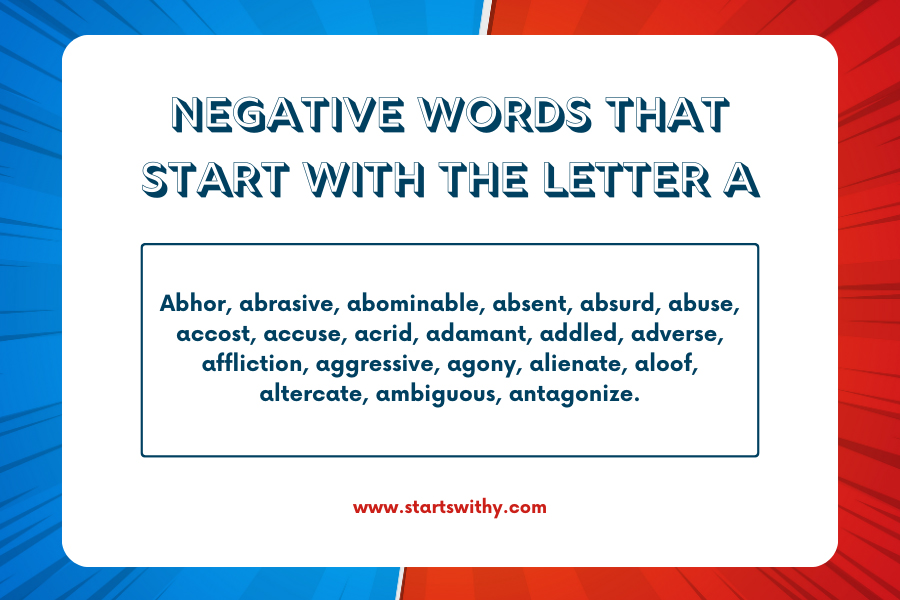
Negative Words That Start With The Letter A
The alphabet starts with the letter ‘A’, a letter that has the unique distinction of being at the beginning of our linguistic journey. While ‘A’ offers many affirming and admirable words, it equally presents a plethora of terms that convey the opposite. These words serve various purposes, from depicting undesirable emotions and situations to illustrating criticism or opposition. This article delves into a deep analysis of negative words that commence with the letter ‘A’.
1. Abhor
To abhor something means to regard it with extreme repugnance or aversion. This strong verb often denotes a profound sense of disgust or hatred towards something or someone.
2. Abandon
While it can be used in neutral contexts, abandon often carries a negative connotation, especially when it pertains to leaving something or someone without any intention of returning, especially in circumstances where continuity or support is expected.
3. Abdicate
To renounce or give up, especially when it pertains to responsibilities, duties, or powers. It often implies a lack of courage or commitment to fulfill one’s obligations.
4. Abject
This adjective describes something that is utterly hopeless, miserable, humiliating, or wretched. It’s a potent term often used to depict the most degrading of human conditions or emotions.
5. Adversary
An adversary is an opponent or enemy. The term is often used in contexts where there’s a rivalry, competition, or conflict.
6. Affliction
An affliction is something that causes pain, suffering, or distress. This could be in the form of a disease, a personal tragedy, or any challenging circumstance that tests one’s resilience.
7. Agitate
To disturb or excite emotionally. It can refer to a literal rousing of emotions, leading to unrest, or the act of stirring up public sentiment for or against a particular cause.
8. Ail
This verb refers to being ill or unwell. When someone ails, they are suffering from some illness or discomfort. It can also denote mental discomfort or unhappiness.
9. Alienate
To make someone feel isolated or estranged. This can refer to an individual feeling out of place in a particular setting or can denote the deliberate act of pushing someone away.
10. Animosity
A strong feeling of hostility or antagonism. It represents more than just casual dislike; it’s a deep-seated resentment or anger towards someone or something.
11. Annoy
A more casual term, to annoy means to irritate or disturb. It can denote both a mild, temporary irritation or a more pronounced and enduring form of vexation.
12. Antagonize
This word describes the act of making someone an enemy or provoking someone into becoming hostile.
13. Apathy
A state of indifference, where an individual lacks interest, enthusiasm, or concern. It denotes a lack of emotional investment or care.
14. Apprehension
This term can refer to the act of understanding, but more often, it denotes a fearful anticipation or the anxiety of facing something unpleasant.
15. Atrophy
A decline or decrease due to neglect or underuse. Commonly used in medical contexts, it refers to the wasting away of body tissues or organs.
List of Negative Words Starting with A
| Abhorrent | Abject | Abnormal |
| Abolish | Abominable | Abominably |
| Abominate | Abomination | Abort |
| Aborted | Abrade | Abrasive |
| Abrupt | Abruptly | Abscond |
| Absence | Absent | Absent-Minded |
| Absentee | Absentminded | Absurd |
| Absurdity | Absurdly | Absurdness |
| Abuse | Abused | Abuses |
| Abusive | Abysmal | Abysmally |
| Abyss | Accidental | Accost |
| Accursed | Accusation | Accuse |
| Accusing | Accusingly | Acerbate |
| Acerbic | Acerbically | Ache |
| Ached | Aching | Acrid |
| Acridly | Acridness | Acrimonious |
| Acrimoniously | Acrimony | Adamant |
| Adamantly | Addict | Addicted |
| Addicting | Addicts | Admonish |
| Admonisher | Admonishingly | Admonishment |
| Admonition | Adulterate | Adulterated |
| Adulteration | Adversarial | Adversary |
| Adverse | Adversity | Afflict |
| Affliction | Afflictive | Affront |
| Afraid | Aggravate | Aggravating |
| Aggression | Aggressive | Aggressiveness |
| Aggressor | Aggrieve | Aggrieved |
| Aghast | Agonies | Agonize |
| Agonizing | Agonizingly | Agony |
| Aground | Ail | Ailing |
| Ailment | Aimless | Alarm |
| Alarmed | Alarming | Alarmingly |
| Alienate | Alienated | Alienation |
| Allegation | Allege | Allergic |
| Allergies | Allergy | Aloof |
| Altercation | Ambiguity | Ambiguous |
| Ambivalence | Ambivalent | Ambush |
| Amiss | Amputate | Anarchism |
| Anarchist | Anarchistic | Anarchy |
| Anemic | Anger | Angrily |
| Angriness | Angry | Anguish |
| Animosity | Annihilate | Annihilation |
| Annoy | Annoyance | Annoyed |
| Annoying | Annoyingly | Annoys |
| Anomalous | Anomaly | Antagonism |
| Antagonist | Antagonistic | Antagonize |
| Anti | Anti-Occupation | Anti-Proliferation |
| Anti-Social | Anti-Us | Anti-White |
| Antipathy | Antiquated | Antithetical |
| Anxieties | Anxiety | Anxious |
| Anxiously | Anxiousness | Apathetic |
| Apathetically | Apathy | Apocalypse |
| Apocalyptic | Apologist | Appall |
| Appalled | Appalling | Appallingly |
| Apprehension | Apprehensive | Apprehensively |
| Arbitrary | Arcane | Archaic |
| Arduous | Arduously | Argumentative |
| Arrogance | Arrogant | Arrogantly |
| Artificial | Artless | Ashamed |
| Asinine | Asininely | Askance |
| Asperse | Aspersion | Assail |
| Assassin | Assassinate | Assault |
| Astray | Astringent | Asunder |
| Atrocious | Atrocities | Atrocity |
| Atrophy | Attack | Audacious |
| Audaciously | Audaciousness | Audacity |
| Austere | Authoritarian | Autocrat |
| Autocratic | Avalanche | Avarice |
| Avaricious | Avariciously | Avenge |
| Averse | Aversion | Awful |
| Awfully | Awfulness | Awkward |
| Awkwardness | Ax |
Conclusion
The alphabet’s initial letter, ‘A’, presents a vivid palette of words that express negativity in various shades and intensities. From personal feelings of animosity to societal issues leading to alienation, these words offer a linguistic lens to view the challenges, conflicts, and crises inherent in the human experience. However, recognizing and understanding these negative terms equips us with the tools to address, analyze, and hopefully alleviate the adversities they represent. By beginning with awareness, we take the first step towards amelioration.
Negative Words That Start With
A | B | C | D | E | F | G | H | I | J | K | L | M | N | O | P | Q | R | S | T | U | V | W | X | Y | Z