Negative words that start with N can describe harmful behavior, an unpleasant experience, a troubling condition, or a poor result. The right choice depends on what you mean: noxious is stronger and more specific than nasty, while nervous often describes a temporary feeling rather than a flaw in someone’s character.

Common negative words that start with N
Use this quick guide to compare common choices. The example sentences show how each word works in context; the short notes flag tone and usage.

| Word | Meaning and tone | Example |
|---|---|---|
| Nasty | Very unpleasant, unkind, or objectionable; informal and forceful. | “A nasty remark turned the friendly debate into an argument.” |
| Neglect | To fail to give something the care or attention it needs; also the failure itself. | “The landlord neglected the leaking roof for months.” |
| Negligent | Careless about a duty or responsibility, often with serious consequences. | “The report found that the contractor was negligent in checking the wiring.” |
| Nefarious | Extremely dishonest or wicked; dramatic and often used for deliberate schemes. | “Investigators uncovered a nefarious plan to falsify the records.” |
| Noxious | Harmful or poisonous, especially when describing a substance, gas, or influence. | “Workers evacuated the room after detecting noxious fumes.” |
| Notorious | Widely known for something bad; commonly followed by “for.” | “The route is notorious for dangerous winter conditions.” |
| Nuisance | A person, thing, or situation that causes annoyance or inconvenience. | “The constant construction noise became a nuisance for nearby residents.” |
| Naive | Too ready to trust or believe; often disapproving, though it can be mild. | “It was naive to share the password in an open message.” |
| Nervous | Uneasy or worried, especially about something that may happen; a feeling, not a moral judgment. | “I felt nervous before the interview, but the conversation went well.” |
| Negligible | So small or unimportant that it can be disregarded; negative only when the small amount is a problem. | “The repair reduced the leak to a negligible amount.” |
Words for criticism, harm, and poor outcomes
Negate means to cancel, deny, or make something ineffective: “One late correction did not negate the damage caused by the false claim.” It is neutral in technical uses, so it fits best when something is genuinely reversed or contradicted.
Nullify is a formal alternative meaning to make something legally or practically invalid: “The missing signature could nullify the agreement.” Nonexistent describes something that does not exist, while noncompliant describes failure to follow a rule or requirement. These are precise choices for factual or professional writing, not general insults.
Inadequate means not good enough for a particular purpose; inferior means lower in quality or status; and unacceptable means not meeting an expected standard. Naming the specific shortcoming—“inadequate evidence,” for example—is clearer than calling something simply “bad.”

Stronger or more formal N-words
Nefarious suggests intentional wrongdoing and is more dramatic than dishonest. Notorious describes a reputation: a person, place, or practice is notorious for something negative. Noxious is most literal with something harmful to health or the environment, though it can also describe an offensive smell or damaging influence. Cambridge Dictionary defines it in terms of being poisonous or harmful, so it is more specific than a general synonym for “bad.”
Nihilistic has a specialized philosophical meaning connected with rejecting established values or the idea that life has meaning. In everyday conversation it is sometimes used loosely for bleak pessimism, but reserve it for a genuinely extreme outlook. A person who is simply doubtful or unhappy is not necessarily nihilistic.
Notable and nonchalant can also sound negative in particular contexts, but neither is inherently negative. A “notable mistake” is an error worth noticing; a “nonchalant reply” may seem too casual, or it may simply be relaxed. Describe the effect you intend instead of treating either word as an insult.
Negative-sounding N-words that depend on context
Some words in long alphabetized lists are not negative by themselves. Nudge is a gentle push or reminder, and it can be helpful: “A calendar alert nudged me to renew the permit.” Neither, none, no, and nothing express negation, but they do not automatically carry a critical tone. Neutral means neither positive nor negative in many uses.
Nervous can convey understandable anticipation; naive can criticize poor judgment but may also describe inexperience without malice. Nonplussed traditionally means confused or surprised, though some speakers use it to mean unfazed. When precision matters, choose a clearer alternative such as confused, surprised, or unbothered.

How to choose the right word
- Describe the actual problem. Use noxious for something harmful, negligent for a failure of care, and notorious for a bad reputation.
- Match the strength to the facts. Nasty is conversational; nefarious implies deliberate wrongdoing; nihilistic carries a narrower philosophical sense.
- Separate a feeling from a judgment. Calling someone nervous describes how they feel. Calling them negligent makes a claim about their conduct.
- Use an example sentence as a test. If the word makes your meaning sound harsher, broader, or more certain than you intend, choose a more exact alternative.
Dictionary entries can help confirm meaning and usage: nasty, neglect, notorious, noxious, naysayer, naive, nihilistic, and nudge.
Editorial note: The original article below is retained in full as an archive of the earlier list. Its entries include words whose tone changes with context, so use the usage notes above when you need to select a genuinely negative word.
The vast expanse of the English language boasts a rich tapestry of words that cater to every shade of emotion and context. Among these, negative words play a pivotal role in conveying discontent, disapproval, or simply representing unfavorable situations or characteristics.
In this article, we delve into a segment of this darker lexicon, focusing on words that commence with the letter ‘N’. From expressing subtle nuances of slight inconvenience to describing dire circumstances, these ‘N’ words are integral to painting a complete linguistic picture. Whether you are looking to expand your vocabulary, understand literary contexts, or simply satisfy linguistic curiosity, this journey through negative ‘N’ words promises to be enlightening.
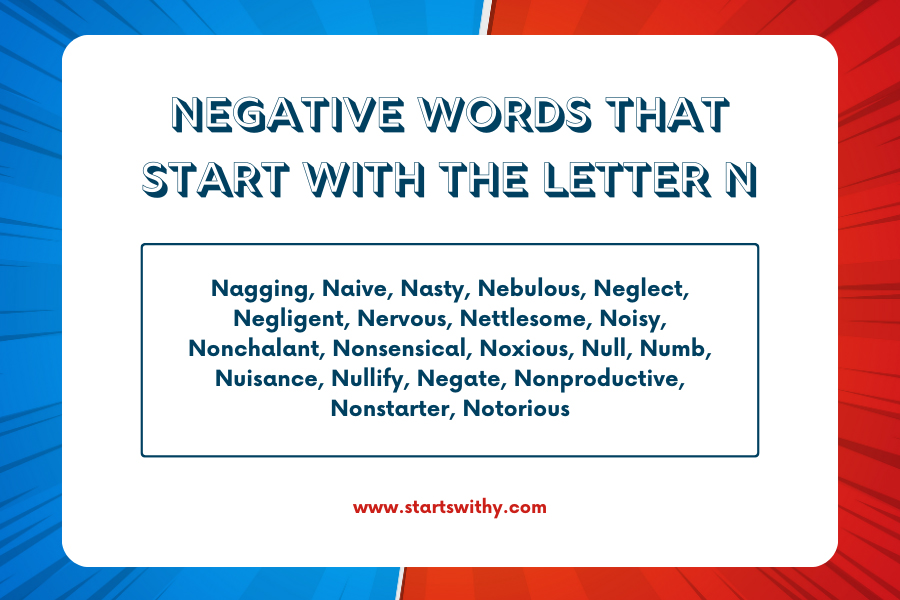
Negative Words That Start With The Letter N
The nuanced nature of the English language provides us with a plethora of words, each carrying its distinct sentiment. Nestled neatly within the confines of this vast vocabulary, the letter ‘N’ offers not just neutral or positive terms, but also a series of words that possess negative connotations. In this article, we’ll traverse the terrain of the letter ‘N’, highlighting some of the more negatively-perceived words it introduces to our lexicon.
1. Nasty
Describing something offensive in smell, taste, or appearance, or a person’s behavior that is mean or unkind. ‘Nasty’ encapsulates an unpleasantness that is hard to ignore.
2. Neglect
The failure to care for or pay attention to someone or something. Neglect often results in deterioration or harm.
3. Nefarious
An adjective used to describe actions or activities that are wicked, villainous, or criminal. Nefarious deeds are often deliberate and morally reprehensible.
4. Notorious
Famous for something bad or negative. Notoriety isn’t a status most seek, as it often stems from unfavorable actions or characteristics.
5. Naysayer
A person who habitually expresses pessimistic views or opposes progress. Naysayers can deter growth and stifle innovative ideas.
6. Nag
To annoy or irritate someone by repeated requests or complaints. Nagging, while sometimes rooted in concern, can strain relationships.
7. Nihilistic
Rejecting all religious and moral principles, often believing that life is meaningless. A nihilistic viewpoint can be profoundly negative and pessimistic.
8. Noxious
Harmful, poisonous, or very unpleasant. Whether referring to substances or attitudes, noxious elements are dangerous and detrimental.
9. Nullify
To render something legally null and void or of no value. Nullification can negate efforts, contracts, or rights.
10. Nudge
A slight or gentle push, often done repeatedly and annoyingly. While sometimes playful, incessant nudging can be intrusive.
11. Nonchalant
Appearing casually calm and relaxed, often indicating a lack of concern or interest. A nonchalant attitude can sometimes be perceived as uncaring or aloof.
12. Nervous
Easily agitated or alarmed; tending to be anxious. Nervous feelings can hinder one’s ability to function optimally in various situations.
13. Negate
To make ineffective or null; invalidate. When efforts are negated, it can lead to frustration and a sense of futility.
14. Nettle
To irritate or annoy. Just as the plant can cause skin irritation, the verb form represents causing discomfort or annoyance to another.
15. Nebulous
Vague, ill-defined, or unclear. Nebulous ideas or statements can lead to confusion and misunderstanding.
List of Negative Words Starting with N
| Nag | Nagging | Naive |
| Naïve | Naively | Narcissistic |
| Narrow-Minded | Narrower | Nastily |
| Nastiness | Nasty | Naughty |
| Nauseate | Nauseates | Nauseating |
| Nauseatingly | Nebulous | Nebulously |
| Needless | Needlessly | Needy |
| Nefarious | Nefariously | Negate |
| Negation | Negative | Negatives |
| Negativity | Neglect | Neglected |
| Neglectful | Negligence | Negligent |
| Neither | Nemesis | Nepotism |
| Nerve-Racking | Nervous | Nervously |
| Nervousness | Nettle | Nettlesome |
| Neurotic | Neurotically | Never |
| Niggle | Niggles | Nightmare |
| Nightmarish | Nightmarishly | Nitpick |
| Nitpicking | No | No One |
| Nobody | Noise | Noises |
| Noisier | Noisome | Noisy |
| Non-Confidence | Nondescript | None |
| Nonexistent | Nonresponsive | Nonsense |
| Nosey | Nosy | Not |
| Nothing | Notoriety | Notorious |
| Notoriously | Nowhere | Noxious |
| Nuisance | Numb |
Conclusion
The letter ‘N’ provides us with a nuanced list of words that, when used in various contexts, convey negativity or disapproval. However, it’s crucial to remember that the presence of such words adds depth to our language, allowing for precise expression. Recognizing and understanding these terms can enhance our ability to communicate complex emotions and situations, ensuring our interactions remain rich and multifaceted.
Negative Words That Start With
A | B | C | D | E | F | G | H | I | J | K | L | M | N | O | P | Q | R | S | T | U | V | W | X | Y | Z