Content note: sensitive terms in the preserved list
The original G-word list below is preserved verbatim. It includes ghetto and genocide, terms connected to persecution and mass atrocity, and geezer, an informal word for a man that can be insulting. These words need more context than a general list of “negative” vocabulary provides.
Ghetto has referred to a confined city area where a minority group was forced or pressured to live. During the Holocaust, Nazi Germany and its allies imprisoned Jewish people in ghettos as part of persecution and mass murder. In casual speech, using ghetto as an insult meaning cheap, inferior, or “bad” can demean people and communities and draw on racialized stereotypes. If you mean a specific condition, describe it directly—such as “poorly maintained,” “crowded,” or “under-resourced”—and avoid treating a community itself as a negative quality. For historical context, see the United States Holocaust Memorial Museum’s explanation of ghettos and Dictionary.com’s usage note on the word’s disparaging adjective use.
Genocide is a noun for a specific crime, not a general adjective meaning “terrible.” The Genocide Convention defines it through particular acts committed with intent to destroy, in whole or in part, a national, ethnic, racial, or religious group. Use the term carefully and only when the context supports it; the related adjective is genocidal. See the United Nations’ explanation of genocide.
Geezer is an informal noun, often referring to an older man; Cambridge notes that the word can be offensive in American English. It may sound affectionate in some relationships and dismissive in others. When age is relevant, “older man” or “older person” is more neutral. See Cambridge Dictionary: geezer.

“Negative” describes tone, not a person’s worth
Some entries name difficult feelings, some describe behavior, and others judge a situation or appearance. That difference matters. Grief is a response to loss, not a character flaw. Guilt can name a feeling or responsibility; it should not be assigned to someone without evidence. A grudge is ongoing resentment. Grumbling is complaining quietly, while goading is provoking someone into action or a reaction. Words such as grim, grueling, and ghastly describe circumstances or experiences rather than automatically defining a person.
The list is broad rather than a list of adjectives only: grief and grudge are nouns; goad, grumble, and grouse can be verbs; grievously and guiltily are adverbs. The form in a sentence determines the job a word is doing. For example, “The exhausting hike was grueling” uses an adjective, while “We grumbled about the long climb” uses a verb.

Examples with clear, fair context
- She felt grief after losing a longtime friend, and her classmates gave her space.
- He held a grudge after the disagreement instead of discussing it.
- The witness felt guilt for a mistake and apologized for the harm it caused.
- The team faced a grueling schedule, so the coach built in rest days.
- His gruff reply sounded abrupt, although he later explained that he was tired.
- The glum student was quiet that morning; a friend checked in without assuming why.
- The report described grim conditions in the shelter and proposed specific improvements.
- She gave a glib answer that sounded confident but did not address the question.
- The movie’s gory scene was unsettling to some viewers, so the review included a content note.
- Instead of goading her brother, he asked calmly what had upset him.
- The committee rejected a groundless accusation because the evidence did not support it.
- After a difficult week, the group found a hopeful way forward.

How to use this vocabulary
Before choosing a negative word, ask what you need to communicate: a feeling, an action, a quality, or a serious event. Prefer a precise description over a broad label, and distinguish what someone did from who that person is. This makes criticism clearer and reduces the risk of turning age, culture, neighborhood, grief, or hardship into an insult.
The alphabetized list and original definitions below remain unchanged. The notes above add part-of-speech guidance and usage context for its sensitive entries.
Navigating the vast expanse of the English language, we often encounter words that evoke a spectrum of emotions. In this article, we delve into the realm of negativity, focusing on words that begin with the letter ‘G’.
These words not only reflect various shades of displeasure, distress, and discontent but also serve as vital tools for writers, speakers, and anyone looking to articulate a specific sentiment. Journey with us as we explore and dissect 20 negative words that commence with the intriguing letter ‘G’. Whether you’re a budding wordsmith or just curious, this list promises a rich linguistic experience.
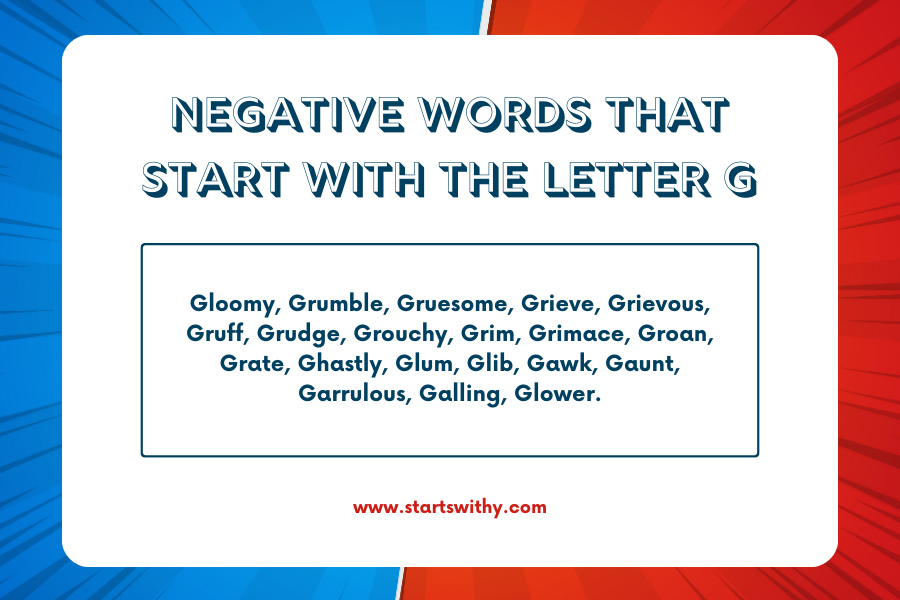
Negative Words That Start With The Letter G
As we gallop through the glossary of the English language, the letter ‘G’ emerges as a goldmine, glistening with a galaxy of words that guide our thoughts, gestures, and expressions. While many of these words are gleeful, glowing, and generous, there exists a gamut of ‘G’ words that gravitate towards the gloomy and grim. This article will guide you through a gamut of these ‘G’ words, granting a greater understanding of their meanings and uses.
1. Grief
A profound sorrow, usually following a loss. Grief can engulf individuals, leaving them grappling with overpowering emotions.
2. Grudge
An enduring feeling of resentment or ill will because of a past insult or injury. To bear a grudge is to harbor negative feelings over time.
3. Guilt
A feeling of responsibility for a wrongdoing or error. Guilt gnaws at one’s conscience and can govern behaviors and decisions.
4. Grumble
A muttered complaint or discontent. When someone grumbles, it signifies dissatisfaction.
5. Grim
Describing something that is stern, forbidding, or uninviting. It’s often used to refer to situations that seem bleak.
6. Ghastly
Shocking, horrifying, or very bad. This word is often used to describe events, actions, or things that evoke fear or dread.
7. Greed
An intense and selfish desire for something, especially wealth, power, or food. Greed can guide individuals to act against their morals.
8. Grueling
Exhausting and intensely demanding. A grueling task is one that tests strength, endurance, and resolve.
9. Gruff
Rough and low in tone; also, brusque in manner. A gruff voice or a gruff person may come off as unfriendly or intimidating.
10. Gauche
Lacking grace, unsophisticated, or socially awkward. Someone who’s described as gauche might display a lack of social finesse.
11. Glib
Fluent but insincere and shallow. Glib remarks might sound smooth but often lack depth and sincerity.
12. Glum
Feeling or looking sullen, dejected, or downcast. Glum captures a mood of despondency.
13. Goad
To provoke or annoy someone into action. To goad is to push someone, often through irritation, towards a reaction.
14. Gory
Involving or showing violence and bloodshed. Gory scenes or stories are not for the faint-hearted.
15. Grotesque
Odd or unnatural in shape, appearance, or manner; fantastically ugly or absurd. The word can describe eerie, distorted figures or situations.
List of Negative Words Starting with G
| Gabble | Gabby | Gaff |
| Gaffe | Gainsay | Gainsayer |
| Gall | Galling | Gallingly |
| Galls | Gangly | Gape |
| Gaping | Garbage | Garbled |
| Garish | Garrulous | Gasp |
| Gasping | Gauche | Gaudy |
| Gaunt | Gawk | Gawky |
| Geezer | Generic | Genocide |
| Get-Rich | Ghastly | Ghetto |
| Ghosting | Ghoulish | Gibber |
| Gibberish | Gibe | Giddy |
| Gimmick | Gimmicked | Gimmicking |
| Gimmicks | Gimmicky | Glare |
| Glaringly | Glassy | Glib |
| Glibly | Glitch | Glitches |
| Gloatingly | Gloom | Gloomy |
| Glower | Glum | Glut |
| Gluttonous | Gnarly | Gnawing |
| Goad | Goading | God-Awful |
| Goof | Goofy | Goon |
| Gossip | Graceless | Graft |
| Grainy | Grapple | Grate |
| Grating | Grave | Gravely |
| Greasy | Greed | Greedy |
| Green | Grief | Grievance |
| Grievances | Grieve | Grieving |
| Grievous | Grievously | Grim |
| Grimace | Grimacing | Grimy |
| Grind | Gripe | Gripes |
| Grisly | Gritty | Groaning |
| Groggy | Gross | Grossly |
| Grotesque | Grouch | Grouchy |
| Groundless | Grouse | Growl |
| Growling | Grubby | Grudge |
| Grudges | Grudging | Grudgingly |
| Grueling | Gruesome | Gruesomely |
| Gruff | Grumble | Grumbling |
| Grumpier | Grumpiest | Grumpily |
| Grumpy | Guarded | Guile |
| Guilt | Guiltily | Guilty |
| Gullible | Gussy | Gutless |
| Gutter |
Conclusion
The letter ‘G’, with its grandeur, houses words that can gladden our hearts and simultaneously, words that can grip us in gloom. By gleaning these negative ‘G’ words, we are better equipped to gauge the gamut of human emotion and experience. Recognizing and understanding these words is a gift that enables richer, more nuanced expressions and communications.
Negative Words That Start With
A | B | C | D | E | F | G | H | I | J | K | L | M | N | O | P | Q | R | S | T | U | V | W | X | Y | Z