Negative Words That Start With V: Quick Answer
Negative words that start with V include vague, vapid, venal, venomous, vexing, vicious, vindictive, and vitriolic. Their effects differ: some criticize conduct, some describe a difficult situation, and a few carry a negative tone only in context. Grammar and context determine which word is accurate.
- For a harsh personal attack: vitriolic, vicious, or venomous; use them sparingly and only when the evidence supports the intensity.
- For an unstable situation: volatile means prone to sudden, unpredictable change; it does not automatically mean angry.
- For shallow or empty content: vapid or vacuous can describe a remark, idea, or expression, but they are judgments rather than neutral facts.
- For conduct: vandalism, violation, or vilification name an act or process more specifically than a broad insult.
- Not every V entry is inherently bad: vulnerable, voracious, and victim are context dependent and should not be used as insults.
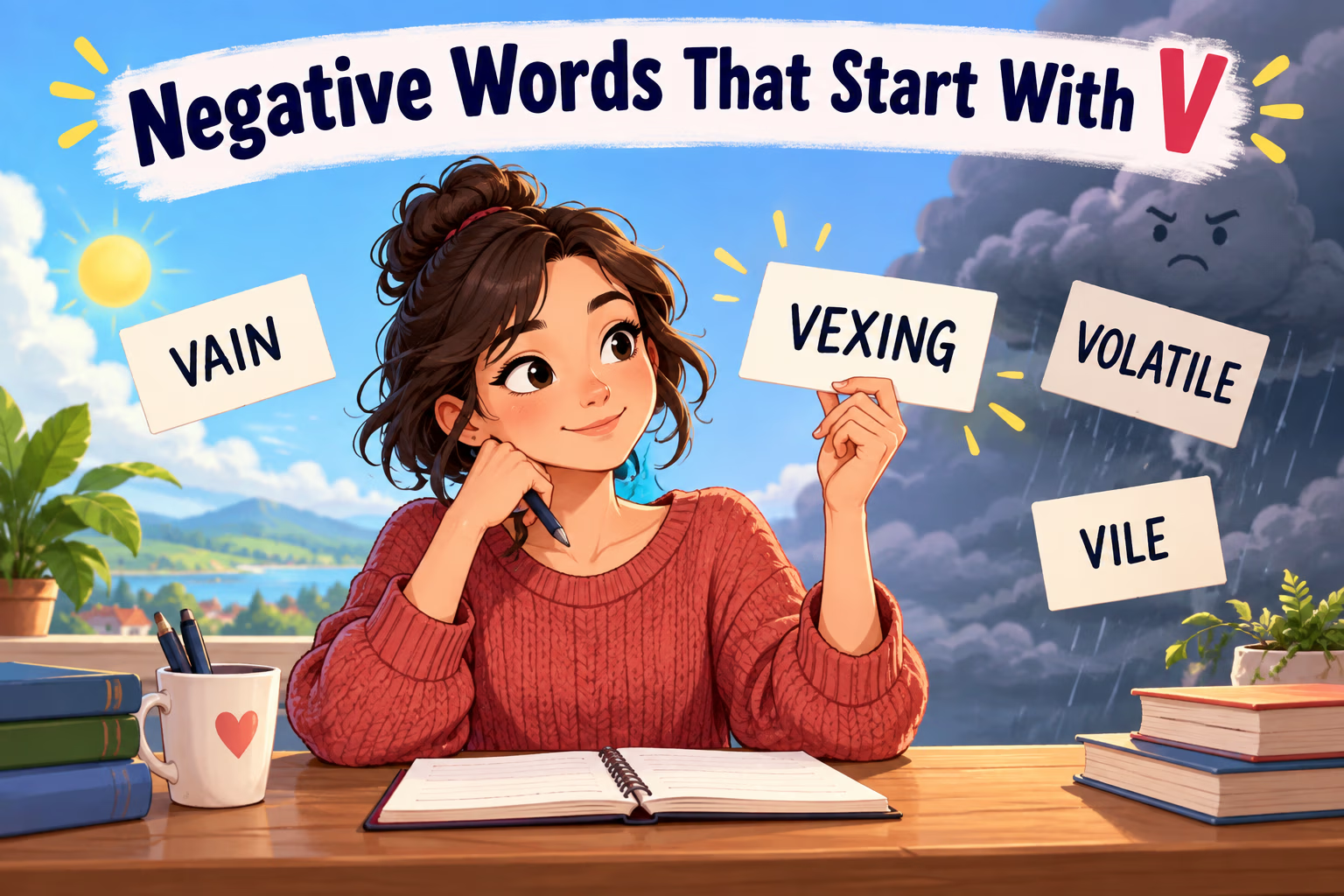
How negative is a V word? Tone, meaning, and grammar
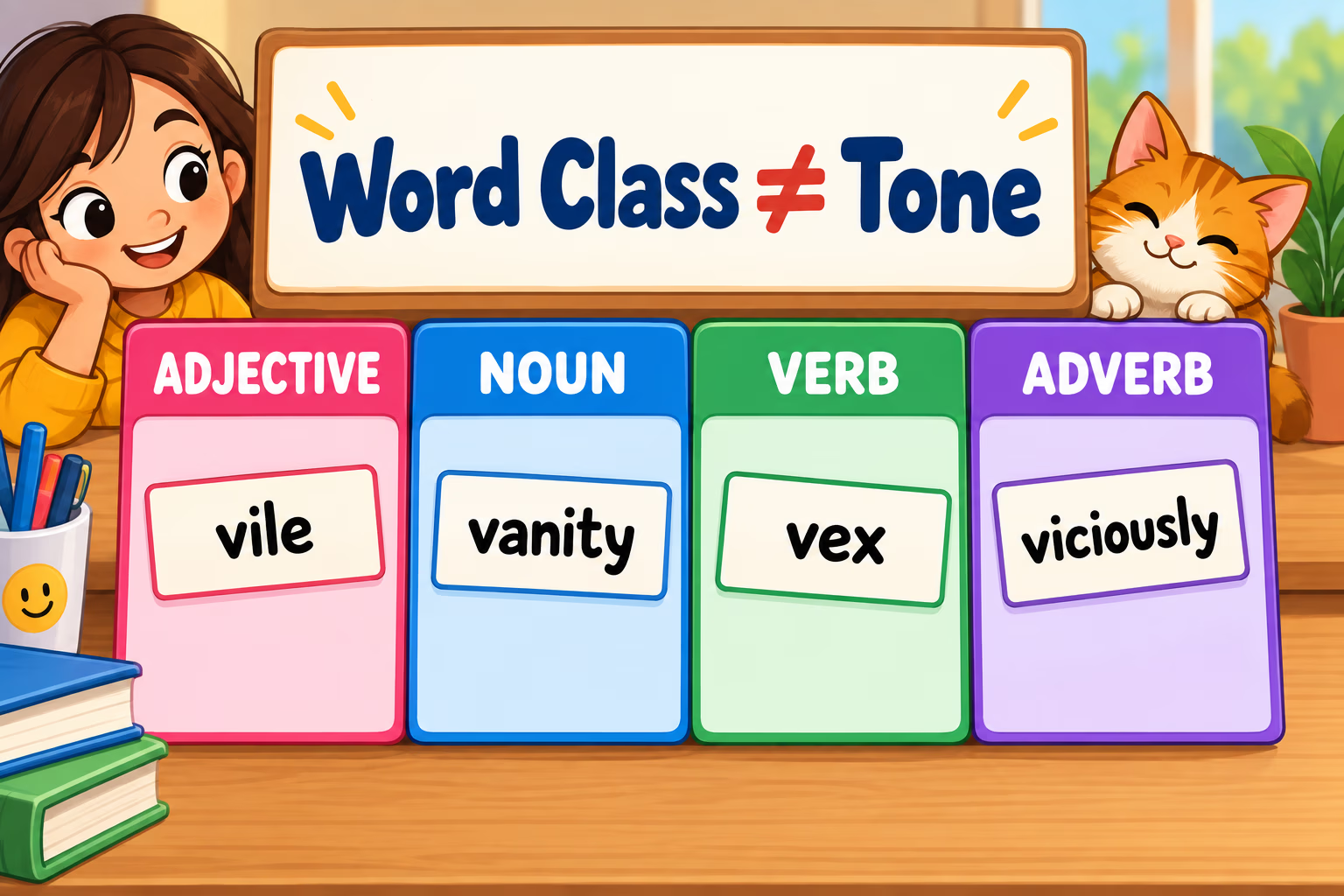
A word’s dictionary meaning, grammatical role, and emotional tone are related but separate. Vex is a verb meaning to annoy or trouble; vexing is an adjective for something frustrating; vexation is a noun for annoyance or distress. Calling a decision “vexing” criticizes the situation, while calling a person “vexing” makes the judgment personal. Cambridge Dictionary identifies vex as a verb and notes that it is old-fashioned in US use, while vexatious has a formal or specialized legal sense in addition to its broader “difficult and irritating” meaning (Cambridge Dictionary: vex; Cambridge Dictionary: vexatious).
| Word | Part of speech | What it criticizes | Example |
|---|---|---|---|
| vapid | adjective | Something dull or lacking liveliness | The review called the plot vapid. |
| vandalism | noun | Deliberate damage to property | The report documented vandalism to the bus shelter. |
| vex | verb | An action or issue that annoys or troubles | The repeated delay vexed commuters. |
| vitriolic | adjective | Speech or criticism marked by bitter hostility | The exchange turned vitriolic after personal attacks began. |
| volatility | noun | A tendency to change suddenly | Price volatility made the estimate uncertain. |
This distinction prevents a common error: treating every word on a “negative words” list as a label for a person. Vandalism names damage, vex names an effect, and volatile can describe prices, chemicals, or a tense situation. Choosing the noun, verb, or adjective that names the evidence makes a sentence both clearer and fairer.
65+ negative V words and related forms
The original article below contains its 20 V entries and remains unchanged. This companion list adds more than 45 dictionary-based words and related forms. Derived forms count toward the “65+” total, so this is a vocabulary reference rather than a claim that every item is a separate, equally common dictionary headword. Several entries are negative only in particular contexts.
| Word or form | Meaning and useful context |
|---|---|
| vacuous | Empty of meaningful thought or purpose; often describes a remark, question, or expression. |
| vacuity | The quality of being empty or lacking substance; a formal noun. |
| vacuously | In a way that appears empty or without thought. |
| vacuousness | The condition of being vacuous; usually a critical or formal description. |
| vapid | Dull, flat, or lacking liveliness; often used of conversation, entertainment, or prose. |
| vapidity | The quality of being vapid; a formal critical noun. |
| vapidly | In a dull or lifeless manner. |
| vainglorious | Excessively proud of one’s own achievements or qualities. |
| vainglory | Unjustified or excessive pride in oneself or one’s accomplishments. |
| valueless | Having no value for a stated purpose; avoid implying that a person has no worth. |
| vandal | A person who deliberately damages property; use only when the act and evidence are established. |
| vandalism | Intentional damage to property, such as breaking signs or defacing a wall. |
| vandalize | To deliberately damage or deface property. |
| venal | Willing to act dishonestly in return for money or another reward, especially in a position of trust. |
| venality | The quality of being venal; corruption motivated by personal gain. |
| vengeful | Wanting to punish someone for a perceived wrong; Cambridge distinguishes it from neutral pursuit of justice (Cambridge Dictionary: vengeful). |
| vengefully | In a way intended to punish someone for a perceived injury. |
| vengefulness | A desire to retaliate or punish; a noun describing a motive, not proof that a person will act on it. |
| vengeance | Punishment inflicted in retaliation; unlike “justice,” it often implies personal retaliation. |
| venom | A toxin produced by some animals; figuratively, bitter malice in words or conduct. |
| venomously | In a spiteful or hateful manner when used figuratively. |
| venomousness | The quality of containing venom or, figuratively, expressing spite. |
| verbose | Using more words than needed; a formal, disapproving term for unnecessarily wordy speech or writing (Cambridge Dictionary: verbose). |
| verbosity | Unnecessary wordiness; it criticizes the amount of language, not whether the content is true. |
| vexed | Annoyed, troubled, or difficult; in “a vexed question,” it can mean complicated or disputed. |
| vexing | Annoying or troubling; typically describes a problem, delay, or question. |
| vexatious | Causing irritation or dispute; in law, the term has a narrower specialized use. |
| vexatiously | In a way that needlessly causes annoyance or trouble; legal use depends on jurisdiction. |
| vexatiousness | The quality of causing irritation or dispute. |
| victimize | To treat someone unfairly or make them a target of harm; use when the conduct is supported. |
| victimization | Unfair treatment or harm directed at a person or group; it describes what happened, not a flaw in the person harmed. |
| victimizer | A person who harms or unfairly targets another person; use with care and evidence. |
| vicious | Intending to cause serious harm, or causing severe physical or emotional pain; it is stronger than “unkind” (Cambridge Dictionary: vicious). |
| viciously | In a cruel or deliberately harmful way. |
| viciousness | The quality of being cruel or severely harmful. |
| vilely | In an extremely unpleasant or morally reprehensible way. |
| vileness | Extreme unpleasantness or moral repugnance. |
| villainous | Like a villain or morally reprehensible; also used playfully in fictional contexts. |
| villainy | Wicked or criminal conduct, especially in fiction or dramatic writing. |
| vilify | To speak or write about someone in an abusive way that damages their reputation. |
| vilification | Abusive public criticism or portrayal that attacks a person’s reputation. |
| vilifier | A person who vilifies someone; a rare, strongly critical noun. |
| vindictively | In a way motivated by a wish to retaliate against someone for a perceived injury. |
| vindictiveness | A desire to harm someone in retaliation; Cambridge describes “vindictive” as disapproving (Cambridge Dictionary: vindictive). |
| violate | To break or disregard a rule, agreement, right, or boundary; specify what was violated. |
| violation | The act of breaking a rule or infringing a right or boundary. |
| violator | A person or entity that breaks a stated rule or right; identify the rule rather than using the word as a general insult. |
| virulent | Extremely harmful or hostile; in biology, capable of causing severe disease. The field changes its meaning. |
| virulence | Severity or harmfulness, including the disease-causing power of a pathogen or the hostility of rhetoric. |
| virulently | In an intensely hostile or harmful manner. |
| vitriolic | Marked by bitter anger or hate, especially criticism or an attack; it describes the language’s tone (Cambridge Dictionary: vitriolic). |
| vitriol | Harsh, bitter criticism or speech; historically also the name for certain sulfates and sulfuric acid. |
| vitriolically | In a bitterly hostile or cutting manner; uncommon, so “with vitriol” is often clearer. |
| vituperative | Containing harsh, abusive criticism; a formal word for insulting speech. |
| vituperation | Harsh verbal abuse or condemnation. |
| vulgar | Crude or offensive by a community’s standards; its meaning varies by context and audience. |
| vulgarity | Crudeness or an offensive expression; identify the specific language or behavior when possible. |
| vulgarly | In a crude or offensive manner. |
| vulturous | Predatory or greedy in a way compared with a vulture; uncommon and strongly figurative. |
| volatility | A tendency to change suddenly and unpredictably; it can describe markets, moods, or situations without implying moral fault (Cambridge Dictionary: volatile). |
Choosing the right word: a practical method
Accurate negative vocabulary names what happened and how certain the judgment is. The quickest improvement is to replace an overall label with a description of the observable action, the affected person or object, and the evidence.
- Identify the target. Is the sentence about an act (vandalism), a quality (vicious), a feeling (vexed), or a condition (volatile)?
- Match the strength. “Vexing” signals annoyance; “vicious” signals serious harm. Do not upgrade a small inconvenience into a moral accusation.
- Check the grammar. Use venality as a noun (“the inquiry examined alleged venality”), venal as an adjective (“a venal official”), and act or acts as needed.
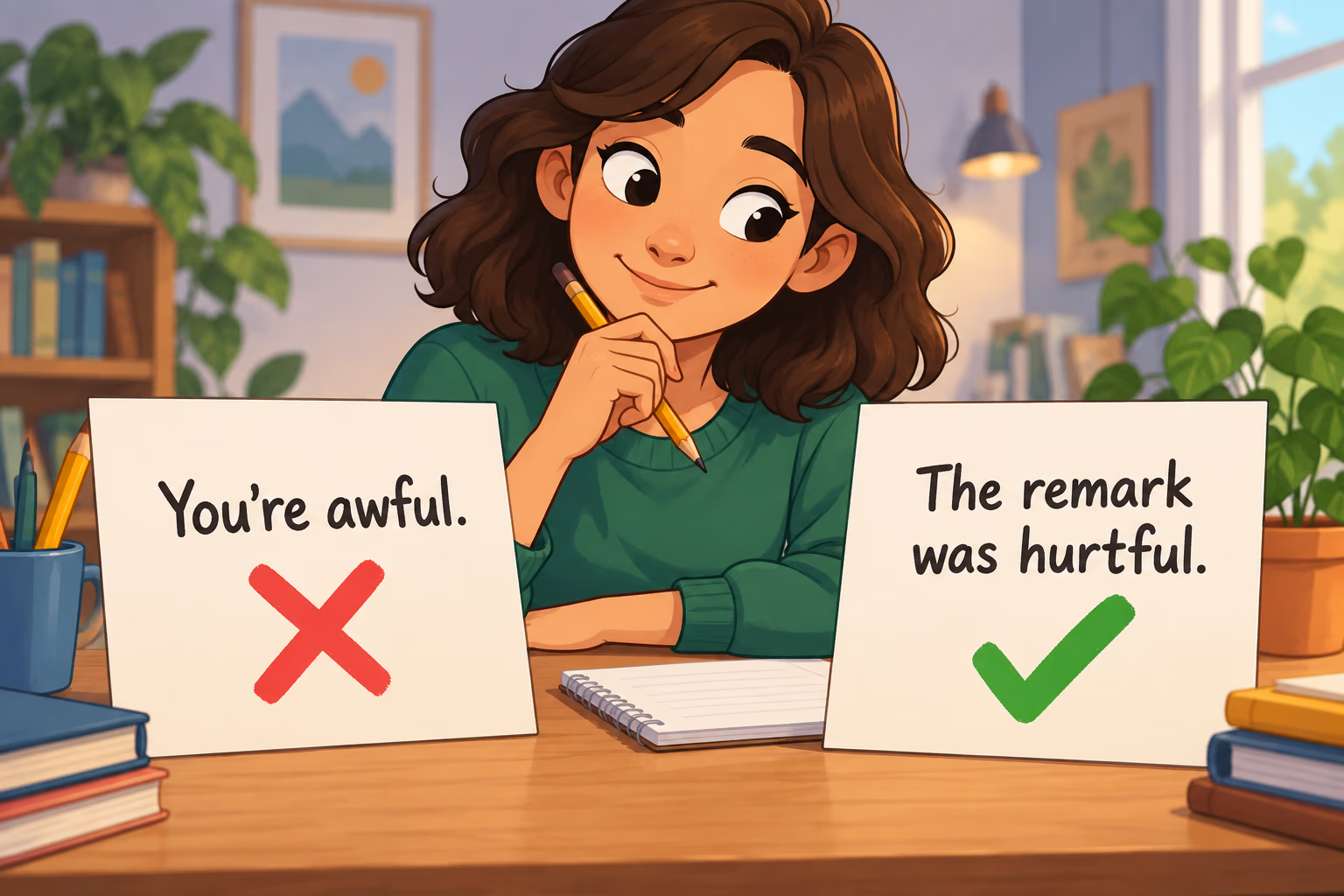
- Describe evidence before motive. “The message included a threat” reports observable content; “the writer was vindictive” infers a motive that may be harder to establish.
- Consider the audience. Words such as vulgar, vile, and vitriolic are evaluative. In school, work, or reporting, a concrete explanation is usually more useful than a label.
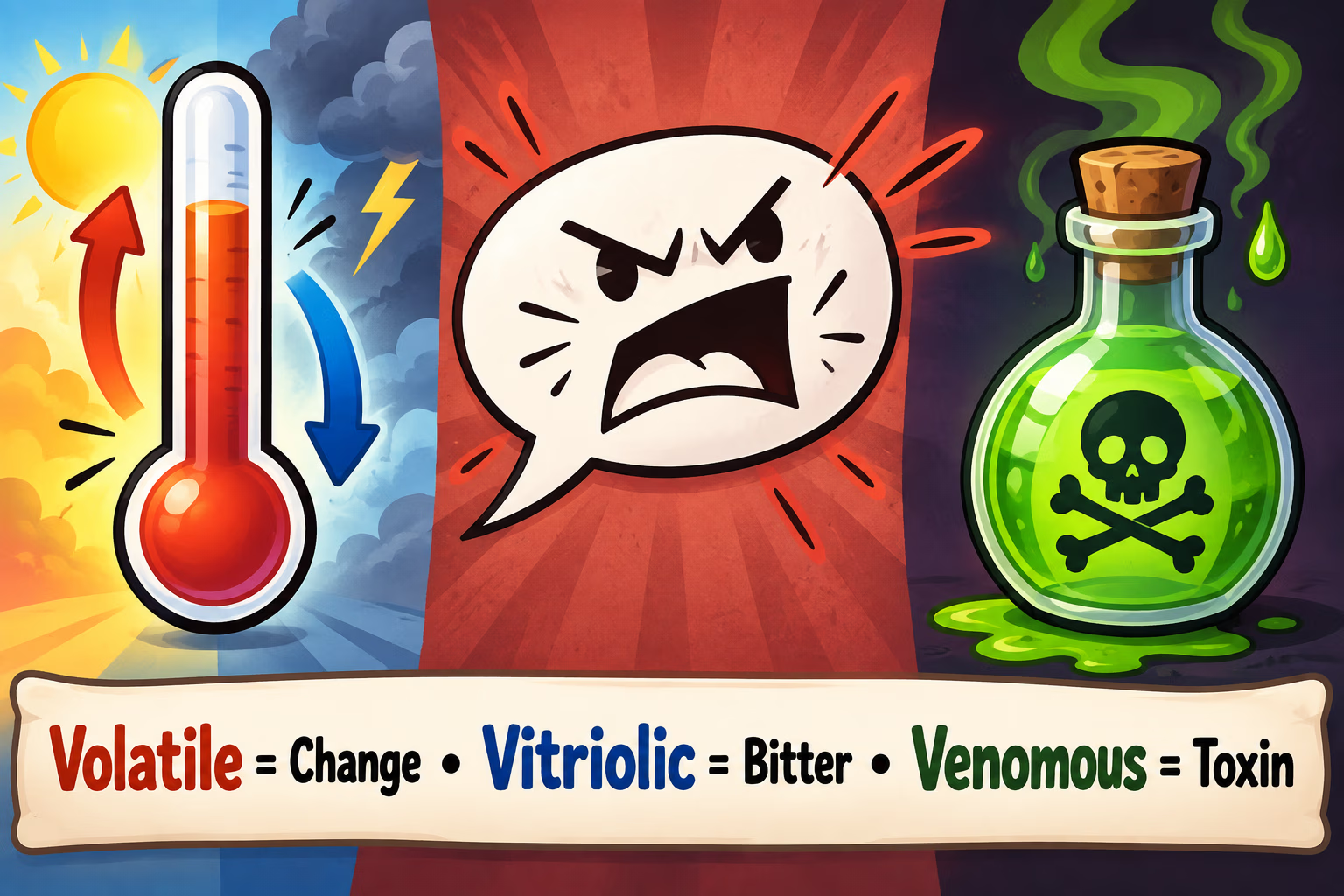
Expert usage note: Volatile, vitriolic, and venomous are not interchangeable. A volatile meeting may change suddenly; a vitriolic remark is bitterly hostile; venomous literally concerns injected toxin and figuratively suggests spite. Cambridge distinguishes sudden change for “volatile,” while its entry for “vitriolic” centers bitter anger. The related word “venomous” has a literal biological meaning as well as a figurative one.
Expert usage note: The ending does not make a word an adjective automatically. In this family, vex is a verb, vexation is a noun, and vexatious is an adjective. The nearby illustration’s “vile / vanity / vex / viciously” set also shows adjective, noun, verb, and adverb roles.
Expert usage note: “Victim” and “vulnerable” are not insults and are not inherently negative traits. Vulnerable means susceptible to harm or influence; it can describe exposure or a temporary circumstance. Victimization names harm done to a person. Do not turn either word into blame for the person affected.
Examples of negative V words in sentences
- The reviewer called the argument vacuous because it offered no supporting reasons.
- The audit found venal conduct only after records showed payments tied to official decisions.
- Repeated false alarms became a vexing problem for the building manager.
- The reporter described the market as volatile after prices swung sharply in both directions.
- Several vitriolic comments attacked a colleague personally instead of challenging the proposal.
- The city documented vandalism to the sign and estimated the repair cost.
- The group rejected a vindictive response and focused on a fair remedy.
- She called the joke vulgar for a formal ceremony, while noting that standards differ by audience.
These examples show why context matters. “Vicious,” “vile,” and “vitriolic” are forceful judgments; “vexing” is milder; “volatile” may be a technical description; and “vandalism” or “violation” can be more precise than a personal insult. For spelling or nuance, check a current dictionary entry before using an unfamiliar or uncommon form.
The preserved list includes a few terms such as vulnerable, victim, and voracious that are not inherently negative; the usage guidance here supplies context without changing that original wording.

The vocabulary of the English language is vast and dynamic, encompassing a wide range of emotions, descriptions, and expressions. Among the lexicon are words that evoke negative sentiments or describe unfavorable situations. Starting with the letter ‘V’, there are numerous terms that can capture the less-than-pleasant aspects of life, events, or characteristics.
This article delves into some of these “V” words, offering readers insight into their meanings and the contexts in which they might be used. Whether you’re looking to enrich your vocabulary, better understand literary contexts, or simply satisfy your linguistic curiosity, these negative words that begin with ‘V’ are sure to provide an enlightening journey.
Negative Words That Start With The Letter V
The English language, with its vast vocabulary, is bound to have a myriad of words that convey the spectrum of human emotions, both positive and negative. Among the many letters that contribute to this lexicon, ‘V’ stands out, especially when it comes to words with negative connotations. This article delves deep into the negative nuances of words starting with the letter ‘V’, examining their meanings, uses, and implications.

1. Vain
A term often used to describe someone overly concerned with their own appearance or achievements. It can also denote futile efforts or actions that yield no results.
2. Vex
To annoy or irritate someone, usually over petty matters. It can also refer to the feeling of being troubled or agitated.
3. Vile
Describing something extremely unpleasant or of poor quality. It’s often associated with morally reprehensible actions or attitudes.
4. Violent
Characterized by the use of physical force to harm or damage someone or something. It can also describe intense or severe emotions or actions.
5. Venomous
Having the ability to inject venom, often related to some animals like snakes. Metaphorically, it can describe a person’s spiteful or malicious intent.
6. Vagrant
A person without a settled home or job, often living on the streets. Sometimes it carries a connotation of being idle or disreputable.
7. Vindictive
Having or showing a strong desire for revenge. It’s often used to describe someone who holds grudges.
8. Void
Lacking or empty of the usual or appropriate content. It can also mean null or invalid, especially in legal terms.
9. Vague
Unclear in meaning or intention. It can denote something that is not well-defined or is ambiguous.
10. Vanity
Excessive pride or admiration in one’s appearance or achievements. It can also refer to the quality of being worthless or futile.
11. Villain
A character in a story or play who opposes the hero. In broader terms, it can refer to someone responsible for harm or wrongdoing.
12. Vitriolic
Filled with bitter criticism or malice. It can describe both language and attitude.
13. Vulnerable
Exposed to the possibility of harm or attack. It can refer to physical, emotional, or situational vulnerability.
14. Vexation
The state of being annoyed or frustrated. It’s a term that captures the essence of irritation.
15. Volatile
Easily evaporated at normal temperatures, often used in scientific contexts. In a broader sense, it can describe situations or personalities that are unpredictable or potentially dangerous.
16. Vice
An immoral or wicked habit or characteristic. Historically, it’s often contrasted with virtue.
17. Victim
A person harmed, injured, or killed due to crime, accident, or other events. It can also refer to someone who is tricked or duped.
18. Virulent
Extremely severe or harmful in its effects, often used to describe diseases. It can also refer to bitterly hostile sentiments or actions.
19. Voided
Having been declared invalid or non-binding. Often used in legal contexts.
20. Voracious
Having a very eager approach to a particular activity, often used to describe appetite. While it can be neutral, it’s sometimes used negatively to describe greediness.
List of Negative Words Starting with V
| Vacuous | Vagrant | Vague |
| Vagueness | Vain | Vainly |
| Vanity | Vehement | Vehemently |
| Vengeance | Vengeful | Vengefully |
| Vengefulness | Venom | Venomous |
| Venomously | Vent | Vestiges |
| Vex | Vexation | Vexed |
| Vexing | Vexingly | Vibrate |
| Vibrated | Vibrates | Vibrating |
| Vibration | Vice | Vicious |
| Viciously | Viciousness | Victimize |
| Vile | Vileness | Vilify |
| Villainous | Villainously | Villains |
| Vindictive | Vindictively | Vindictiveness |
| Violate | Violation | Violator |
| Violators | Violent | Violently |
| Viper | Virulence | Virulent |
| Virulently | Virus | Vitriolic |
| Vociferous | Vociferously | Volatile |
| Volatility | Vomit | Vomited |
| Vomiting | Vomits | Vulgar |
| Vulnerable |
Conclusion
The ‘V’ in the English alphabet unveils an array of negative words, each reflecting certain nuances of human behavior, emotions, or situations. From personal characteristics to wider societal issues, these words encapsulate the challenging aspects of human experiences. Understanding them enriches our language and gives depth to our expressions, allowing us to accurately convey the challenges and adversities we face.
Negative Words That Start With
A | B | C | D | E | F | G | H | I | J | K | L | M | N | O | P | Q | R | S | T | U | V | W | X | Y | Z
Frequently Asked Questions About Negative Words That Start With V
What is the strongest negative word that starts with V?
Vile, vicious, and vitriolic are among the strongest, but they describe different things. “Vile” conveys extreme unpleasantness or moral repugnance; “vicious” suggests intent to cause serious harm; “vitriolic” describes bitterly hostile speech. Choose the one that fits the evidence rather than ranking them as exact synonyms.
Is “volatile” always a negative word?
No. Volatile describes something likely to change suddenly, such as a market, chemical, mood, or situation. The change may be risky or inconvenient, but the adjective itself does not prove bad intent or poor character. State what is changing and why the volatility matters in the specific sentence.
Are “venomous,” “vitriolic,” and “vicious” synonyms?
No. Venomous literally means producing or delivering venom and can figuratively suggest spite. Vitriolic means bitterly angry or hostile, especially of speech or criticism. Vicious suggests an intention or tendency to cause serious harm. Their overlap is rhetorical intensity, not identical meaning.
Can “vulnerable” describe a person without insulting them?
Yes. Vulnerable can neutrally describe exposure to physical, emotional, or other harm. “Vulnerable to flooding” describes a risk; “the vulnerable” can refer to people at higher risk in a particular situation. Avoid treating vulnerability as weakness or as the person’s fault.
What is the difference between “vengeful” and “vindictive”?
Both concern retaliation after a perceived wrong. Vengeful emphasizes a desire to punish someone; vindictive is commonly disapproving and often suggests a persistent or spiteful wish to harm. Neither word establishes a motive on its own, so use it only when the context supports that interpretation.
How can I use a negative V word in a sentence responsibly?
Name the observable behavior or condition, then select a word with matching force. “The comment included a personal insult” is more verifiable than “the speaker is vile.” Reserve terms such as venal, vicious, and vexatious for meanings they actually carry, and explain specialized or legal usage.


