Negative words that start with E describe difficult feelings, harmful actions, unfavorable conditions, or criticism. Words such as envious, exploitative, erratic, and egregious do different jobs, so the best choice depends on whether you are describing a feeling, an action, a pattern, or an outcome.
This guide groups useful E words by meaning, gives clear example sentences, and explains when a word may be neutral or unfairly judgmental. The original list and its examples remain below.
Negative words beginning with E at a glance
- Feelings: envy, exasperation, embarrassment, and exhaustion describe different emotional or physical states.
- Harmful actions: exploit, endanger, exclude, and deceive point to conduct and its effects.
- Unfavorable conditions: erratic, eroding, excruciating, and elusive describe patterns, changes, pain, or difficulty.
- Strong criticism: egregious means extremely bad or conspicuously wrong; it is stronger than a general word such as “poor.”
- Context matters: evade, eliminate, and elusive can be neutral in a technical or practical sentence.
“Negative” is a broad writing label, not a fixed dictionary category. Some words name an unpleasant emotion, some describe harmful conduct, and others become critical only in a particular sentence. Choosing the specific type makes a sentence more accurate and less likely to label a person unfairly.
How do you choose the right negative E word?
Start with the thing you need to describe: a feeling, an action, a recurring pattern, or an effect. Envious describes wanting what another person has; exploitative describes taking unfair advantage; erratic describes irregular behavior; and exhausting describes something that drains energy.
| What you mean | Useful E word | Example | What it emphasizes |
|---|---|---|---|
| Resentful desire for another’s advantage | envious | She felt envious of the recognition her colleague received. | A feeling, not proof of someone’s character |
| Unfair use of a person or resource | exploitative | The report criticized the exploitative contract terms. | Conduct and unequal benefit |
| Irregular or unpredictable pattern | erratic | Erratic delivery times made planning difficult. | Variation over time |
| Exceptionally serious fault | egregious | The audit found an egregious error in the totals. | Severity and conspicuousness |
| Making an existing problem worse | exacerbate | Delaying repairs could exacerbate the water damage. | A worsening effect |
| Avoiding a question or obligation | evasive | The spokesperson gave an evasive answer about the delay. | Indirectness or avoidance |

Negative E words for feelings and difficult states
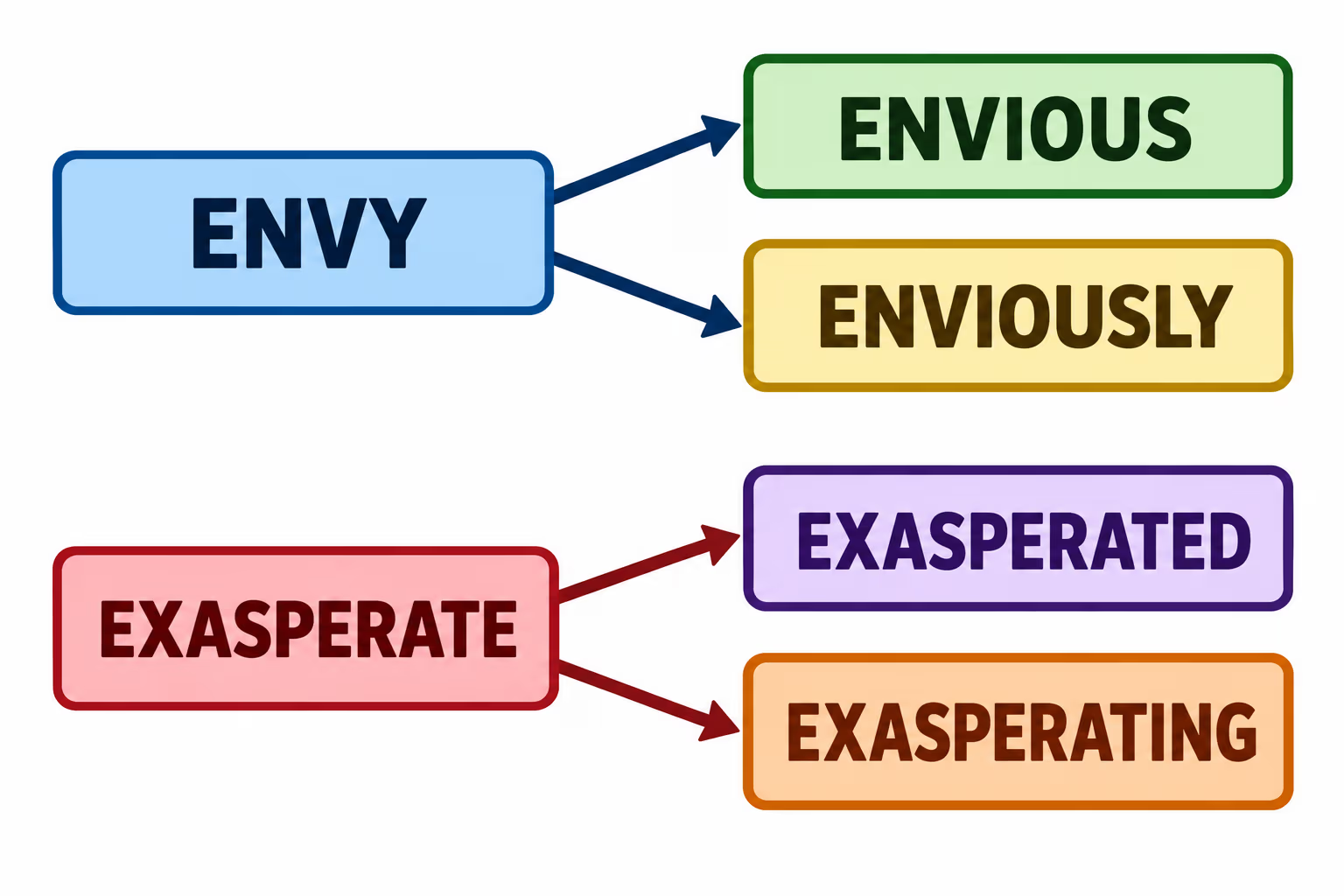
Emotion words are most precise when they describe a person’s reported experience instead of presenting an interpretation as a fact. Envy is the wish to have something someone else has; Cambridge Dictionary also notes its related adjective envious. “I felt envious of her opportunity” reports a feeling, while “she is envious” turns one possible emotion into a broad character judgment.
- Embarrassed: feeling awkward or self-conscious after a mistake or attention.
- Exasperated: intensely annoyed, often after repeated difficulty.
- Exhausted: extremely tired; it can refer to physical or mental fatigue.
- Envious: wishing you had another person’s quality, possession, or opportunity.
- Estranged: no longer close or on friendly terms, often after a relationship has changed.
- Empty: lacking contents, or describing a person’s reported sense of emotional absence; use the intended sense clearly.
These words are not interchangeable. A delayed train may be exasperating, a long shift may be exhausting, and an awkward introduction may be embarrassing. Naming the cause helps a reader understand the feeling without guessing.
Negative E words for harmful actions and effects
Action words can make criticism more concrete by naming what happened and who or what was affected. Endanger means to put someone or something at risk, while exacerbate means to make an existing problem more severe; Cambridge Dictionary makes that risk-based meaning explicit for endanger.
- Exploit: use someone or something unfairly for advantage. Specify the conduct rather than using the verb as an unexplained accusation.
- Exclude: leave someone or something out. The word can describe a neutral selection rule or an unfair barrier, depending on the facts.
- Endanger: put at risk of harm, damage, or loss.
- Exacerbate: worsen a problem that already exists; it does not simply mean “cause.”
- Erode: gradually wear away, literally or figuratively, as repeated delays erode trust.
- Extinguish: put out a flame or bring something to an end; context determines whether the result is harmful.
When writing about real people or organizations, distinguish an observable action from an inferred motive. “The policy excluded applicants without a local address” identifies an effect; “the team deliberately exploited applicants” also asserts intent and needs evidence for that claim.
Words that sound negative but can be neutral
Several E words in negative-word lists are not inherently negative. Evade can mean avoiding danger as well as avoiding responsibility; eliminate can mean removing a safety hazard; and elusive can describe a difficult-to-find species without criticizing it.
| Word | Potentially negative use | Neutral or positive use |
|---|---|---|
| evade | The manager evaded questions about the missing funds. | The cyclist swerved to evade a pothole. |
| eliminate | The agency eliminated a service without warning users. | The filter can eliminate a common contaminant. |
| elusive | A clear answer remained elusive during the interview. | Researchers documented an elusive nocturnal bird. |
| erratic | Erratic supervision left staff unsure of expectations. | Erratic rainfall describes an uneven weather pattern. |
| exile | The dissident was exiled after the government’s order. | A person may describe a voluntary period abroad as self-imposed exile. |
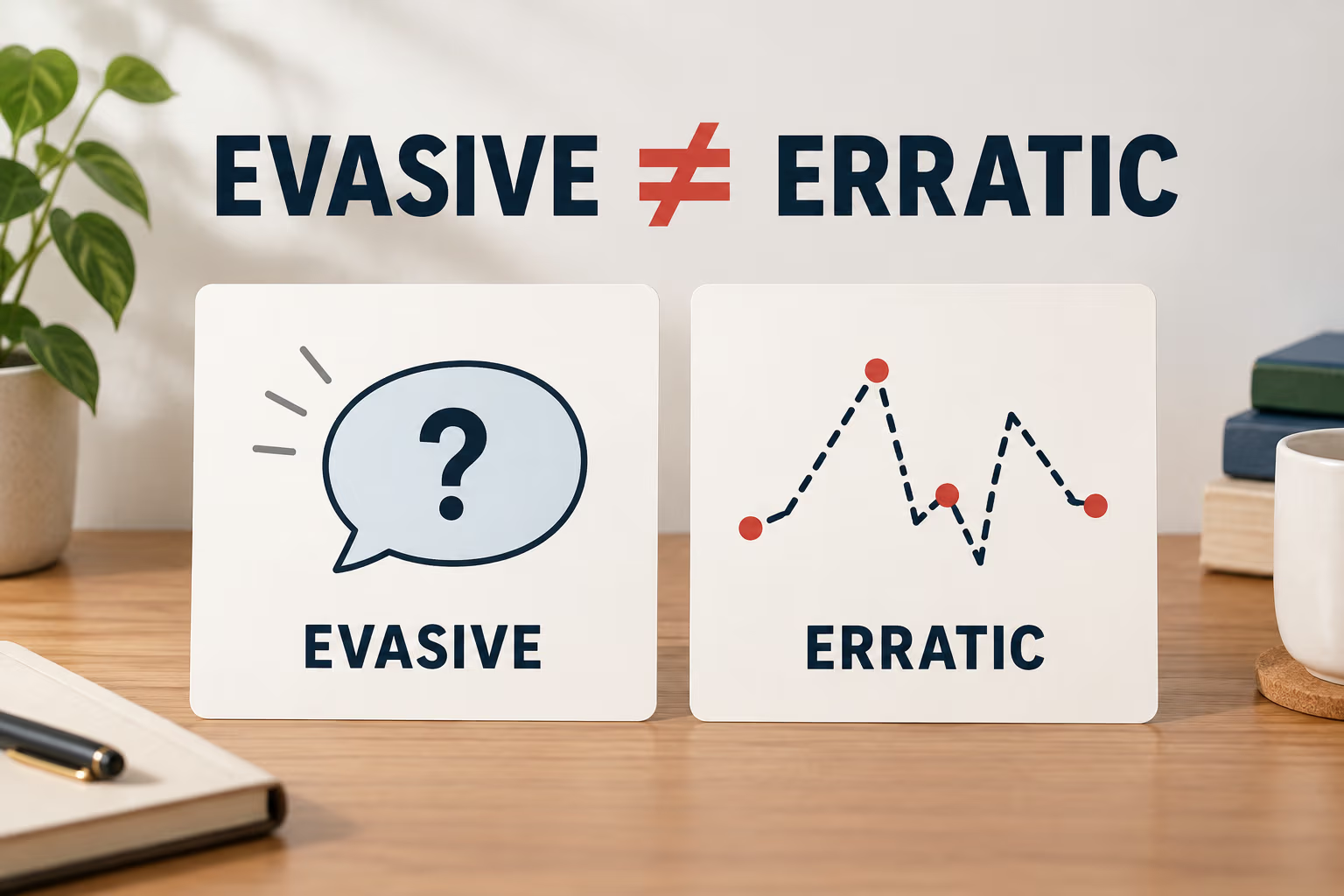
Cambridge Dictionary defines evasive as indirect or unclear when answering, especially to avoid an honest answer, but also uses it in the practical phrase “evasive action.” This contrast is a reminder to inspect the noun and situation before treating a word as a moral judgment. Erratic, by comparison, describes something irregular or unpredictable; it does not itself establish why the pattern occurred.
How can you use E words without overstatement?
- Name the evidence. Describe the action, pattern, or result you observed.
- Choose the narrowest accurate word. Use inconsistent for variation, erratic for pronounced unpredictability, and egregious only for a conspicuously severe fault.
- Separate impact from motive. “The delay endangered the project deadline” states a risk; it does not claim someone intended harm.
- Use person labels carefully. Prefer “the answer was evasive” to “he is evasive” when you have evidence about one response rather than a stable trait.
- Check intensity. Excruciating is much stronger than “uncomfortable”; reserve it for extreme physical or emotional pain.
In professional feedback, observable wording is usually more useful than a string of negative adjectives. “The report omitted three required sources and repeated two unsupported claims” gives the writer a route to revise; “the report was egregious” gives a verdict without the repair steps.
Frequently asked questions about negative E words
What is a strong negative word that starts with E?
Egregious is a strong choice for a conspicuously serious mistake or violation. It is more forceful than bad or poor, so use it when the severity is clear and supportable. For ordinary criticism, a more specific word such as inaccurate or incomplete may be more informative.
Are envy and jealousy the same?
The words overlap in everyday use but can emphasize different situations. Envy centers on wanting a quality or possession someone else has; jealousy often involves fear of losing a valued relationship or advantage. In casual conversation speakers may use them loosely, so context clarifies the intended meaning.
Is erratic always an insult?
No. Erratic means irregular, uncertain, or unpredictable, and it can describe rainfall, a schedule, a machine, or behavior. When used about a person, it can sound critical; describe the specific action or pattern when you want feedback to be fair and useful.
What is the difference between evasive and elusive?
Evasive describes avoiding something, especially a direct answer or danger. Elusive describes something difficult to find, catch, understand, or achieve. A speaker may give an evasive response; a solution may remain elusive. The words share an E beginning but have different meanings.
Can negative E words describe things instead of people?
Yes. Egregious can describe an error, erratic can describe a schedule, excruciating can describe pain, and eroding can describe a shoreline or trust. Describing an event or effect often avoids turning a temporary difficulty into a label for someone’s character.
Sources for definitions and usage
- Cambridge Dictionary: envy and envious
- Cambridge Dictionary: egregious
- Cambridge Dictionary: exasperate
- Cambridge Dictionary: evasive and erratic
- Cambridge Dictionary: endanger
Original negative words that start with E list
The source article and its original wording are preserved below.

Every language boasts an array of words that capture the spectrum of human emotions and experiences. In the realm of negative emotions, English is particularly rich. Starting with the letter ‘E’, there is a collection of words that evoke feelings of sadness, disappointment, or negativity. Whether they are used to describe a person, place, or situation, these words have the power to set the tone and shade the meaning of a sentence.
This article dives deep into the negative words that begin with the letter ‘E’, exploring their meanings, nuances, and contexts. Join us as we traverse this linguistic landscape, discovering the many shades of negativity conveyed by the English language.
Negative Words That Start With The Letter E
Every letter in our intricate language paints pictures of emotions, states, and scenarios, ranging from ecstatic to eerie. The fifth letter of the English alphabet, ‘E’, is no exception. While it embodies effervescent and elated expressions, it also enshrines emotions and entities emanating negativity. This exposé seeks to explore the ‘E’ words exuding such adverse vibes.

1. Envy
One of the seven deadly sins, envy signifies an insatiable desire for someone else’s possessions or qualities. It can often lead to resentment and dissatisfaction with one’s own circumstances.
2. Exacerbate
This term means to make an already bad situation even worse. It signifies the worsening or increase in severity of something negative.
3. Exile
Whether self-imposed or enforced, exile describes being barred or banned from one’s native country, typically for political or punitive reasons.
4. Erode
Whether it’s soil, stone, or self-confidence, when something erodes, it diminishes gradually over time.
5. Exploit
To selfishly use someone or something, often in an unfair manner for personal gain.
6. Evade
To intentionally avoid or escape from by cunning, guile, or dexterity. It often has the undertone of dodging responsibility or confrontation.
7. Eliminate
To remove or get rid of, often with force or ruthlessness. This can be particularly negative when talking about eliminating competition or an obstacle.
8. Elusive
Something that eludes grasp or comprehension. Often used to describe intangible feelings or objects that are hard to obtain.
9. Embarrass
A feeling everyone wants to avoid; it denotes discomfort or self-consciousness due to a particular situation or action.
10. Enmity
A feeling of active opposition or hostility. It goes beyond mere dislike and enters the realm of animosity.
11. Erratic
Marked by a lack of consistency, predictability, or stability. It’s often used to describe unpredictable behavior or patterns.
12. Extinguish
To put an end to; it often denotes the end of something that was once lively, like a flame or hope.
13. Excruciating
A word that emphasizes extreme pain or distress, whether physical or emotional.
14. Exile
Being forced to live somewhere other than one’s home, often as a result of punitive measures.
15. Endanger
To expose to danger or the threat of loss or injury.
List of Negative Words Starting with E
| Earsplitting | Eccentric | Eccentricity |
| Eerie | Effigy | Effrontery |
| Egocentric | Egomania | Egomaniacal |
| Egotistic | Egotistical | Egotistically |
| Egregious | Egregiously | Election-Rigger |
| Elimination | Elusive | Emaciated |
| Emasculate | Embarrass | Embarrassed |
| Embarrassing | Embarrassingly | Embarrassment |
| Embattled | Embittered | Embroil |
| Embroiled | Embroilment | Emergency |
| Emotional | Emotionless | Emphatic |
| Emphatically | Emptiness | Empty |
| Encroach | Encroachment | Encrusted |
| Endanger | Endangered | Enemies |
| Enemy | Enervate | Enfeeble |
| Enflame | Engulf | Enjoin |
| Enmity | Enrage | Enraged |
| Enraging | Enslave | Entangle |
| Entanglement | Entrap | Entrapment |
| Envious | Enviously | Enviousness |
| Epidemic | Equivocal | Erasable |
| Erase | Erode | Erodes |
| Eroding | Erosion | Err |
| Errant | Erratic | Erratically |
| Erroneous | Erroneously | Error |
| Errors | Eruptions | Escapade |
| Eschew | Estranged | Evade |
| Evasion | Evasive | Evil |
| Evildoer | Evils | Eviscerate |
| Exacerbate | Exacerbating | Exaggerate |
| Exaggeration | Exasperate | Exasperated |
| Exasperating | Exasperatingly | Exasperation |
| Excessive | Excessively | Exclusion |
| Exclusionary | Excoriate | Excruciating |
| Excruciatingly | Excuse | Excuses |
| Execrate | Exhaust | Exhausted |
| Exhausting | Exhaustion | Exhausts |
| Exhort | Exile | Exorbitant |
| Exorbitantly | Expel | Expendable |
| Expensive | Expire | Expired |
| Explode | Exploit | Exploitation |
| Exploitative | Exploited | Explosive |
| Exposed | Expressionless | Expropriate |
| Expropriation | Expulse | Expunge |
| Exterminate | Extermination | Extinguish |
| Extort | Extortion | Extortionate |
| Extraneous | Extravagance | Extravagant |
| Extravagantly | Extreme | Extremism |
| Extremist | Extremists | Eyesore |
Conclusion
The ‘E’ in our linguistic repertoire is enriched with words that evoke a spectrum of feelings and scenarios. Recognizing and understanding the weight of these negative words allows for deeper empathy, clearer communication, and more nuanced expression. As with every dark cloud, there’s a silver lining: by knowing these words, we can better appreciate the positive ones that stand in contrast, ensuring a balanced narrative in our discourse.
Negative Words That Start With
A | B | C | D | E | F | G | H | I | J | K | L | M | N | O | P | Q | R | S | T | U | V | W | X | Y | Z


