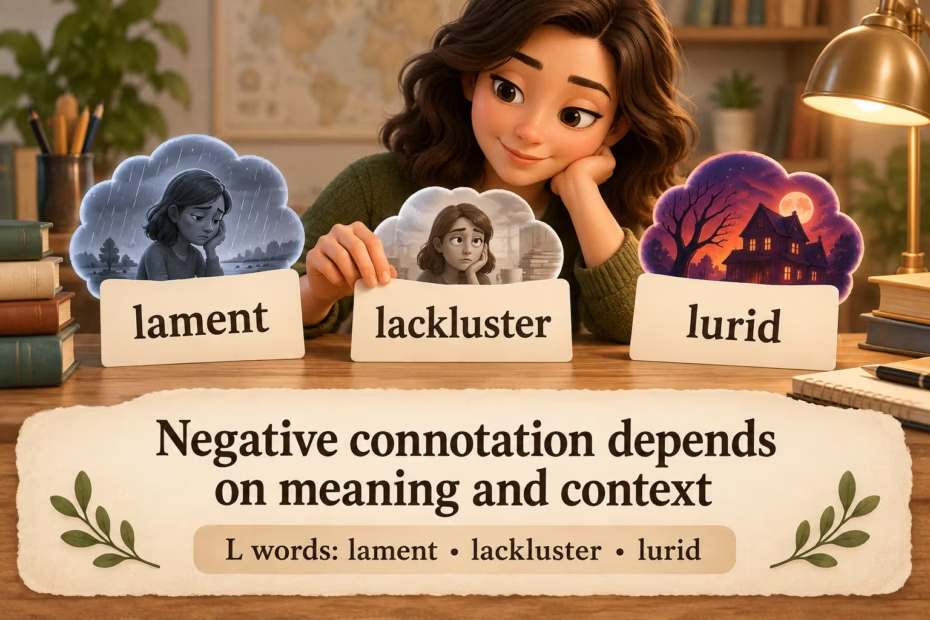
Some L words carry an unfavorable tone, but “negative” depends on the sense and sentence. A negative connotation is an association; grammatical negation makes a statement not true or not the case, commonly with words such as not or no.
How do meaning and context affect negative words?
Words on a negative-word list are not all insults or inherently negative. Lack can describe a factual absence, lapse can mean a temporary interruption, and lurid has both sensational and color/light senses. Choose the sense that fits the sentence, and describe a specific action, passage, or result instead of labeling a person. Avoid using demeaning labels such as lunatic or loser for people.
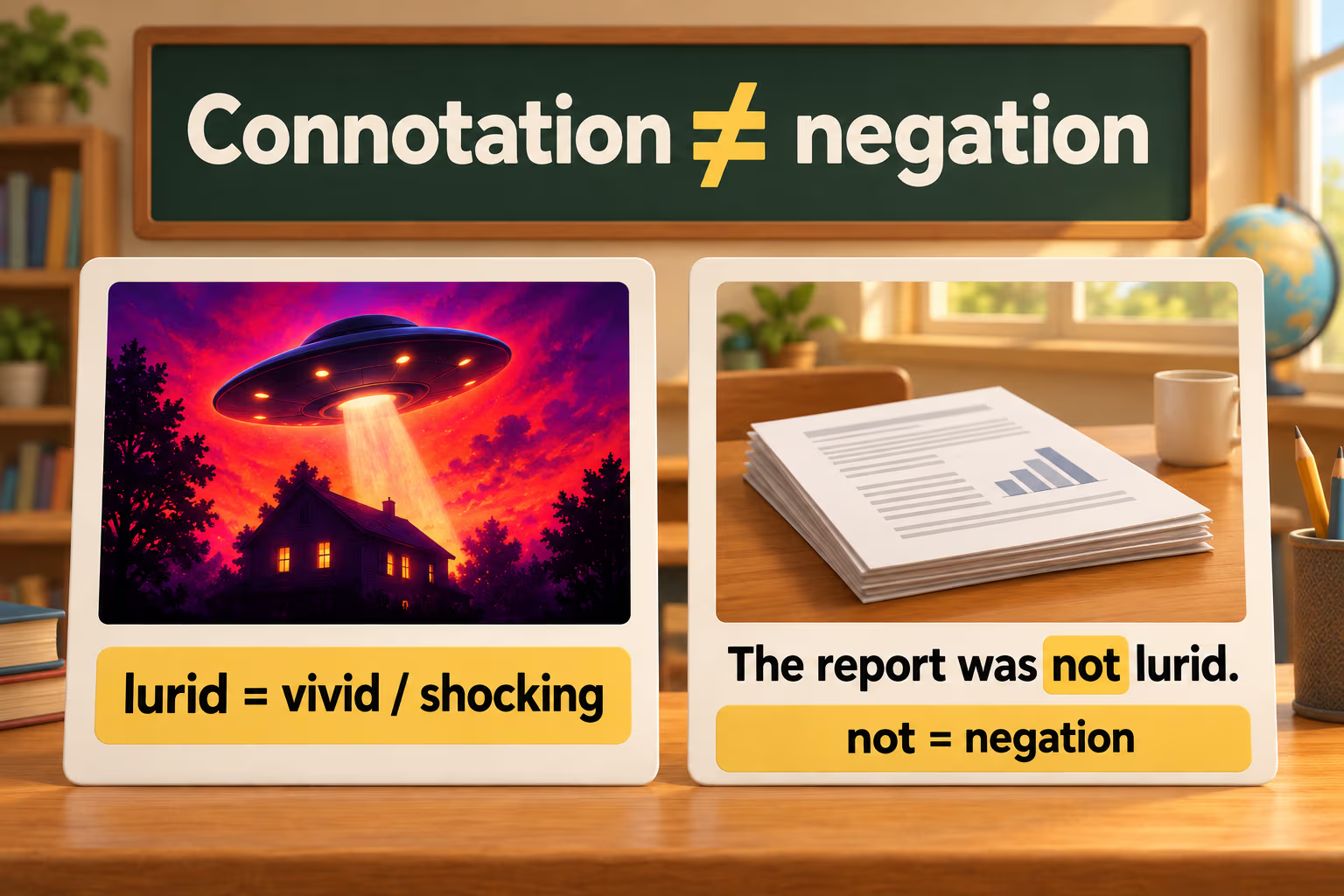
What is the difference between connotation and negation?
Connotation is an association a word may suggest; negation makes a statement negative. In “The report was not lurid,” not supplies grammatical negation, while lurid still means vivid or sensational. A negatively connoted word can also appear in a positive, neutral, or explicitly negated sentence.

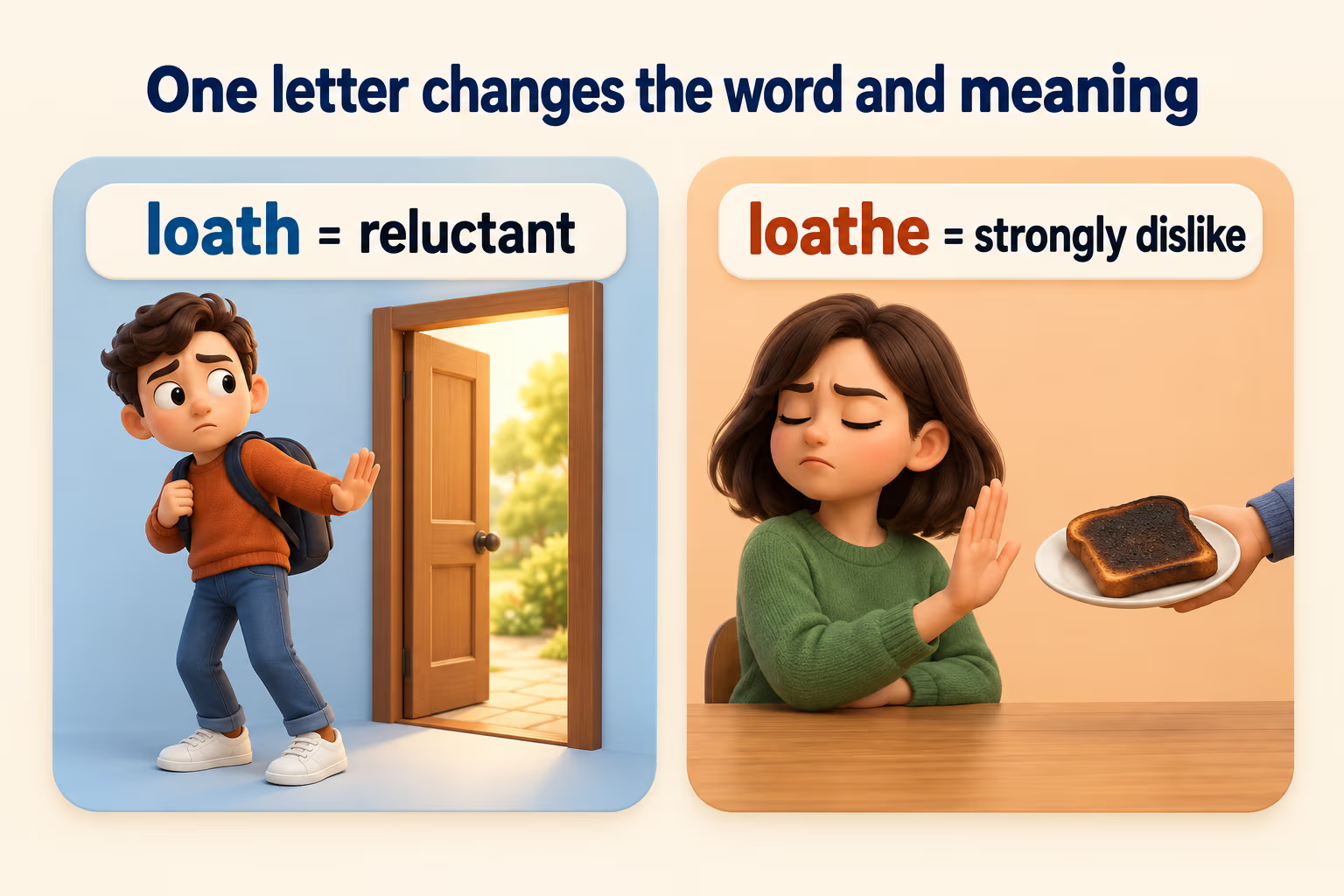
How do “loath” and “loathe” differ?
Loath is commonly an adjective meaning reluctant or unwilling; loathe is commonly a verb meaning to dislike intensely. Merriam-Webster also records loathe as a less common adjective variant, so context and syntax help distinguish the usual forms.
How can you use critical words precisely?
Keep criticism specific and proportionate: “The opening paragraph is lackluster” evaluates a passage, while labeling a writer that way turns an observation about the work into a judgment about a person. Some entries in the source directory are insulting or stigmatizing when applied to people; treat them as vocabulary to recognize, not labels to assign.
Litigious can mean prone to engage in lawsuits, but the word alone does not show that a particular claim is unnecessary. Likewise, libel is a legal term whose requirements vary by jurisdiction; a dictionary gloss is not a legal conclusion.

Use the directory carefully: “Negative” is a context label, not a fixed property of every entry; words such as lengthy, little-known, lone, and lull can be neutral or favorable. Some entries are outdated or hurtful when applied to people: lunatic is dated and offensive in its mental-health sense, and lame can use disability as a put-down. Treat such words as vocabulary to recognize, not labels to assign. NIH recommends respectful disability language.
Lethargic describes a low-energy state; it does not by itself show laziness, a diagnosis, or a cause. MedlinePlus notes that fatigue can have many causes and may be a symptom. The original litigious and lurid glosses are also simplified: being litigious does not establish that a particular claim is unnecessary, and lurid can describe vivid color or light as well as shocking subject matter. Check the intended sense and use context.
Delving into the vast realm of the English language, we often come across words that evoke strong emotions, be they positive or negative. The letter “L,” though frequently associated with love and laughter, is not without its share of less favorable terms.
In this article, we’ll take a closer look at some of the negative words that begin with the letter “L,” shining a spotlight on their meanings, origins, and how they’ve found their places in our everyday lexicon. Whether you’re a word enthusiast or simply someone looking to expand your vocabulary, understanding these words can provide valuable insight into the more somber side of our language.
Negative Words That Start With The Letter L
When meandering through the vast tapestry of the English language, it’s intriguing to spotlight specific alphabets and the words they herald. The letter ‘L’ is especially layered, offering a lexicon ranging from love to lullaby. Yet, it also paves the way for words that possess a more somber, even negative resonance. This article endeavors to shed light on the negative facets of words that begin with the letter ‘L’.

1. Lament
To mourn or express sorrow in a demonstrative manner. Lamentations often evoke feelings of deep sadness and loss.
2. Loathe
A potent term denoting intense dislike or disgust for something or someone. It’s stronger than mere dislike, indicating a profound aversion.
3. Lackluster
Signifying something that lacks vitality, force, or enthusiasm. A lackluster performance, for instance, fails to impress or engage.
4. Languish
To become weak or feeble; to suffer neglect. It can also mean to remain unattended or be disregarded.
5. Litigious
Having an unreasonably excessive tendency to engage in lawsuits. A litigious individual might be quick to take legal action, often unnecessarily.
6. Lethargic
Characterized by sluggishness or lack of energy. Lethargy can hinder productivity and dampen one’s spirits.
7. Lambaste
A forceful word that means to criticize or reprimand sternly. Lambasting can often feel harsh and unrelenting.
8. Lurid
Gruesome, sensational, and shocking. Lurid details often captivate with their vividness but might also repel due to their graphic nature.
9. Loath
Reluctant; unwilling. It’s important to distinguish between “loath” (reluctant) and “loathe” (intense dislike).
10. Lie
To make a false statement with the intention of deceiving. Lies erode trust and can damage relationships.
11. Lack
To be without or deficient in something. The word carries connotations of insufficiency or absence.
12. Lacerate
To tear or deeply cut something, often in a jagged manner. Lacerations can be both physical and metaphorical, indicating deep wounds.
13. Lugubrious
Looking or sounding sad and dismal. It’s often used to describe someone’s demeanor or the tone of an event.
14. Lapse
A temporary failure in judgment, memory, or behavior. Lapses can lead to mistakes or oversights.
15. Libel
A published false statement that damages a person’s reputation. Engaging in libel can have legal repercussions.
List of Negative Words Starting with L
| Laborious | Lack | Lackadaisical |
| Lacked | Lackey | Lackeys |
| Lacking | Lackluster | Lacks |
| Laconic | Lag | Lagged |
| Lagging | Lags | Laid-Off |
| Lambast | Lambaste | Lame |
| Lame-Duck | Lament | Lamentable |
| Lamentably | Languid | Languish |
| Languor | Languorous | Languorously |
| Lanky | Lapse | Lapsed |
| Lapses | Lascivious | Last-Ditch |
| Latency | Laughable | Laughably |
| Laughingstock | Lawbreaker | Lawbreaking |
| Lawless | Lawlessness | Layoff |
| Layoff-Happy | Lazy | Leak |
| Leakage | Leakages | Leaking |
| Leaks | Leaky | Lecher |
| Lecherous | Lechery | Leech |
| Leer | Leering | Leery |
| Left-Leaning | Lemon | Lengthy |
| Less-Developed | Lesser-Known | Letch |
| Lethal | Lethargic | Lethargy |
| Lewd | Lewdly | Lewdness |
| Liability | Liable | Liar |
| Liars | Licentious | Licentiously |
| Licentiousness | Lie | Lied |
| Lies | Life-Threatening | Lifeless |
| Limit | Limitation | Limitations |
| Limited | Limits | Limp |
| Listless | Litigious | Little-Known |
| Livid | Lividly | Loath |
| Loathe | Loathing | Loathly |
| Loathsome | Loathsomely | Lone |
| Loneliness | Lonely | Loner |
| Lonesome | Long-Time | Long-Winded |
| Longing | Longingly | Loophole |
| Loopholes | Loose | Loot |
| Lose | Loser | Losers |
| Loses | Losing | Loss |
| Losses | Lost | Loud |
| Louder | Lousy | Loveless |
| Lovelorn | Low-Rated | Lowly |
| Ludicrous | Ludicrously | Lugubrious |
| Lukewarm | Lull | Lumpy |
| Lunatic | Lurch | Lure |
| Lurid | Lurk | Lurking |
| Lying |
Conclusion
The letter ‘L’, while leading to luminous and laudable terms, also lends itself to words carrying a weight of negativity. These ‘L’ words, with their varied shades of meaning, serve as a testament to the versatility and depth of the English language. By familiarizing ourselves with such words, we gain a deeper appreciation of the nuances in our language, ensuring that our expression remains both informed and impactful.
Negative Words That Start With
A | B | C | D | E | F | G | H | I | J | K | L | M | N | O | P | Q | R | S | T | U | V | W | X | Y | Z


