Human body parts that start with N: an anatomy guide
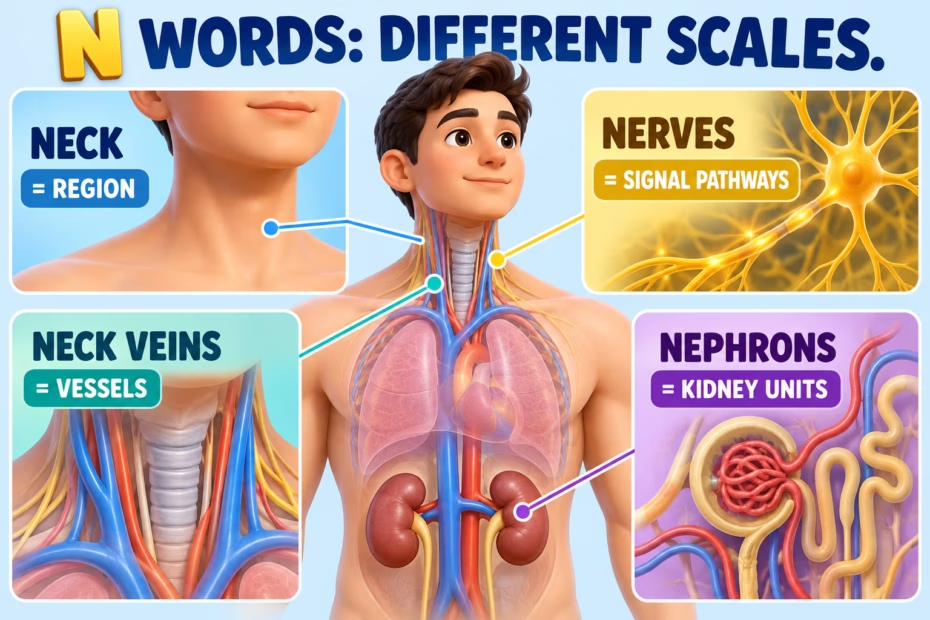
Human body parts that start with N include structures at very different scales: nails and the nose are visible body structures, the neck is a region, nerves are signal-carrying tissues, and nephrons are microscopic kidney units. This guide distinguishes those terms, explains how the nose’s parts fit together, and separates well-established anatomy from claims in the older article below.
- Whole structures: nails, nose, nipple, and neck.
- Named substructures: nares, nasal cavity, nasal septum, nasal bone, neck veins, and neck muscles.
- Microscopic or internal structures: nerves and nephrons.
Which N words name a body part, region, or unit?
The list is useful for vocabulary, but its entries are not all the same kind of anatomical object. A region can contain organs, muscles, vessels, and nerves; a nephron is a functional unit within an organ; and “nares” names openings rather than a separate organ.
| Term | What it names | Where or what it does |
|---|---|---|
| Nails | Hard keratin plates and their surrounding nail units | Cover the ends of fingers and toes; the matrix produces the nail plate. |
| Nares | The openings of the nose | External nares are the two visible openings; posterior nares connect the nasal cavity to the nasopharynx. |
| Nose / nasal cavity | An external structure / internal air passage | Air passes through the cavities; nasal lining warms, moistens, and filters it, while olfactory tissue detects odor molecules. |
| Nasal septum / nasal bone | A midline partition / paired bones forming part of the bridge | The septum separates right and left nasal passages; the nasal bones support the upper bridge. |
| Neck / neck muscles / neck veins | A body region / muscle groups / blood vessels | The region contains structures for movement, breathing, swallowing, circulation, and other functions. |
| Nerves | Bundles or pathways of nerve fibers | Carry sensory information and motor or autonomic signals between the central nervous system and body. |
| Nephrons | Microscopic functional units of the kidneys | Filter blood and adjust the filtrate, returning needed substances and water while helping remove wastes. |
| Nipple | A feature of the breast or chest | Contains sensory tissue; in lactating breasts, milk ducts open at the nipple. |
Scale matters: “neck” is a region rather than one structure, and “nerves” is a broad class. A precise list can include them, but it should not imply that each entry is anatomically equivalent to a separate organ.
How do nares, the nasal cavity, and the septum differ?
Nares are the openings, nasal cavity is the passage inside the nose, and nasal septum is the partition between its right and left sides. Posterior nares are the back openings from the nasal cavity into the nasopharynx; “naris” is the singular form of “nares.”
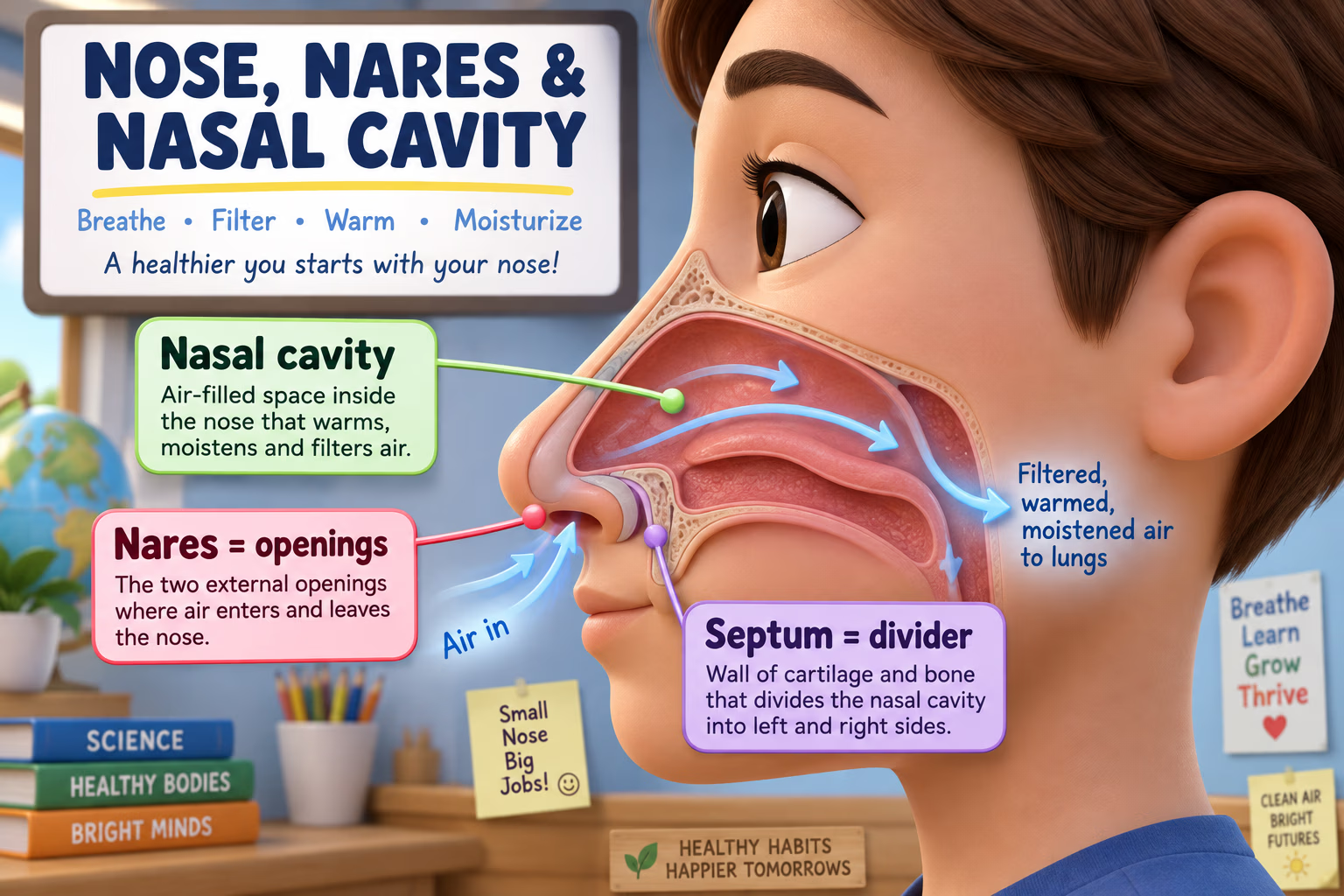
The nasal cavity is lined by mucosa. Its cilia, mucus, and blood-rich tissues help catch particles and condition incoming air. Olfactory receptor neurons occupy specialized tissue high in the cavity; their signals contribute to smell and to the flavor we perceive while eating. Most ordinary nasal hairs are near the entrance, in the nasal vestibule, rather than spread throughout the cavity. The NCBI Bookshelf overview of nasal anatomy describes the septum, nasal passages, and respiratory mucosa; a neuroscience chapter on olfactory receptor neurons explains the specialized sensory lining.
The septum is made of cartilage in front and bone farther back. Its job is to divide and support the nasal passages; it does not guarantee equal airflow. The nasal cycle naturally shifts airflow resistance over time, and swelling, a deviated septum, or other conditions can affect one side more than the other.
What does a nephron do?
A nephron is a kidney’s microscopic filtering unit. Its glomerulus filters fluid from blood into the nephron, then its tubule returns needed water and substances to the bloodstream and leaves additional wastes in the fluid that becomes urine.
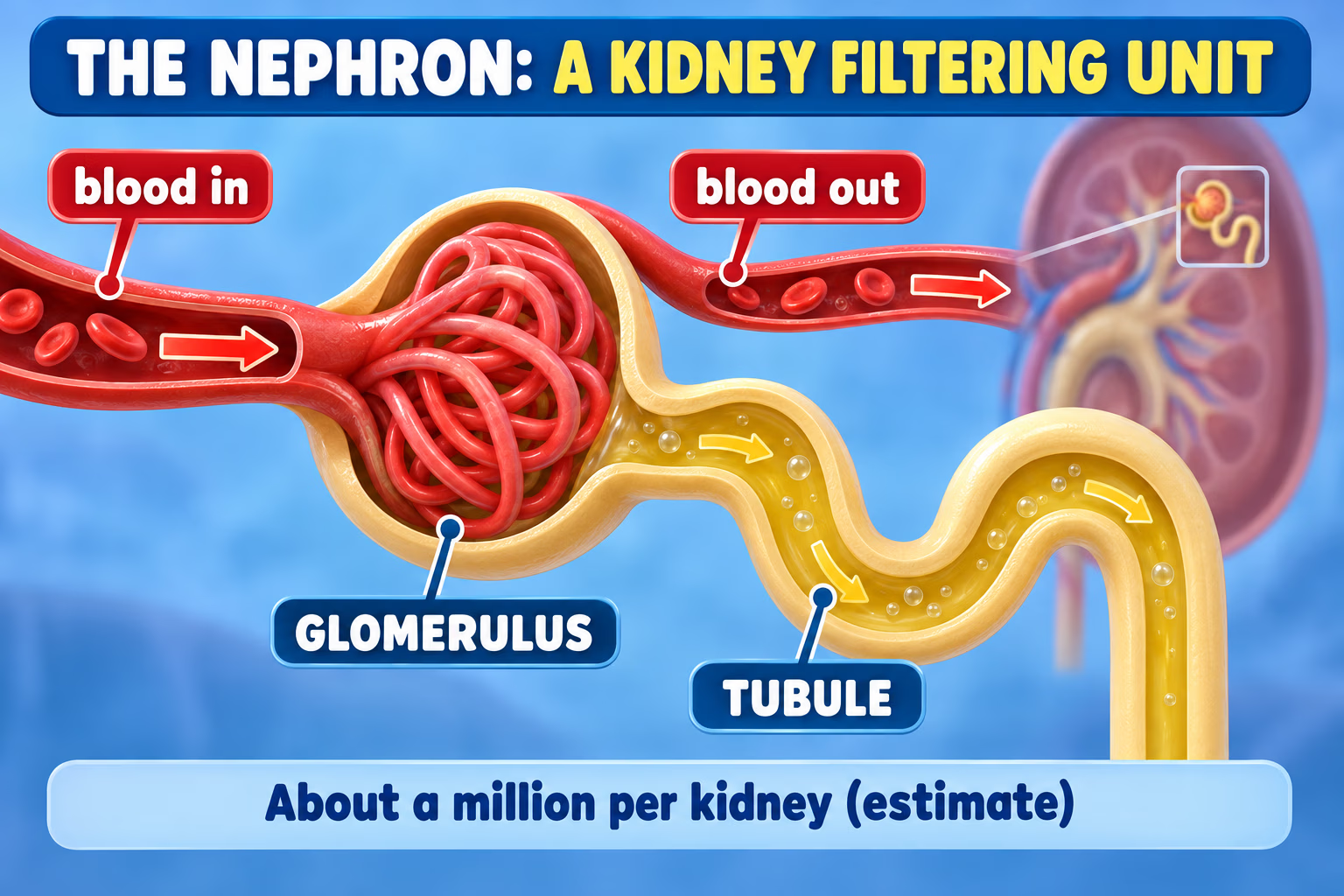
The U.S. National Institute of Diabetes and Digestive and Kidney Diseases describes each kidney as having about one million nephrons; actual nephron number varies among people. The number is a useful scale estimate, not a count that can be assumed for every kidney. A nephron is not itself a whole kidney, and it does not simply “make urine” in one step: filtration and selective reabsorption both matter.
How are nails built?
The visible nail plate is made of compact, hardened keratinized cells. The nail matrix beneath the proximal nail fold produces most of that plate; the nail bed lies underneath and supports it, while the cuticle helps seal the space at the nail’s base. The NCBI Bookshelf review of nail anatomy describes these parts and their roles.
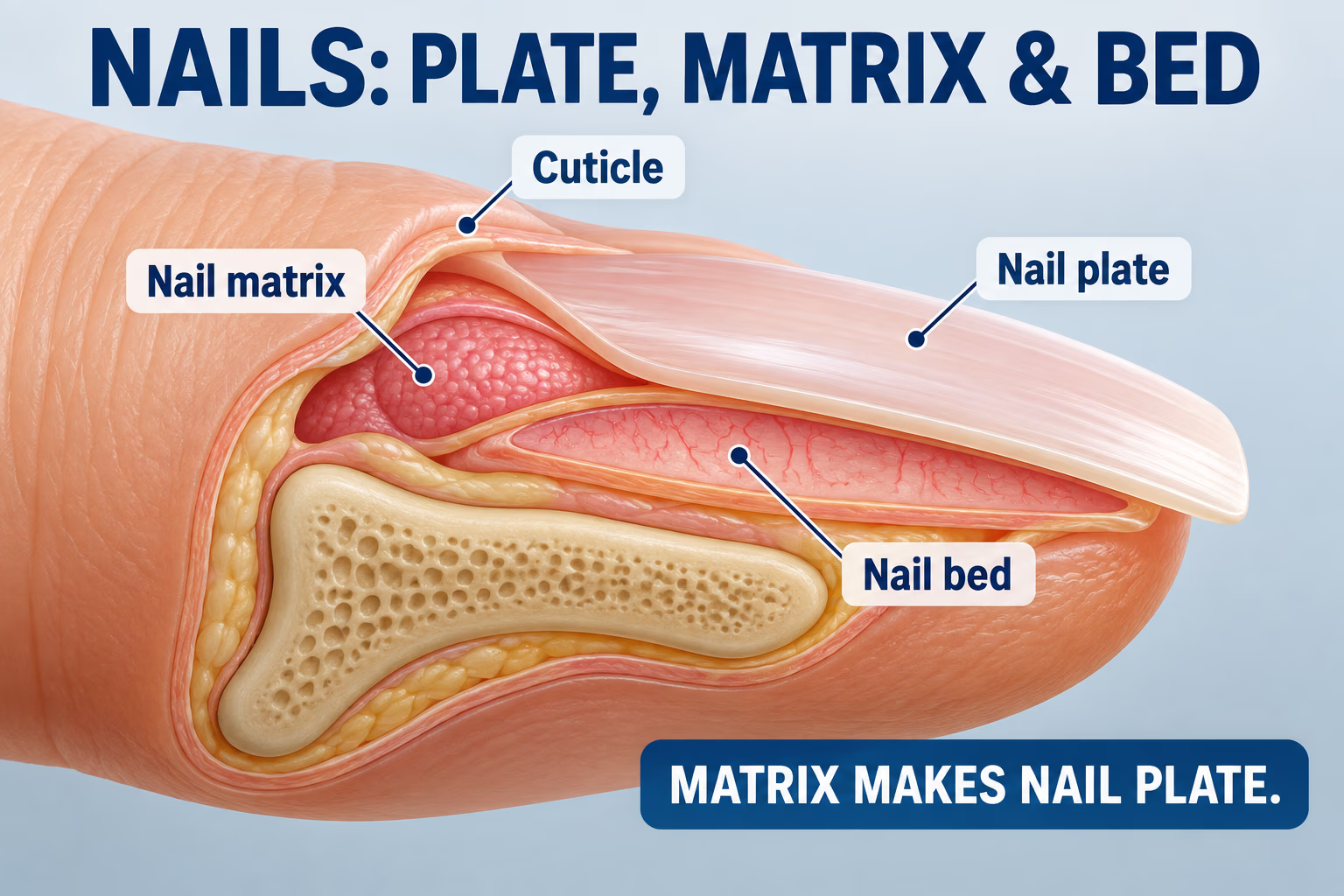
Nails protect the ends of digits and provide counterpressure that supports fine touch and handling. Nail appearance can change with ordinary aging, injury, infection, medicines, or health conditions; a single color, ridge, or spot does not diagnose a specific illness. MedlinePlus lists many possible causes of nail changes, so persistent or concerning changes are best discussed with a qualified clinician rather than self-diagnosed from a list.
What do neck veins, nerves, and neck muscles do?
The neck is a compact passage between the head and torso. It contains cervical vertebrae, muscles, arteries and veins, nerves, the airway, esophagus, glands, and lymphatic structures, so the word “neck” covers many systems rather than one body part.
- Neck veins: the internal and external jugular veins are among the vessels that return blood from the head and neck toward the heart; they differ in depth and drainage routes.
- Nerves: nerves carry information; their fibers are not all insulated in the same way, and the olfactory receptor neurons are an example of neurons with unmyelinated axons.
- Neck muscles: groups of muscles move and stabilize the head and neck; some also assist with swallowing or breathing. The diaphragm is a breathing muscle, but it is in the trunk, not the neck.
Visible neck veins can vary with posture, exertion, and individual anatomy. A picture or isolated observation cannot explain why a vein looks prominent; new symptoms or concerns belong with a healthcare professional. Avoid using the legacy article’s brief description as a self-check or diagnosis.
Why are some older claims below qualified?
Older anatomy articles may mix correct vocabulary with memorable details that sound more certain than the evidence permits. In this source, examples include an exact count and cross-species ranking for smell receptors, the claim that every person’s nose is unique like a fingerprint, a universal age for nasal-bone development, and a general claim that nasal bones heal quickly because of blood supply. The new material above omits these as settled facts because the wording lacks a reliable, appropriately qualified source.
The source also says the septum ensures equal airflow and that deeper neck muscles include the diaphragm. Those statements are inaccurate as written: airflow can vary between sides, and the diaphragm is a trunk muscle. Nasal hair, olfactory receptors, nerve sheaths, and signs seen in nails or neck veins also require more precise framing than a short popular list provides.
Frequently asked questions
Are nares and nostrils the same thing?
“Nares” is the anatomical term for the nasal openings, commonly called nostrils. The external nares open to the outside; the posterior nares connect the nasal cavity to the nasopharynx.
Is the nasal cavity the same as the nose?
No. The nose includes its external shape and internal structures; the nasal cavities are the air passages inside it. The septum divides the passages, which meet farther back.
How many nephrons are in a kidney?
NIDDK gives about one million as a useful estimate per kidney. Nephron numbers vary between individuals, so that figure is not an exact count for every person.
Can nail appearance show a specific disease?
Nail changes can have many causes, including local injury, infection, aging, medicines, and some health conditions. One visual sign alone cannot establish a diagnosis; a clinician considers the whole pattern and relevant history.
Are neck veins body parts?
Yes. Neck veins are blood vessels in the neck region. “Neck” names the region, while a jugular vein names a particular vessel within it.

Source note for the original article
The preserved article below is an older introductory list, not a clinical reference. Treat its enthusiastic examples as informal descriptions. Its “40 million olfactory receptors” figure and claim that this exceeds every other mammal are unsupported as stated; receptor-gene counts, sensory-neuron counts, and estimates of odor detection are different measurements. The claim that no two noses are alike like fingerprints is also an unverified absolute. The nasal-bone claims about universal development around age two and rapid healing from good blood supply are not established here as general rules. The source’s assertion that the septum ensures equal airflow is incorrect: airflow can alternate between sides during a normal nasal cycle, and the septum does not guarantee balanced flow or shield every delicate structure. The nasal cavity’s filtering is not performed by hairs throughout the cavity; hairs are concentrated near its entrance. The source’s description of all nerve bundles as protected by myelin is too broad: some axons, including olfactory axons, are unmyelinated. A nephron count of about one million per kidney is an approximate population-level figure, not an exact count for every person. Nipple anatomy and lactation vary; the legacy wording about women is not universal to every person with nipples. Neck-vein visibility and nail changes do not diagnose a condition on their own. The source’s “over 20 neck muscles” is an approximate classification-dependent count; the diaphragm is not a neck muscle. Its exercise and medical-care remarks are general, not individualized advice. Consult a qualified clinician for personal health questions.
The intricacies of the human body are a testament to nature’s architectural prowess. Each part, regardless of its size or visibility, has a role in the grand symphony of life. As we navigate the anatomical landscape alphabetically, it offers a systematic lens through which we can appreciate our physiological complexity.
With the letter ‘N’, we embark on a journey that traverses the exterior and dives deep within, uncovering parts familiar and those seldom acknowledged. From the protective shield of our nails to the intricate neural networks that communicate our every sensation, this article sheds light on the body parts that commence with the letter “N,” emphasizing their structure, function, and significance in the human narrative.
Human Body Parts That Start With The Letter N
The human body, in its intricate design and myriad components, remains one of the most studied and marveled at subjects in science and art alike. Venturing alphabetically, each letter unfurls a host of organs, systems, and structures that piece together the puzzle of our anatomy. As we explore the letter ‘N’, we find a mix of recognizable and lesser-known body parts. In this detailed account, we will delve deep into those body components that begin with the letter “N,” elucidating their form, function, and importance.
1. Nails

Found at the tips of our fingers and toes, nails are familiar structures that play both protective and aesthetic roles.
- Structure and Location: Nails are composed of keratin, a tough protein. They consist of the nail plate (the visible part), the nail matrix (where new nail cells are produced), the nail bed (under the nail plate), the cuticle (skin at the base of the nail), and the lunula (the crescent-shaped white area).
- Functions: Nails protect the sensitive tips of fingers and toes. They also enhance our tactile sensation and are used for scratching and other minor tasks.
- Clinical Significance: Nail health can be an indicator of overall health. Issues like fungal infections, nail-pitting, or yellowing may signify underlying conditions or nutritional deficiencies.
2. Nares

Often referred to as nostrils, nares are the external openings of the nasal cavity.
- Structure and Location: There are two nares, separated by the nasal septum, leading into the nasal cavity.
- Functions: Nares are the primary entry and exit points for air during breathing. They also play a role in filtering, moistening, and warming the air that enters the respiratory system.
- Clinical Significance: Blockage, inflammation, or injury to the nares can affect breathing. Conditions like nasal polyps or deviations of the nasal septum can impact the nares’ function.
3. Neck

Connecting the head to the rest of the body, the neck is a vital and versatile structure.
- Structure and Location: The neck houses numerous structures, including the cervical spine, trachea, esophagus, blood vessels, muscles, and glands such as the thyroid and parathyroids.
- Functions: The neck supports the head, allows for its movement, facilitates the passage of air and food, and houses crucial blood vessels connecting the brain with the rest of the body.
- Clinical Significance: A variety of medical conditions can impact the neck, from muscular strains and cervical spine disorders to thyroid diseases and lymphadenopathy.
4. Nerves

These are the body’s electrical wiring, transmitting signals between the brain, spinal cord, and other body parts.
- Structure and Location: Nerves are found throughout the body. They consist of bundles of axons, protected by a myelin sheath, which facilitates the transmission of electrical impulses.
- Functions: Nerves are essential for sensation, movement, and organ function. They relay messages between the brain and the rest of the body, ensuring seamless coordination.
- Clinical Significance: Nerve damage or neuropathy can result from various conditions, including diabetes, trauma, infections, or exposure to toxins. Symptoms may include pain, numbness, and weakness.
5. Nephrons

Found in the kidneys, nephrons are the fundamental functional units responsible for filtering the blood.
- Structure and Location: Each kidney contains about a million nephrons, each consisting of a renal corpuscle (glomerulus and Bowman’s capsule) and a renal tubule.
- Functions: Nephrons filter blood, removing waste products and excess substances to form urine. They also play a role in regulating blood pressure, electrolyte balance, and blood volume.
- Clinical Significance: Damage or dysfunction of nephrons can lead to kidney diseases. Conditions like glomerulonephritis or diabetic nephropathy directly impact nephron function.
6. Nipple
Located on the chest, nipples are present in both males and females.
- Structure and Location: Nipples are protruding structures at the center of the areola on the breast.
- Functions: In females, nipples play a role in breastfeeding as milk is secreted through ducts that open at the nipple.
- Clinical Significance: Infections, inflammation, and certain cancers can affect the nipple. Any unusual discharge, inversion, or change in appearance should be medically evaluated.
7. Nose: Your Smelly Superhero

The nose, perched prominently on our faces, is more than just a sniff-and-breathe apparatus. It’s a sensory powerhouse, packed with 40 million olfactory receptors – that’s more than any other mammal! These tiny detectives identify thousands of smells, from the delicate fragrance of a rose to the pungent aroma of stinky gym socks.
But the nose isn’t just about smelling. It also acts as a natural air conditioner, warming and humidifying the incoming air before it reaches your lungs. Plus, tiny hairs inside the nostrils trap dust and debris, keeping your respiratory system clean. And did you know your nose even helps you taste? When you eat, odor molecules travel from your mouth to the back of your nose, adding another layer of flavor to your food.
Fun fact: Your nose is as unique as your fingerprint! No two noses are exactly alike, thanks to the combination of bone, cartilage, and soft tissue that shapes this amazing organ.
8. Neck Veins: Highways of the Head and Neck

Peek beneath your chin or along the sides of your neck, and you might see some thin blue lines – those are your neck veins! These vital vessels play a crucial role in returning blood from your head and neck back to your heart. Imagine them as tiny highways, constantly shuttling deoxygenated blood back to the central station for a fresh refill.
The two main veins in your neck are the jugular veins. The internal jugular vein, located deeper inside, carries blood from the brain, while the external jugular vein, closer to the surface, drains blood from the face and scalp. These veins can become more visible when you exert yourself, cough, or strain, as the pressure increases within them.
It’s important to note that swollen or tender neck veins can sometimes be a sign of an underlying medical condition. If you notice any concerning changes in your neck vein appearance, consult a doctor to rule out any potential issues.
9. Nasal Bone: The Bridge Builder

The nasal bone, a small, flat bone located at the bridge of your nose, might seem insignificant. But don’t underestimate its power! This sturdy bone works with other nasal bones and cartilages to form the framework of your nose, providing support and structure. It also protects the delicate structures underneath, like the nasal septum and the blood vessels that supply your nose.
The nasal bone also plays a vital role in shaping your nose’s appearance. Its size and shape contribute to the overall width and projection of your nose. Interestingly, the nasal bone is one of the first bones in the face to complete its development, often around the age of two.
Fun fact: Did you know that the nasal bone is one of the most commonly fractured bones in the face? This is because its location makes it vulnerable to injuries from falls, bumps, or even sports impacts. However, due to its good blood supply, the nasal bone heals relatively quickly in most cases.
These are just a few snippets about the fascinating world of noses, neck veins, and nasal bones. Remember, your body is full of incredible structures, each with a unique story to tell. So, the next time you take a breath, feel the cool air in your nose, or notice the veins pulsing in your neck, take a moment to appreciate the amazing machinery that keeps you going!
10. Nasal Cavity: The Airway Wonderland

Imagine a tunnel lined with soft, velvety walls, warming and humidifying the air as it rushes through. This, my friends, is the nasal cavity, the passageway for air entering and leaving your body. But it’s much more than just a simple air duct!
- Air Filtration System: Tiny hairs within the cavity trap dust and debris, keeping your lungs clean.
- Heating and Humidifying Unit: The lining of the cavity releases mucus, which warms and moistens the air you breathe, protecting your lungs from dryness and irritation.
- Scent Detective: Millions of olfactory receptors nestled in the upper part of the cavity identify thousands of smells, adding a delicious dimension to your world.
Did you know the nasal cavity is even divided into two chambers by a thin wall called the nasal septum?
11. Nasal Septum: The Divider in Chief

Think of the nasal septum as a wall down the middle of your nose, keeping the left and right chambers separate. It’s made up of both bone and cartilage, providing structural support and ensuring smooth airflow.
- Maintaining Balance: The septum ensures airflow is equal on both sides, preventing one nostril from getting overwhelmed.
- Protecting Delicate Structures: It shields the sensitive parts of the nose, like blood vessels and nerves, from injury.
- Shaping Your Sniffer: The shape and size of the septum contribute to the unique appearance of your nose.
Interestingly, a deviated septum, where the wall is crooked, can affect airflow and lead to breathing difficulties. Thankfully, medical procedures can help correct this imbalance.
12. Neck Muscles: The Movers and Shakers

Our necks aren’t just for holding our heads; they’re packed with over 20 muscles that enable us to move, swallow, and even breathe! These amazing muscles work together to perform various functions:
- Head Movement: Muscles like the sternocleidomastoid and scalenes allow you to tilt, turn, and bend your head in all directions.
- Speech and Swallowing: The suprahyoid muscles play a vital role in speech and swallowing by moving the larynx and tongue.
- Breathing Support: Deeper neck muscles, like the diaphragm, assist with breathing by expanding and contracting the chest cavity.
Keeping these neck muscles strong through exercises like head rolls and chin tucks can improve posture, prevent pain, and boost overall well-being.
So, the next time you take a breath, wiggle your nose, or nod your head, remember the incredible workings of the nasal cavity, nasal septum, and neck muscles. These unsung heroes play a crucial role in keeping us healthy and connected to the world around us. Keep exploring, keep learning, and keep appreciating the amazing machinery that makes our bodies tick!
List of Human Body Parts Starting with N
| Nares, Posterior | Nasal Bone | Nasal Cavity |
| Nasal Cavity, Dry Bones | Nasal Septum | Nasal Septum, Dry Bones |
| Nasolacrimal Duct | Neck | Neck Muscles |
| Neck Veins | Nerves | Nerves Of The Upper Extremity |
| Nose | Nipple | Nephrons |
| Nails |
Conclusion
The letter ‘N’ offers a nuanced view of the human body, revealing the diversity of our anatomy. From the hard keratin of our nails to the delicate filtering units of our kidneys, the structures starting with ‘N’ underline the body’s multifaceted design. Recognizing and understanding these parts, from their basic form to their complex functions, amplifies our appreciation for the intricacies of human life and biology.
Human Body Parts That Start With
A | B | C | D | E | F | G | H | I | J | K | L | M | N | O | P | Q | R | S | T | U | V | W