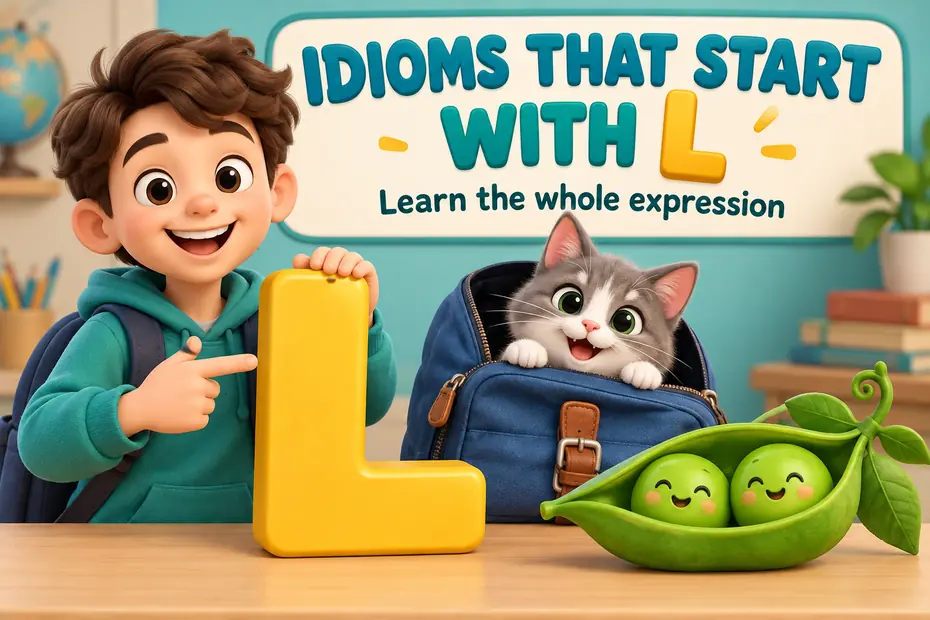
Useful idioms that start with L
Common idioms that start with L include let the cat out of the bag, learn the ropes, a long shot, and the last straw. Their meanings cannot always be understood from the individual words. Learn the complete expression, its grammar, and a realistic example rather than translating every word literally.
- Let the cat out of the bag means reveal a secret.
- Learn the ropes means learn how a job or activity works.
- A long shot describes an attempt unlikely to succeed.
- The last straw is the final problem after earlier frustrations.
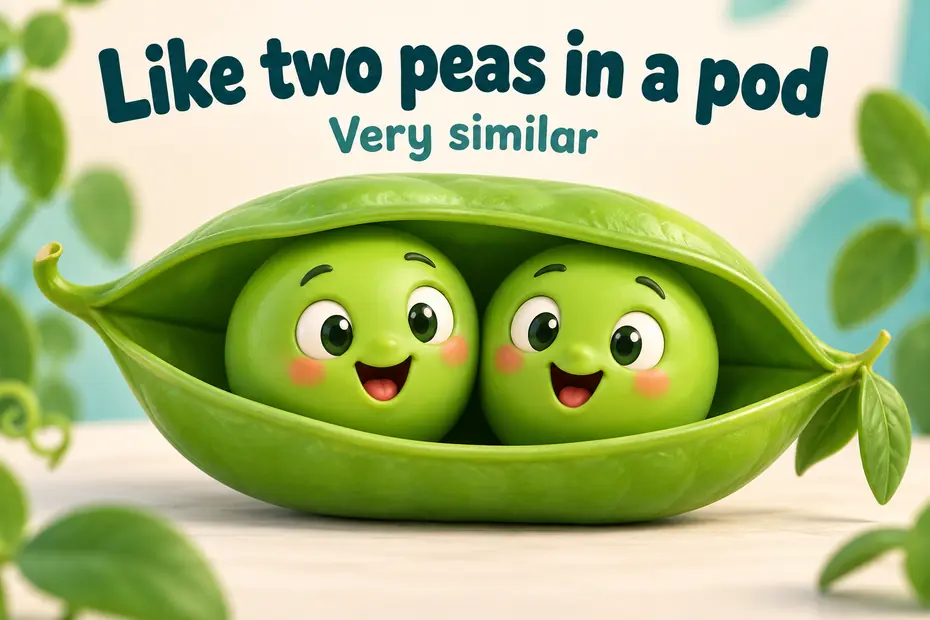
- Like two peas in a pod emphasizes strong similarity.

Corrections and cautions for the older table below: “Like shooting” is incomplete; the full expression is “like shooting fish in a barrel.” The usual form is “like a fish out of water,” without the before water. “Like two peas in a pod” means very similar, not merely always together. “Laughter is the best medicine” is a saying about the value of laughter, not a literal claim that laughter treats injuries or replaces care. “Looney Tunes” is a proper title; using a similar expression to insult someone’s mental health is not neutral learner vocabulary.
Which L idiom fits your meaning?
Choose an idiom by the situation you mean to describe. A long shot concerns low chances of success; the last straw concerns accumulated frustration. Mixing them changes the message even though both may describe a difficult situation.
| Expression | Meaning | Original example |
|---|---|---|
| Let the cat out of the bag | Reveal a secret | I mentioned the cake and let the cat out of the bag. |
| Learn the ropes | Learn how an activity works | A colleague helped me learn the ropes on my first day. |
| A long shot | An unlikely attempt | Finding the lost key in the park is a long shot. |
| The last straw | A final unbearable problem | The third cancelled appointment was the last straw. |
| A leap of faith | Trust despite uncertainty | Moving to an unfamiliar city felt like a leap of faith. |
| Like two peas in a pod | Very similar | The sisters have matching laughs and are like two peas in a pod. |
The table groups expressions by their main words, so articles such as a and the may appear before L. A dictionary may file “the last straw” under last or straw. Alphabetical lists are finding aids; the actual expression still needs its usual article when you put it in a sentence.

How do you change an idiom’s grammar?
Keep the core expression recognizable, but adjust the verb tense and pronoun to fit the speaker. “I learn the ropes” becomes “I learned the ropes.” “Lose your touch” becomes “She has lost her touch.” A dictionary’s one’s is a placeholder, not a word you normally copy into your own personal example.
- Present: “He learns the ropes quickly.”
- Past: “He learned the ropes during training.”
- Continuing activity: “He is learning the ropes.”
- Changed pronoun: “I think I have lost my touch.”
- Noun phrase: “That suggestion is a long shot.”
Do not alter distinctive words simply because another word seems similar. “Let the dog out of the bag” does not preserve the established secret-revealing expression. By contrast, changing “let” to “letting” in “She regretted letting the cat out of the bag” is a normal grammatical adjustment.
Which similar expressions should you keep apart?
“Lose touch” means stop keeping in contact, while “lose your touch” means become less skilful at something. “We lost touch after graduation” concerns a relationship; “I have lost my touch at table tennis” concerns ability. The possessive word makes an important difference.
“Learn the ropes” describes becoming familiar with a task, while “know the ropes” describes already understanding it. “The last straw” names the final frustration, not necessarily the worst problem in isolation. A small inconvenience can be the last straw when it follows a series of larger difficulties.
When should you use plain wording instead?
Use plain wording when an idiom might confuse the audience, sound too casual, or obscure a practical instruction. “Please keep the party secret” is clearer than “Don’t let the cat out of the bag” for a beginner who has not learned the expression. “The attempt is unlikely to succeed” can replace “It’s a long shot” in a formal explanation.
Context also controls tone. Calling someone a loose cannon is critical: it suggests unpredictable behaviour that may cause trouble. Expressions about age, intelligence, or appearance can sound insulting even when a vocabulary list gives a short neutral-looking definition. Learn what a phrase communicates about the speaker’s attitude as well as what it refers to.
For practice, write a short situation before choosing an idiom: “My friend revealed our surprise plan” naturally leads to “My friend let the cat out of the bag.” Then read the sentence with the plain meaning substituted. If the substitution changes the intended message, choose another expression.
Frequently asked questions
Do L idioms always begin with the letter L?
Not in every complete sentence or dictionary heading. Lists often ignore articles and introductory words: a long shot and the last straw are commonly grouped under L. The list’s arrangement does not mean you should remove the article. Use “It was a long shot,” rather than “It was long shot.”
Is learn the ropes about actual ropes?
It can describe literal learning in a context involving ropes, but its idiomatic meaning is learning how a job or activity works. “She is learning the ropes at the office” concerns procedures and responsibilities. The setting tells you that the speaker is not describing rope handling.
Does a long shot mean impossible?
No. A long shot has a low chance of success, but it is still an attempt someone may choose to make. “It’s a long shot, but I will ask whether a seat is available” expresses limited optimism. Use impossible only when you actually mean success cannot occur.
Should idioms be capitalized?
Use ordinary sentence capitalization when writing an idiom in prose. A list heading may capitalize important words for presentation, but “She learned the ropes” does not need capitals on the expression. Proper names and titles follow their own capitalization rules, separate from whether a phrase is idiomatic.
Sources: Cambridge: long shot; Cambridge: the last straw; Cambridge: leap of faith; Cambridge: learn/know the ropes; Cambridge: similarities and peas in a pod; Cambridge: letting the cat out of the bag. Examples are original.

Laden with layers of linguistic legacy, idioms lend language a lustrous charm, linking literal meanings with literary metaphors that light up our lexicon. Launching into the twelfth letter of the alphabet, this leg of our journey is led by the lyrical and laudable letter “L”, a linchpin in the labyrinth of English expressions.
From “let the cat out of the bag” to “luck of the draw”, the letter “L” lays out a landscape of idioms, each laced with its own lore, lineage, and luminosity in the vast lexicon of English. Created for linguistic lovers, literary laureates, and those longing for a little linguistic levity, this segment promises to lure readers into a lavish world of “L” idioms. Let’s launch into this linguistic landscape, luxuriating in the legacy and lure of each phrase, and learn about the layers of life and lore they encapsulate.
Idioms Beginning With Letter L
Launching into the lush landscape of English idioms, we land on the luminous letter ‘L’. Laden with layers of linguistic lore, ‘L’ limns a litany of lively idioms that lend our language its luster. In this lengthy lexicon, let’s leisurely leaf through the landmark idioms linked with the letter ‘L’.
- Let the Cat Out of the Bag
- Meaning: To reveal a secret or surprise by accident.
- Example: “I wanted the party to be a surprise, but Jane let the cat out of the bag.”
- Look Before You Leap
- Meaning: Think carefully about what you are about to do before you do it.
- Example: “You should look before you leap and research the company before accepting a job offer.”
- Lost in Translation
- Meaning: When something loses its original meaning or essence when it’s translated into another language or context.
- Example: “The humor of the book was lost in translation when it was made into a movie.”
- Last Straw (or The Straw That Broke the Camel’s Back)
- Meaning: The final problem in a series that makes the situation unendurable.
- Example: “When he forgot our anniversary, it was the last straw; I had to speak to him about being more considerate.”
- Lick into Shape
- Meaning: To improve something or someone, or bring them to a satisfactory state.
- Example: “The manuscript is rough, but a good editor can lick it into shape.”
- Like a Bull in a China Shop
- Meaning: Someone who is very clumsy or careless in the way they move or behave.
- Example: “He knocked over two displays in the store – like a bull in a china shop.”
- Land on One’s Feet
- Meaning: To emerge from a difficult situation safely or successfully.
- Example: “Despite facing financial difficulties, she always lands on her feet.”
- Let Sleeping Dogs Lie
- Meaning: To avoid restarting a conflict or raising a touchy issue.
- Example: “He decided not to mention the old disagreement and let sleeping dogs lie.”
- Love is Blind
- Meaning: When you love someone, you cannot see their faults.
- Example: “She overlooks all his bad habits, truly proving that love is blind.”
- Loose Cannon
- Meaning: Someone who is unpredictable and can cause damage if not kept in check.
- Example: “His outbursts at work make him a loose cannon, and colleagues tread lightly around him.”
- Lend an Ear
- Meaning: To listen carefully or sympathetically.
- Example: “If you ever need to talk, I’m here to lend an ear.”
- Like Two Peas in a Pod
- Meaning: Two people who are very similar in appearance or thinking.
- Example: “My brother and I are like two peas in a pod – we both love the same things.”
- Let Bygones Be Bygones
- Meaning: To forgive and forget past differences or disputes.
- Example: “I know we’ve had our disagreements, but let’s let bygones be bygones.”
- Lose One’s Touch
- Meaning: No longer have the ability or skill one once had.
- Example: “I used to be great at chess, but I think I’ve lost my touch.”
- Living on Borrowed Time
- Meaning: To continue living after a point or event at which one might have been expected to die.
- Example: “After surviving that severe illness, he feels like he’s living on borrowed time.”
List of idioms Starting with L
| Idiom | Meaning |
|---|---|
| Larger Than Life | Conveying A Sense Of Greatness, Imposing |
| Last But Not Least | What I Have Just Said Does Not Reflect A Ranking In Importance. |
| Laughter Is The Best Medicine | Laughing A Lot Is A Very Effective Means Of Recovering From Physical Or Mental Injury |
| Learn The Ropes | Become More Familiar With A Job Or Field Of Endeavor, Be Trained |
| Leave No Stone Unturned | Look Everywhere |
| Leave Someone In The Lurch | Abandon Someone In A Difficult Situation |
| Left Out In The Cold | Being Ignored |
| Lend An Ear | Listen |
| Let Bygones Be Bygones | Agree To Forget About A Past Conflict |
| Let Off Steam | To Express Anger And Frustration In A Way That Does No Damage |
| Let One’S Hair Down | To Relax And Enjoy Themselves. |
| Let Sleeping Dogs Lie | Stop Discussing An Issue |
| Let Someone Off The Hook | To Not Hold Someone Responsible For Something |
| Let The Cat Out Of The Bag | Give Away A Secret |
| Let The Genie Out Of The Bottle | Reveal Something Hitherto Suppressed |
| Letter Of The Law | The Explicit Meaning Of A Law, As Opposed To The Spirit Of The Law, The Law’S General Intention |
| Lick One’S Wounds | Rest After A Bad Defeat |
| Life Is A Bowl Of Cherries | Life Is Wonderful Or Very Pleasant |
| Light A Fire Under Someone | Inspire Someone To Work Very Hard |
| Light At The End Of The Tunnel | A Sign Of Hope After A Long Period Of Difficulties |
| Like A Fish Out Of The Water | Very Uncomfortable |
| Like A Kid In A Candy Store | To Be So Excited About One’S Surroundings That One Acts In A Childlike Or Silly Way |
| Like A Moth To A Flame | Drawn To Something Or Someone Despite The Dangers |
| Like Father, Like Son | Sons Inherit Their Fathers’ Traits And Preferences, Often Even Without Realizing It. |
| Like Riding A Bicycle | Something You Never Forget How To Do |
| Like Shooting | Fish In A Barrel Very Easy |
| Like Taking Candy From A Baby | Very Easy |
| Like The Cat That Got The Cream | Looking Particularly Self-Satisfied, Often To The Annoyance Of Others |
| Like Two Peas In A Pod | They’Re Always Together |
| Lion’S Den | Any Dangerous Or Frightening Place. |
| Lion’S Share | The Largest Part Of Something |
| Live And Learn | I Made A Mistake |
| Live Large | Have A Luxurious Lifestyle |
| Living In Cloud Cuckooland | Having Unrealistic Or Foolish Beliefs Or Plans. |
| Living On Borrowed Time | Following An Illness Or Near-Death Experience, May People Believe They Have Cheated Death |
| Living Under A Rock | Ignorant Of Important Events. Usually Used As A Question |
| Loaded For Bear | Prepared For Problems, Well Prepared For A Challenge |
| Loan Shark | A Predatory Lender, One Who Makes High-Interest Loans To Desperate People |
| Lock Horns | To Lock Horns Is To Argue, To Come Into Conflict. |
| Long In The Tooth | Old, Of Advanced Years |
| Long Shot | Something With Little Chance Of Success |
| Look At Life | How You Observe Things That Happen, Your Opinion On Daily Matters |
| Look Before You Leap | Take Only Calculated Risks |
| Look Down Upon | To View Someone Or Something As Unworthy |
| Look The Other Way | Take No Notice Of Violations Of Laws Or Rules, Unofficially Condone Something |
| Look Up To | To Respect Someone As A Role Model |
| Look What The Cat Dragged In | Someone Unwelcome Has Arrived. |
| Looney Tunes | Someone Who May Not Be Mentally Healthy |
| Loose Cannon | Someone Out Of Control, Someone Who Speaks Or Acts Recklessly |
| Lose It | To Suddenly Become Unable To Behave Or Think In A Sensible Way |
| Lose One’S Touch | Suffer A Decline In One’S Skill At Doing Something |
| Lose The Thread | Be Unable To Follow Someone’S Reasoning |
| Lose Touch | To Fall Out Of Contact |
| Love At First Sight | Falling In Love With Somebody The First Time You See Them |
| Love Rat | Somebody Who Cheats On His/Her Partner |
| Love Someone With All Of One’S Heart And Soul | To Love Someone Completely |
| Lower The Boom | Implement A Punishment, Reprimand Severely |
| Low-Hanging Fruit | Easy Parts Of A Task, Solutions Easy To Obtain |
In Review
Luxuriating in ‘L’ idioms, we unearth a library of linguistic legacies that lace our conversations with layers of meaning. These idiomatic landmarks, loaded with history and heart, lighten our dialogues with levity and lore. For language lovers and learners alike, locking into ‘L’ idioms is a lucrative lesson. So, let loose, learn, and let your language be lit up with the luminescence of these ‘L’ idiomatic legends!
Idioms That Start With
A | B | C | D | E | F | G | H | I | J | K | L | M | N | O | P | Q | R | S | T | U | V | W | Y | Z